Sunday, October 7, 2018

On Democratic Accountability in a Republic: The Pentagon Papers

The publication of portions of the Pentagon Papers despite President Nixon’s threats of treason highlighted the fact that four presidents successively lied to the American People on build-up of U.S. involvement in Indochina (most notably, Vietnam) and the Nixon administration lied on the prospects for victory in the Vietnam War—a war that had not even been declared by Congress. Clearly, democratic accountable extends to foreign policy at least in broad outline, such as in whether or not to continue an active engagement militarily in another region of the world. Even in U.S. presidents being able to get away with effectively declaring war even as one of their roles is that of commander-in-chief—a huge conflict of interest!—democratic accountability by the popular sovereign, the People—is important, even vital should the legislative and judicial branches fail as checks in the separation-of-powers feature of the U.S. Constitution.

Friday, October 5, 2018

Deaf-Signing at Mandela's Memorial and Kavanaugh's Confirmation FBI Probe: Cover-Ups?

Watching U.S. President Barak Obama speak of his hero, Nelson Mandela, on December 10, 2013, something was distracting me; the rather large man signing for the deaf used such exaggerated gestures I had trouble concentrating on what Obama was saying. Little did I know that the interpreter was a “fake,” according to the Deaf Federation of South Africa. “It was horrible; an absolute circus, really, really bad, Nicole Du Toit, an official sign language interpreter, told the AP. “Only he can understand those gestures,” she added.[1]  I suspect that labeling the fiasco a “circus” skates over the underlying mentality in over-reaching and lying to cover it up. Years later, I wondered the same thing concerning Brett Kavanaugh's nomination to the U.S. Supreme Court. Are we, the public, out of the loop concerning what really goes on inside governments? 


1. Kim Hjelmgaard and Marisol Bello, “Interpreter For Deaf Branded a Fake,” USA Today, December 12, 2013.

Connecting the Dots: Zuckerberg's Facebook Stock

Why did Mark Zuckerberg unload $2.3 billion of his Facebook stock? The complete answer likely involves more than meets the eye, at least relative to what business reporters and editors had to say publicly in 2013. What was not said is itself a story worth publishing. Beyond Zuckerberg’s stratagem, what the media didn't say might be more significant than what made it through the filters.
Part of the answer concerning Zuckerberg’s sell-off involves his need for cash to pay taxes that would be due from his exercising an option to purchase 60 million Class B shares in 2013. This move likely implies a belief that Facebook stock would not go much higher. Had Zuckerberg strongly believed at the time that Facebook was yet to cash in on advertising revenue beyond that which the market had already factored into the company’s stock price, the CEO would not have exercised the options in expectation of a wider spread. Even with the taxes coming due, the billionaire could probably have found an alternative way to come up with the cash. 

The organizational lifecycle. When Zuckerberg decided to sell a block of shares and exercise options, he already had a picture of Facebook already on the downward slope without much chance of revitalization. Image Source: www.sourcingideas.blogspot.com
The full essay is at "Zuckerberg's Facebook Stock."

Mandela’s Courage as Politicized Forgiveness

Whereas we grasp the interior sense in which Gandhi taught to forgive, the media promoted a false, politicized forgiveness as operating in Mandela’s case. I am of course impugning the aggrandizing press here, rather than Mandela himself. In claiming that Mandela “insisted on forgiveness,” John Mahaha uses the following quote from the man himself: “To go to prison because of your convictions and be prepared to suffer for what you believe in, is something worthwhile. It is an achievement for a man to do his duty on earth irrespective of the consequences.”[1] The suffering being referred to here is neither suffering for its own sake nor suffering unnecessarily. In regard to being willing to suffer for what he believed in, Mandela had Gandhi as a role model, though (and this is crucial) Gandhi's social-moral principle of nonviolence cannot be reconciled with Mandela's prescription of violence. 


Nelson Mandela reaching out to a former enemy. Political or religious forgiveness? (Image Source: Wikimedia Commons)

The full essay is at "Mandela's Courage as Forgiveness."


1.  John Dramani Mahama, “Mandela Taught a Continent to Forgive,” The New York Times, December 5, 2013.
2. William Welch, “South Africa’s Leader Transformed Nation, Self,” USA Today, December 27, 2013.

Can the Federal Reserve Handle Banks Too Big To Fail?

The biggest banks operating in the U.S. reaped an estimated $13 billion of income by taking advantage of the Federal Reserve’s below-market rate of .001% on $7.7 trillion in emergency loans in the wake of the credit freeze in September 2008. Rather than using the additional funds to increase lending, the banks fortified reserves and paid bonuses out to executives. Had member of Congress had been able to anticipate all this, it is possible that they would have prescribed stronger medicine, perhaps even including breaking up the banks with over $1 trillion in assets.

Thursday, October 4, 2018

Picking a President by Polls

It is one thing to say that something is broken; it is quite another thing to fix it. In such a case, if it ain’t broke, don’t fix it doesn’t cut it. Any pathological fear of change must give way or the brokenness must be endured. During the last half of 2011, over a year before the U.S. presidential election, the election season was already in full swing. Without any primaries or caucuses, the media and “debate” (i.e., talking points) organizers divided the Republican candidates into two tiers. Besides being an artificial dichotomy given the spectrum of support revealed in polls, that they were being used to prioritize among the candidates in the “debates” and more generally in terms of electability is problematic. 

The full essay is at "Picking a U.S. President." 


U.S.Budget Deficits: Of Virtue or Vice?

Chronic government fiscal deficits, and thus debt, may suggest that a people is not up to self-governance. Moreover, the imbalance may be a drawback of democracy itself. That is to say, a people may not have sufficient will to constrain its own consumption to that which the people are willing to pay.
 
The full essay is at "U.S. Budget Deficits."

Democracy and Over-Population in India: Foreign Direct Investment

How well can the democratic form of governance serve as a means by which a society is circumscribed, or restricted in some way? In other words, can self-government be used to enact self-discipline on the body politic itself? Adding another level to this question, can elected representatives be expected to go beyond fixes that are perceived societally as sufficient to redress the underlying causes of governmental, economic, or societal problems? Far from urging or implying the supremacy of non-democratic forms of government, such questions invite improvement in democracy itself. In this essay, I reflect on these questions using India’s industrial policy as a case study.
 
Singh and Gandhi at a rally. It is clear who's the boss.   AP
 
 The full essay is at "India's Industrial Policy."


BP's Criminal Guilt in the Deepwater Horizon Oil Rig Disaster

More than two years after the worst oil disaster in U.S. history, BP agreed in 2012 “to accept criminal responsibility for the . . . disaster that killed 11 workers.” What does it mean for an association to “accept criminal responsibility”? The notion seems unwholesomely anthropomorphic, if not chimeric in nature. Taken even just practically, holding a corporation itself criminally responsible may not be make sense, even as a deterrent. I contend that the notion of criminality applies only to human beings, whereas civil charges are suitable for associations including corporations.
The full essay is at "BP's Criminal Guilt."


Sunday, September 30, 2018

The Seminarian

A closeted gay student at an evangelical seminary is a contrast with a rather obvious clashing point, with the predicted ending being that the student is kicked out and must find or come into his own identity free of exterior constraints. Yet The Seminarian (2010) smartly avoids that road well-traveled. Instead, the screenwriter risks giving theology a prominent, and perhaps even central place in the film. The venture is at odds with the bottom-feeder mentality of Hollywood represented in the film, De-Lovely (2004), in which Cole Porter’s bisexuality occupies center-stage. Comparing these two films, irony drips off the screen as De-Lovely, which is patterned after a theatrical musical, looks down on Hollywood and yet has a common theme, while The Seminarian is a film through and through and yet takes the high road by supposing that the viewers can and will stay through some substantive theology, which transcends social issues and even the dramatic.

The full essay is at "The Seminarian."

Friday, September 28, 2018

Visionary Leadership at Zynga

Faced with a stock price down 75 percent since its IPO and conflict with subordinates throughout 2012, Zynga’s chief executive Mark Pincus had plenty on his plate as he met with Bill Campbell of Apple in September of that year. Zynga investor and venture-capital firm Kleiner Perkins Caufield & Byers had brought Campbell in to advise the CEO. While it is tempting to play around the edges and work on “communication processes” and hand out more employee stock-options, the bottom-line in such cases is typically the need to improve the products either simply to be better products or better tailored to changing consumer tastes and habits. Product development that can transform companies may result from the vision of a leader for whom strategy is simply a matter of reaching a destination already known.
 
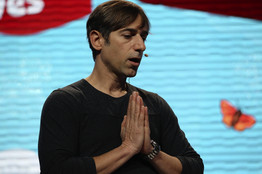
Mark Pincus, CEO of Znyga. From this picture, it is hard not to like the guy.       Reuters


CEOs in 2012: Avoid the “Fiscal Cliff”!

Reporting in November 2012 in anticipation of the across-the-board budget cuts and end of the Bush tax cuts, together expected to amount to around $500 million for 2013 alone, the Wall Street Journal observed that some large American corporations were “making plans to slow investments, lay off workers and pay less-generous dividends if Congress and the Obama administration don’t find a way to avert the so-called fiscal cliff.” Such plans could represent a self-fulfilling prophesy wherein a hit of just over a half trillion dollars in an economy of over $16 trillion is nonetheless depicted by the media as a cliff. In actuality, it could be more like taking a step down the stairs rather than falling off a cliff. Even if the federal budget cuts and end of the Bush tax breaks in 2013 would not in themselves drive the U.S. economy off the cliff into an economic abyss, the assumption of economic Armageddon could build-up downward momentum to something even far worse than a return to recession. The culprits are those in business, government and the media who were engaging in a series of steadily loud exaggerations. It could justifiably be asked, what’s the difference?
 J.P. Morgan led banks in bailing out Wall Street in 1907.  Source: Upsidetrader.com


The full essay is at "CEOs Warn the U.S. Government: No Fiscal Cliff!"


Off-Shore Drilling off Virginia’s Coast: The Stakeholder Framework Applied

By the early 1990’s, the U.S. had banned drilling off the Atlantic coast. In the wake of BP’s deep-water-drilling disaster in the Gulf of Mexico in 2010, President Obama cancelled his go-ahead of drilling leases off Virginia’s shore. A few years later, Doug Domenech, the Secretary of Natural Resources in Virginia, and that republic’s head of state, Bob McDonnell, teamed up with Virginia’s two delegates in the U.S. Senate to “put Virginia’s coast on the energy map through an act of Congress.” Domenech said, “I personally believe that the East Coast of the U.S. does have the ability to be the prolific economic basin.” The Bureau of Ocean Energy Management estimated based on two-dimensional seismic surveys that 3.3 billion barrels of recoverable oil exist under the Atlantic’s outer continental shelf and 31.1 trillion cubic feet, or 886.3 million cubic meters, of natural gas. However, the executive arm of the U.S. Government alone is more than that bureau. Moreover, lest this conflict over drilling be viewed as primarily between Virginia and the U.S. Government, it should be noted that the East Coast is not exclusive to Virginia.

 
Respecting the integrity (i.e., valid claims) of both frameworks requires integrity, or self-discipline.   Worden 


Constructing a Constitution: Egypt in the Arab Spring

Concerning a new constitution, which is more important: the process or the content? In Egypt in 2012, that most secularists and the Coptic Christian representatives walked out of the assembly working on a constitutional document suggests that the final product would not have legitimacy for all of Egypt. To be sure, it is possible for a partisan group to design a system of basic law that is not overtly self-serving at others’ expense. The document that emerged from the assembly weakens the presidency and strengthens the parliament. This shift was in line with the popular protest in “the Arab Spring.” However, the assembly left in place a “longstanding article” grounding Egyptian law in the principles of one religion. Furthermore, a provision on women’s equality was left out, and the military generals would keep their existing power. Moreover, anticipating dissolution from Mubarak-appointed judges, the assembly began its work from the last Egyptian constitution.
Do the members of the constitutional assembly look liberal or conservative?  Reuters
The full essay is at "How to Make a Constitution."

Sunday, September 23, 2018

De-Lovely: A Film Depicting the Sea-Change from Broadway to Hollywood

Cole Porter (1891-1964), an American composer and songwriter, is the centerpiece of the film, De-Lovely (2004). The film begins when he meets Linda, who would become his wife. Their relationship is at the center of the story, as well as Porter’s love songs sung throughout the film. Although the complicated nature of the relationship takes center stage, the film can be viewed as a moving snapshot of the first half of the twentieth century, when film made inroads that would dwarf the stage.


The full essay is at "De-Lovely."