Whereas the Montreal Protocol in 1985 created a fund to
reimburse countries for the incremental costs of banning ozone-depleting
chemicals, later international agreements, such as the Kyoto Protocol, oriented
to reducing global warming have not given countries, including developing nations
such as China, a financial incentive to reduce carbon emissions. In fact, the
U.S. Government rejected the Kyoto Protocol because the reductions only applied
to developed countries. Even though China reduced its carbon emissions per unit of GNP by half from 1990 to
2010 by investing in alternative energy sources and mandating that polluting
companies publicly disclose their respective emissions, the amount of
emissions continued to increase dramatically through the period. How do we discern whether the Chinese government has done enough? Furthermore, are other countries enabling China and thus indirectly responsible and thus culpable too?

The steep rise in carbon emissions in China from 2003 demonstrate just how misleading incremental, or marginal, changes can be. Even China's goal of a 20% reduction in emissions by 2020 may not mean much in terms of the total amounts emitted.
Because CO2 is a “stock”
pollutant—meaning that global warming is a function of the total amount of
accumulated CO2 in the planet’s atmosphere (regardless of when added)—a
country’s total emissions figure is key (total accumulated as well as annual
amounts). As the following graph shows, China would have to do much more than
it had accomplished during the first decade of the twenty-first century.
By 2010, industrialized countries had become large net-importers of products such as steel whose manufacture involves sizable CO2 emissions.
Developed countries have enabled China’s emissions to the
extent that they are “contained” in products exported. The increase for China
from 1990 to 2010 (blue and red bars in the bar-graph below) is astonishing. So
too is the increase in carbon emissions “embodied” in products imported by
developed countries. Interestingly, the E.U. imported more product-emissions
than did the U.S. both in 1990 and 2010. The larger manufacturing output of the
U.S. may explain much of the difference in the respective nets. Europeans
critical of the U.S. for walking away from the Kyoto Protocol may be surprised
to learn that their country has been enabling foreign carbon-emissions more.
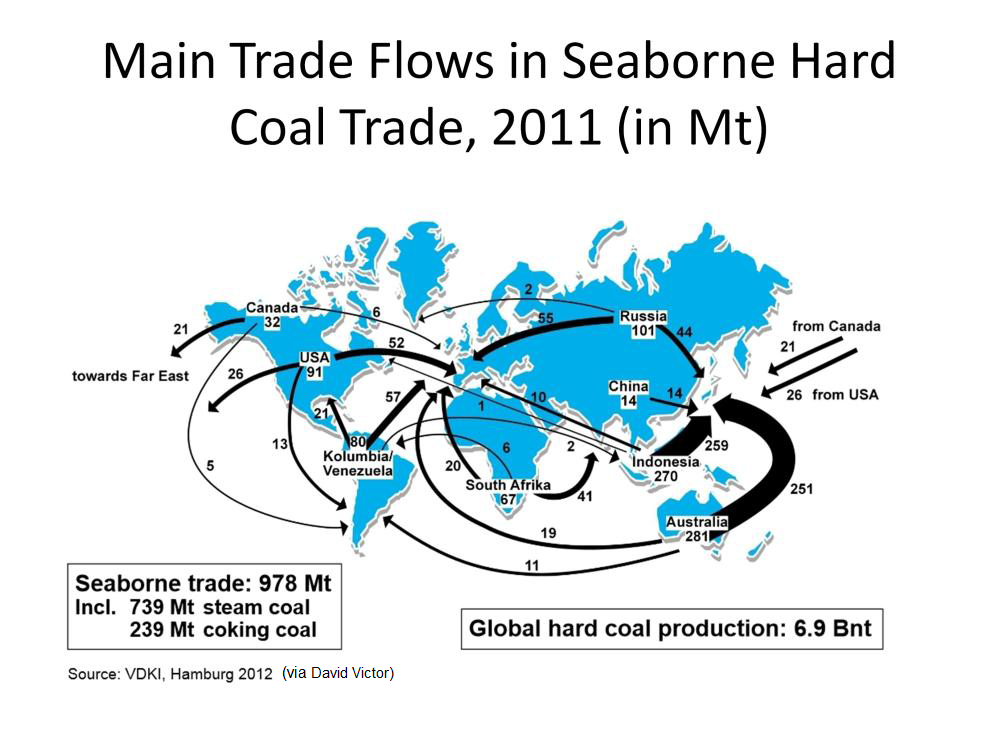
The thick black lines heading to China from Australia and Indonesia stand out in this map, suggesting just how much carbon China emitted in 2011.
Coal exports to China can be understood as another instance of enabling. As
global shipping costs for bulk commodities such as coal dropped significantly, the
amount of the commodity traded increased significantly. Obviously, major
exporters have a financial incentive to oppose global carbon-emissions limits
being written into multilateral treaties. In 2011, Australian companies extracted
a lot of coal, a majority of which went to China. Indeed, the sheer magnitude
of coal imported into China can tell us a lot about just how much carbon China
continued to emit in spite of the government’s forays into alternative energy
sources. Even though parts of Australia had been burned by the hole in the
ozone layer decades before 2011, the continent’s government and mining
companies have had a financial incentive to keep China from shifting to wind
and solar energy sources sufficiently even to level-off China’s annual carbon
emissions.
Had the Kyoto Protocol included carbon limits for developing countries, complete with “self-enforcing”
financial incentives (e.g., an international fund to cover incremental costs of
compliance) and disincentives (e.g., other countries in the treaty can boycott trade
with non-compliers), in spite of opposition from major coal-exporters, perhaps
China would have curtailed the upward trend in the country’s total
carbon-emissions even by 2010. Lest it
be thought that the dictatorship in China has far outpaced the world’s largest
democracy (i.e., India) as a “global citizen” enabling our species to have a
future, keeping global warming to within 2 degrees (C) will require much more
from China, and indeed the world.