Showing posts with label leadership vision. Show all posts

Monday, December 30, 2024

Jimmy Carter: A Post-Presidential Leader

The linking of leadership with a position, whether atop a government or a corporation, is so well established that it is easy for us to overlook U.S. President Carter as a leader because he was such a micromanager while in office. Carter’s steady leadership by example, and thus by acting as a symbol, began after he had lost re-election. Nelson Mandela of South Africa had led as a symbol in civil rights before he was elected president, and Gandhi effectively exercised ethical political, moral and religious leadership without holding any office. The reductionism or, at the very least, the mere association of leadership with holding an office biases how we evaluate leaders, as distinct from governors.  


The full essay is at "Jimmy Carter."

Tuesday, November 10, 2020

Corporate Federalism: Did AOL Miss an Opportunity?

Citing twelve past and present AOL employees, The Wall Street Journal characterized AOL in 2011 as a “culture of clashing fiefs and personalities created by a rapid series of acquisitions that haven’t jelled.”[1] Just in managing the likes of Michael Arrington and Arianna Huffington, Tim Armstrong had his hands full as CEO. Both Arrington and Huffington were strong defenders of editorial independence in their respective units. Arrington started a venture capital firm partly financed by AOL to invest in tech firms even as Arrington’s division at AOL, TechCrunch, wrote on technology firms. The problems for AOL went well beyond acquiescing in a structural conflict of interest of TechCrunch writing on particular tech companies while investing in some of them but not others. A person familiar with AOL said that Armstrong “had a macro vision that was right but didn’t have the right plan to implement it.”[2] That is to say, his visionary leadership was good but his strategic management was bad. Strategic leadership demands better. AOL may have been a good candidate for a federal system of governance because the publishing units needed some autonomy even at the cost of foregone corporate cooperation. 

The full essay is at "Corporate Federalism and AOL."

1. Jessica E. Vascellaro and Emily Steel, “Culture Clashes Tear at AOL,” Wall Street Journal, September 10-11, 2011. 
2. Ibid.

Tuesday, June 16, 2020

Integrity in Ethical Leadership

In the late twentieth century, many leadership scholars explored the link between ethics and leadership. The ethical component was portrayed not only as adherence to particular principles, but also as character giving rise to virtue ethics and integrity. Unfortunately, neither character nor integrity are leadership skills; hence our topic goes beyond the apparently easy fix of training. This puts the emphasis on the hiring process, which can be dominated by positional experience and a candidate’s vision for the organization. Upper-echelon leadership, such as of a business, government, religious organization, or university, involves the articulation of a broad vision that can include even societal norms and values.  Steve Jobs’ vision, for instance, was of a society in which communications would be done entirely differently. Although ethical principles and virtues were not salient in his vision, any head of an organization can highlight ethical principles in his or her vision.[1] Having such an emphasis and a societal-transformational vision can both resonate with people whose interests go beyond organizational effectiveness. Such visions are fun. My focus here is on integrity in ethical leadership, whether virtues or ethical principles are salient in the vision. Of particular difficulty is determining whether integrity has ethical content or is merely consistency between word and action. I contend that if integrity is interpreted as only the consistency, the ethical leadership may not really be ethical.

The full essay is at "Integrity in Ethical Leadership."

1. P. Madsen, “Managing Ethics,” Executive Excellence 7, no. 12 (1990): 11-12.

Sunday, June 7, 2020

Strategic Leadership

Strategic planning is oriented to enhancing the bottom-line.  Leadership affects organizational performance as well.[1] Therefore, strategic leadership, which can be defined as the formulation and articulation of a vision depicting a social reality and incorporating strategic aims, can enhance a firm’s sustainable competitive advantage.[2] Strategic leadership is an intangible core competency that can give rise to a core capability differential involving reputation.[3] That strategic leadership is difficult to understand and therefore to imitate contributes to its value in no small measure. But a straightforward application of strategic leadership may be thwarted if a tension develops in its exercise.  In particular, the principles behind an enduring leadership vision can be at odds with pressing strategic interests, especially as these profit-interests change while the abstract vision still holds.

The full essay is at "Strategic Leadership."


[1]. J. A. Petrick and J. F. Quinn, “The Challenge of Leadership Accountability for Integrity Capacity as a Strategic Asset,” Journal of Business Ethics 24 (2001): 331; S. Finkelstein and D. Hambrick, Strategic Leadership: Top Executives and Their Effects on Organizations (St. Paul, MN: West Publishing, 1996); J. Ciulla, “Leadership Ethics: Mapping the Territory,” Business Ethics Quarterly, 5, no. 1(1995): 5-28; K. B. Lowe, K.G. Kroeck, and N. Sivasubramaniam: “Effectiveness Coorelates of Transformational and Transactional Leadership: A Meta-analytic Review of the MLQ Literature,” Leadership Quarterly 7, no. 3 (1996), 385-425.
[2]. R. D. Ireland and M.A. Hitt, “Achieving and Maintaining Strategic Competitiveness in the 21st Century: The Role of Strategic Leadership,” Academy of Management Executive 13, no. 1 (1999): 43.
[3]. Petrick and Quinn, “The Challenge of Leadership”; J. A. Petrick et al, “Global Leadership Skills and Reputational Capital: Intangible Resources For Sustainable Competitive Advantage,”  Academy of Management Executive 13, no. 1(1999): 58, f.n. 2.

Monday, December 9, 2019

Congress: Hitched to the Status Quo

To lead is to be out in front, pointing the jet’s nose one way rather than another. Leadership is not that which causes drag at the back of the plane. Leadership is not that which holds a society in place or protects the vested interests. Whether envisioning something new or a return to a better time, a leader is not oriented to the status quo. It is significant, therefore, that the Minority Leader of the U.S. House of Representatives, one of the two chambers in the American Congress, has stated publicly that the Congress is rigged to advantage the status quo. The stunning implication is that members of Congress are actually anti-leaders.

The full essay is at "Congress and the Status Quo."

Wednesday, September 11, 2019

Political Ideology and Religious Doctrine: Pope Francis and His American Critics

Political ideology and religious doctrine are distinct, yet confusion can justifiably exist because ideology can seep into doctrine or be claimed to be such when it is not. This interlarding of political ideology into religious doctrine, or theology, is perhaps best demonstrated in Christian liberation theology, which includes political (e.g., justice) and economic (e.g., equality of income or wealth) prescriptions in the future Kingdom of God manifest on Earth. Generally speaking, political (and economic) ideology can legitimately be viewed as being human, all too human, and thus as fundamentally distinct from religious revelation and even doctrine (though even these may be influenced and even distorted on our end by the taint of human nature). Put another way, the source of revelation and even doctrine comes from “above,” whereas political (and economic) ideology are human artifacts. Therefore to infuse such artifacts into religious doctrine risks polluting it such that the religious or spiritual auspices are impaired. David Hume suggests in his Natural History of Religion that the human mind cannot long hold onto the divine idea manifesting purely as simplicity, so we attach other ideas—anthropomorphic ones—to our conceptions of the divine. Such ideas are of human traits or characteristics, hence “from below.” Sadly, we rarely recognize this human activity; rather, we take God to have such characteristics. The criticism of Pope Francis by “ultraconservative” American Catholics, including some notable clergy, illustrates just how problematic the admixture of political ideology and religious doctrine can be.

Saturday, August 17, 2019

When Platitudes Undermine Real Change: The Case of U.S. President Obama

U.S. President Obama’s 2010 speech at the UN’s annual opening lacked tangible proposals.  For example, he urged progress on the Middle East peace talks, but proffered no proposal.  He said Africa could be prosperous agriculturally, but gave no proposal for how.  He claimed that corruption in governments of developing countries is a problem, but offered no solution.  Pointing to corruption in general diffuses responsibility so talking about it does not shame anyone into making hard choices. Such platitudes belied the president's claim to being an advocate of real change. 

The full essay is at "Platitudes Undermine Real Change."

Wednesday, February 13, 2019

Johnson’s “Reinvention” of JC Penney: Too Much and Too Little

In April 2013, JC Penney’s board wished the CEO, Ron Johnson, “the best in his future endeavors.” His effort to “reinvent” the company had been “very close to a disaster,” according to the largest shareholder, William Ackman. During Johnson’s time at the company as its CEO, shares fell more than fifty percent. In February 2013, Johnson admitted to having made “big mistakes” in the turnaround. For one thing, he did not test-market the changes in product-line and pricing-points. The latter in particular drove away enough customers for the company’s sales to decline by 25 percent. Why did Johnson fail so miserably?

The full essay is at "JC Penny Reinvented?"
Ron Johnson's short tenure as CEO of JC Penney was disastrous, according to Altman.   Source: Reuters


Friday, February 8, 2019

Second-Term Inaugural Addresses of American Presidents: Of Transformational or Static Leadership?

According to a piece in the National Review, “George Washington might have had the right idea. Second inaugural addresses should be short and to the point. Of course, speaking only 135 words as Washington did in 1793 might be a little severe.”[1] Consider how short, and (yet?) so momentous Lincoln's Gettysburg Address was. The challenge for second-term-presidents, whether Barack Obama or the sixteen two-term presidents before him, is “how to make a second inaugural address sound fresh, meaningful and forward-looking." Almost all of Obama’s predecessors failed at this. Only Abraham Lincoln and Franklin D. Roosevelt made history with their addresses. One stirred a nation riven by civil war; the other inspired a country roiled by a deep depression. All but forgotten are the 14 other addresses, their words having been unable to survive the test of time. Even those presidents famed for their past oratory fell short.”[2] This is a particularly interesting observation: surviving the test of time being the decisive criterion. Even a president whose silver tongue mesmerizes a people of his or her time may not deliver ideas that survive beyond being a cultural artifact of the president’s own time. What of an address that is quite meaningful in its immediate time yet does not pass the test of time so as to be recognized as a classic? 

The full essay is at "Inaugural Addresses: Of Leaders?"

1. George E. Condon, Jr., “The Second-Term Inaugural Jinx,” National Journal, January 20, 2013.
2. Ibid.

Sunday, December 2, 2018

The Essence of Leadership

According to DePree (1989, p.19), the first responsibility of a leader is to define reality. This might seem metaphysically esoteric, but I believe DePree hit the nail on the head. Even though far less has been written in leadership research about the importance of viewing reality and interpreting it than about traits, styles and situational factors, defining reality is the fundamental task distinguishing leadership as a phenomenon (Caldwell, Bischoff & Karri, 2002, p. 153).

 Material from this essay has been incorporated into The Essence of Leadership: A Cross-Cultural Foundation, which is available at Amazon. 

Sources:

Caldwell, C, S.J. Bischoff, and R. Karri: 2002, “The Four Umpires: A Paradigm for Ethical Leadership,” Journal of Business Ethics 36, 153-163.
De Pree, M.: 1989, Leadership Is an Art (Doubleday: NY).

Monday, November 19, 2018

Leadership vs. Management: Change vs. Constancy?

In the "leadership vs. management" dichotomy, "management focuses on getting work done on time, on budget, and on target--in other words, steady execution and control--while leadership focuses on change and innovation." However, this contrast of implementation and innovation is a different dichotomy. Abstractly speaking, a category mistake may be involved in this false dichotomy. Change would be occurring in the execution of an innovative vision. In the realm of change alone, formulating and selling it can be distinguished from making the change. Therefore, the “leadership vs. management” distinction does not reduce to “change vs. status quo."

Material from this essay has been incorporated into The Essence of Leadership: A Cross-Cultural Foundation, which is available at Amazon. 

Sunday, October 14, 2018

Steve Jobs at Apple: A Visionary

Typically as a company transitions from an enterprising, creative new venture to a large organization to be managed, a staid CEO replaces a visionary founder. In the case of Steve Jobs at Apple, the very nature of the man’s vision was not only inherently at odds with the status-quo underpinning of a large organization with a budget, but also essential to the company’s business model. Hence, the company, including its shareholders, paid a price for years for jettisoning Jobs. The film, Jobs (2013), is centered on the distinctiveness of Jobs’ vision. Although the film also hints at why this distinctiveness is such that the company would (and did) lose as a large organization after making the typical founder-to-CEO transition.


The full essay is at "Jobs."

Friday, September 28, 2018

Visionary Leadership at Zynga

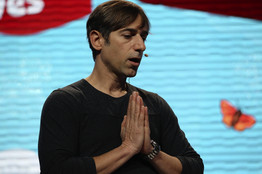
Faced with a stock price down 75 percent since its IPO and conflict with subordinates throughout 2012, Zynga’s chief executive Mark Pincus had plenty on his plate as he met with Bill Campbell of Apple in September of that year. Zynga investor and venture-capital firm Kleiner Perkins Caufield & Byers had brought Campbell in to advise the CEO. While it is tempting to play around the edges and work on “communication processes” and hand out more employee stock-options, the bottom-line in such cases is typically the need to improve the products either simply to be better products or better tailored to changing consumer tastes and habits. Product development that can transform companies may result from the vision of a leader for whom strategy is simply a matter of reaching a destination already known.
 
Mark Pincus, CEO of Znyga. From this picture, it is hard not to like the guy.       Reuters


Off-Shore Drilling off Virginia’s Coast: The Stakeholder Framework Applied

By the early 1990’s, the U.S. had banned drilling off the Atlantic coast. In the wake of BP’s deep-water-drilling disaster in the Gulf of Mexico in 2010, President Obama cancelled his go-ahead of drilling leases off Virginia’s shore. A few years later, Doug Domenech, the Secretary of Natural Resources in Virginia, and that republic’s head of state, Bob McDonnell, teamed up with Virginia’s two delegates in the U.S. Senate to “put Virginia’s coast on the energy map through an act of Congress.” Domenech said, “I personally believe that the East Coast of the U.S. does have the ability to be the prolific economic basin.” The Bureau of Ocean Energy Management estimated based on two-dimensional seismic surveys that 3.3 billion barrels of recoverable oil exist under the Atlantic’s outer continental shelf and 31.1 trillion cubic feet, or 886.3 million cubic meters, of natural gas. However, the executive arm of the U.S. Government alone is more than that bureau. Moreover, lest this conflict over drilling be viewed as primarily between Virginia and the U.S. Government, it should be noted that the East Coast is not exclusive to Virginia.

 
Respecting the integrity (i.e., valid claims) of both frameworks requires integrity, or self-discipline.   Worden 


Wednesday, March 21, 2018

Mark Zuckerberg: Facebook’s Unjust Strategic Leader in a Crisis

Mark Zuckerberg, founder and CEO of Facebook (and Instagram) “remained silent” during the two days after the data-breach scandal broke in March, 2018 as E.U. and U.S. lawmakers “pummeled Facebook and its stock price” dropped 9 percent.[1] The company lost $50 billion in market value in just those two days![2] Beyond the self-interested investors and the demoralized employees, the company’s 2 billion users—the suppliers of the raw content (to be mined as well as shared)—and the world (i.e., societal level) looked for ethical (i.e., atoning as well as protective) leadership from the company’s CEO. To be just, I submit, the leadership could not have been a mere reflection of Zuckerberg’s or Facebook’s immediate self-interests.

The full essay is at "Leadership Lacking at Facebook."

Employees look for leadership in the midst of a demoralizing crisis. (USA Today)


See also the booklet, Taking the Face off Facebook


1. Jessica Guynn, “As Facebook Reels from ‘Catastrophic Moment’ in Cambridge Analytica Crisis,” Mark Zuckerberg Is Silent,” USA Today, March 21, 2018.
2. Kevin Roose and Sheera Frenkel, “Missing From Facebook’s Crisis: Mark Zuckerberg,” The New York Times, March 21, 2018.

Monday, March 19, 2018

The Founder of Theranos: A Flawed Charismatic Vision and Leader


“Theranos rose quickly from being a college dropout’s idea to revolutionize the blood analysis industry to a hot tech bet that accrued $700 million in funding and many famous names for its board.”[1] Elizabeth Holmes, the company’s founder, was stripped of her position at the company in 2018 after the SEC discovered her deep involvement with the fraud at the company. Her “smarts, fierce determination and Steve Jobs-inspired look . . . were critical” to her being able to perpetuate the lie that the company had a device that could do blood tests with just a scant amount of blood, obviating the unpleasant experience of having blood drawn by needle.[2] Although Jack Welsh, Bill Gates, and Steve Jobs accomplished enough to warrant their fame, I submit that companies are too prone to create “champions”—even strangely calling them “rock stars.” In other words, even though charismatic vision is of value to a business, neither such a leader nor his or her vision itself should be overplayed. Business, I submit, has a marked tendency to do just that, and often with impunity.


On leadership vision, see Skip Worden, The Essence of Leadership: A Cross-Cultural Foundation


[1] Marco della Cava, “Behind the Scenes of Theranos’ Dramatic Rise, Fall,” USA Today, March 16, 2018.
[2] Ibid.

Friday, March 2, 2018

11/11/11

In Berlin at the Brandenburg Gate on 11/11/11 in 2011, costumes were the norm in the evening as revelers celebrated the numeric convergence. I suspect that unlike the Chinese, the Europeans were struck by the convergence itself, rather by any good luck attached to the numerology. I myself was struck by the convergence alone. Both at 11:11am and 11:11pm, I was surprised that other Americans around me seemed to be either ignorant of the alignment or utterly indifferent to it. It occurred to me that just as a given time-date system is artificial, so too are human cultures—which include political and economic values that are stitched together by leaders who peddle meaning to the masses. Both our systems and our ideologies are all too limiting, yet we can find meaning in them. Perhaps this is ultimately why we have them and the leaders that trumpet them or suggest new ones. I contend that 11/11/11 too plays into the human instinct for sense-making, especially in terms of visual and cognitive symmetries.

The full essay is at "11/11/11"

Saturday, February 24, 2018

Presidential Leadership

In the wake of the failure of the joint congressional committee that was tasked with coming up with a proposal to reduce federal deficits over a decade by $1.2 trillion, Michael Bloomberg, mayor of New York City, said at a news conference, “It’s the chief executive’s job to bring people together and to provide leadership. I don’t see that happening.” The mayor may have been wrong. Take the word executive: literally it is to execute, or implement, which implies management rather than leadership. Put another way, implementation depends on a goal already established, presumably by a leader. To lead is to formulate a vision of social reality that is an ideal, and thus consisting of goals rather than actualities, and then to persuade others to accept that social reality. Once the directionality is established, the means, or strategies, can be executed by managers (i.e., those who manage the implementation).

The full essay is at "Presidential Leadership."

Sunday, December 3, 2017

Cult of the Leader: The Case of North Korea

Baudrillard writes of "hyper-reality," which arises when productions—perhaps created by publicists and other spin doctors—become the reality that is taken seriously at the expense of the originals.  The modern art of Andy Warhal provides an analogy. His portraits are not exactly pure "copies" of the originals, so his way of depicting reality should not be identified as the definitive truth. Such “hyper-reality” can become the stuff of leadership. DePree (1989, p.19) writes that the first responsibility of a leader is to define reality. According to Nanus (1992, p.61), “leaders create realities through the force of vision.” The reality envisioned is a social reality. Although it can include the leader, the content of the vision is usually distinguished from the messenger.

Material from this essay has been incorporated into The Essence of Leadership: A Cross-Cultural Foundation, which is available in print and as an ebook at Amazon. 


Sources:


DePree, M. Leadership is an Art (Doubleday, New York, 1989).

Nanus, B.: 1992, Visionary Leadership: Creating a Compelling Sense of Direction For Your Organization (Jossey-Bass: San Francisco).


Saturday, August 19, 2017

A European Utility Re-Envisioning Energy: An Opportunity for Visionary Leadership

When Eneco began a business called CrowdNett in which the company would sell large home-batteries to people having solar panels, the Dutch electric utility was on the way toward putting its electricity-production business out of business. The company would continue, though radically transformed. The strikingly different strategic-course correction was based on a rather unique vision of a novel social reality in which homes generate their own energy and then some. In the context of climate change and accumulating carbon dioxide in the atmosphere, Eneco’s CEO had an opportunity in 2017 to lead not only organizationally, but societally as well by promoting the radical social reality already envisioned.

The full essay is at "Re-Envisioning Energy."

For more on visionary leadership and management, see The Essence of Leadership: A Cross-Cultural Foundation, available in print and as an ebook at Amazon.