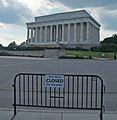
It is much easier to point out the sliver in the other person's eye than the plank in one’s own. Regarding the gradual political consolidation of power at the federal level in the U.S. at the expense of not only the member-state governments, but also the federal system itself, it is easier for a political party to dismiss its own contribution than to take a wider stance including the continued viability of the federal system, or federalism, itself. As a result, both of the major parties has contributed to the increasing political consolidation at the expense of the check-and-balance feature that a balancedfederal system has. The full essay is at "Encroaching Political Consolidation in the U.S."
A manager does not preside. To manage is to be actively engaged in the operations of an organization; it is not to “sit before,” as in representing the organization itself externally and intervening in it only as needed in serving as guardian of its “constitutional” order. For example, if a company’s corporate governance system is about to implode, the President is there to preside as the board (and major stockholders) come to terms. In other words, the President would be oriented to maintaining the meeting foremost—intervening in the discussion only if a key juncture is likely to result in an implosion of the governance system. Material from this essay has been incorporated into The Essence of Leadership: A Cross-Cultural Foundation, which is available in print and as an ebook at Amazon.
According
to The New York Times at the end of 2018, internal documents generated at
Facebook in 2017 showed that the company “gave Microsoft, Amazon, Spotify, and
others far greater access to people’s data” even after having raised a privacy
wall than Facebook had disclosed.[1] That is, Facebook
effectively exempted some of its business partners from the company’s privacy
rules without notifying users. In
many quarters, this would be called lying, which in turn would suggest a sordid
management at Facebook. The more subtle astonishment, I submit, is that 2.2
billion users had stayed with Facebook after the hidden use of personal data
for political purposes. The partnership between Facebook and Cambridge
Analytica had hardly been made in heaven. Why such enduring trust in spite of
external data being clear grounds for losing trust and giving up using
Facebook? How many betrayals would be necessary? In literal marriages, trust
can be lost “like that!” Similarly, when a child even unconsciously loses trust
for her parents, the solid basis of trust in a normal parent-child relationship
is lost most likely forever. Why has Facebook—a distant business punctuated by
lies—get a pass?
Integrity is arguably essential to the credibility of
religious functionaries—even and especially those with considerable
organizational power. So it was significant that Marie Collins, whom Pope
Francis had appointed to the Vatican’s commission on sexual abuse by clergy and
herself had been a victim of such abuse, resigned on March 1, 2017 due to “fine
words in public and contrary actions behind closed doors.”[1]
Notably, the commission suspended Peter Saunders a year before, “after he
accused the panel of failing to deliver on its promises of reform and
accountability” even including recommendations that the Pope had approved.[2]
What is the basis of the problem? I submit that the conflict of interest that
is inherent in having the clergy of a religious organization hold each other
accountable is, much like industry self-regulation, culpable in this case.
On September
20, 2016, U.S. Senators questioning Wells Fargo’s CEO, John Stumpf in the
Senate’s Banking Committee “seemed unmoved” by his “attempts to explain why
more senior bank executives had not been tied to the widespread illegal sales
activity.”[1] Bank employees may have opened as many as two million accounts in customers’
names without those customers’ knowledge.[2] Senator Elizabeth Warren, a Massachusetts Democrat, “said the illegal sales
were a big driver of Wells Fargo’s success as one of the nation’s most
profitable banks.”[3]
She called on Stumpf to give back a large portion of his compensation, resign
and be criminally investigated. I contend that giving back some of his compensation
and resigning from the bank would have been necessary for the CEO get past the
scandal in being able to be a credible and trustworthy ethical leader. That the
bank’s board acted independently from its chairman, the CEO, a week later in
taking back $41 million of his compensation and $19 million of the stock grants
from Carrie Tolstedt, who had led the bank’s retail banking division (and
cancelled any bonus for either official) does not lend the CEO any renewed
credibility.[4]
Rather, the action made the bank’s board members look like they were trying to
do what was necessary, given the CEO’s underperformance during the Senate
hearing.
Credibility is absolutely essential to viable leadership,
whether in religion, politics, or business. A leader who undercuts one of his
or her promises effectively expunges it of any worth and is essentially a “lame-duck”
leader thereafter unless he or she puts difficult effort into becoming worthy
of being trusted again. It does not take long for followers to get the message
if one of them who relied on the promise is punished for doing so. Chairman Mao
is infamous for having made such a promise in the Hundred Flowers movement.
Unfortunately, he killed many Chinese who relied on Mao’s word. A similar
dynamic, though much less extreme, occurred just after a synod in 2014 called
by Pope Francis, who in this respect can be likened to Mao. Fortunately for the
Catholic pope, his own religion offers him a way out.
Strategic leadership relates an organization’s differentiated core competencies to its ideologies, identity, mission and view of the macro environment system. Relates implies that strategic elements are not identical with a vision containing values. In fact, a tension can be involved, as interest applies one way to core competencies and another to the social reality that a leader promotes in line with an organizational mission (and identity). For one thing, the basis of a competitive advantage can be rather limited temporally, due to technological changes, for example, while values espoused are presumably long-lasting in their validity and thus not easily changed.
Ethical leadership as a means of managing strategic leadership (Worden, 2003a and 2003b)
Corporations have undoubtedly oriented their philanthropy to
take advantage of the potential synergy with marketing their products and
services. This “revelation” should not surprise anyone in modernity. Even so,
overdoing any convergence to maximize profits is certainly open to ethical
critique, even if leaning excessively on strategic interest at the expense of
reputational capital is perfectly legal. This point ought to impress itself on
the frontal lobe of any dean who hires lawyers to teach business ethics. In
this essay, I focus on McDonald’s funding of its own charitable organization,
McDonald House Charities. Has the corporation’s financial contribution been
sufficient, ethically speaking, to justify the resulting reputational capital,
marketing synergies, and long-term profitability?
It can be said that the media's currency is credibility. If so, the American media may have outdid itself yet again in characterizing the federal government's sequester in 2013 as an imminent disaster of Congressional design. Countdown clocks going back days only escalated the orchestrated yet subterranean calculus of attention-getting and fear-mongering by the usual suspects. Not only did the actual sequester not turn out to be a train wreck; the enforced budget discipline brought the spending line significantly more into line with the revenue line.
Later in the same year, the clocks were back for the government partial shutdown and a default deadline. CNN outdid itself. Not only did the network sport a clock counting down to the partial shutdown; the countdown clock turned into a precise indicator of the ongoing duration of the partial shutdown down to the second, even after eleven days! The unnecessary, dogmatic inclusion of minutes and seconds could only have been intended to deliberately stretch out the manufactured sense of alarm or crisis beyond its unnatural life. The mendacity and manipulation are of course unethical, yet the novel practice had already become the industry's norm so the viewers naturally assumed it must be proper and well-proportioned.
Even as the days, hours, minutes and seconds mounted, CNN added a second clock just below the first in order to countdown the upcoming default deadline. Fortunately, after a day or two of numbers galore, someone at the network made the momentous decision to simplify the "shutdown" clock into a count of days. Unlike the excessive day-count by the networks as the hostage situation in Iran went on and on in 1979, CNN's "Government Shutdown" day-count and "Debt Ceiling Deadline" clock were seemingly etched onto the screen (except during commercials, of course). Although the advent of the 24/7 news-channel eased this shift appreciably, the trajectory itself can be graphed as a curve evincing a sort of cancerous decadence spreading through the body politic. I want to unpack the very nature of that pathogen by placing a slice of the media on a microscope slide.
A look at the catastrophic partial government shutdown. Wikimedia Commons.
Is what we have here one artificial "catastrophe" on top of another? That the first had never really gotten off the ground as catastrophic was apparently beside the point as the media began crying wolf yet again. Perhaps imminent catastrophe as a sort of continuing resolution had already become the primary strategy of television news editors, who were at least outwardly impervious to whether or not the last crisis had actually turned out to be catastrophic as they had thought and pronounced. No learning curve extraneous to what sells was allowed by those who refuse to look in the rear-view mirror. The new "reality" (or reality show) premised on a permanent adrenaline-rush (coffee no longer being required) had been found to be cheap to produce, and thus it had become the default. For added fun, the viewers could look forward to a cacophony of puffed-up talking mouths forming a cavalcade of exaggerated metaphors with no curtain call in sight.
The confluence of the government's partial shutdown and the prospect of a default fueled a confluence in turn of journalists and politicians around a storyline to which only they and Wall Street were privy. Meanwhile, the usual suspects treated the public to an exaggerated roller-coaster ride over the supposition that the cars really could suddenly fall to the ground. The manufacturers were even considerate enough to supply a countdown clock!
Source: NPR.org
Besides magnifying the significance of each public statement and meeting by labeling almost every twist and turn "BREAKING NEWS," broadcast and online/print journalists as well as the ubiquitous pundits happily joined members of Congress in misappropriating war terminology even to someone's refusal to talk to someone else on Capitol Hill.
For example, former U.S. House Speaker Newt Gingrich said at one point on CNN, "It is a nasty, bloody fight." Meanwhile, U.S. House representatives were referring to the difficulty in reaching a deal as a terrible battle. Had any of them been to the real battlefields at Gettysburg in Pennsylvania? Had the former Speaker, perhaps when he was studying for the doctorate in American history? Lest the thick, humid air of the odious irony cause anyone difficulty in breathing, I can supply a bayonet to cut through the miasma of soupy air.
To correct the squalid, sensationalizing habit of militarizing the "sausage making" in Congress, an actual military veteran gives us a needed reality-check in an ad sponsored by a vet group and aired on CNN just before the former Speaker over-reached. The veteran declares with an obvious note of disgust and disbelief, "It is not an epic battle. I've been in an epic battle and running the government is not one of them." I was instantly reminded of Sen. Lloyd Benson's clever response to Sen. Dan Quayle in the vice-presidential debate in 1988.
As if recalling faded images of soil tainted with the blood of those who had sacrificed their lives does not go over the top, the Huffington Post ran the following headline: "[U.S. Senator] Joe Manchin: Democrats May Consider 'Nuclear Option' On Debt Ceiling." Was it really necessary to stir the old fears of those Americans who could still remember the corrosive taste of the Cold War? Selfish and inconsiderate, or perhaps the old sin of pride overlaid with whipped presumptuous,may aptly describe the underlying mentality. Yet even sickness can be found in the nucleus of the interlarding pathogen.
Ironically, Wolf Blitzer of CNN turned away after only a minute or so from Sen. Rubio speaking live in the U.S. Senate chamber on the Iranian nuclear talks then going on only days after Sen. Manchin made his infamous "nuclear option" threat. In spite of the fact that getting Iran to the negotiating table had just been a significant step toward a solution and the media around the world was covering the talks, the veteran news anchor in America relegated the issue as soon as he discerned that the topic was not the upcoming debt-ceiling. As though an infant missing his thumb for two seconds, Blitzer quickly said (paraphrasing), "Senator Rubio on the Senate floor is just talking about Iran. I want to turn to . . . on what is going on right now on Capitol Hill." Nothing was going on.
I was astonished that the folks at CNN could be so obsessed with microscopic, minute reports of this and that meeting of lawmakers, a brief public statement of no substance (e.g., "We want fairness."), and various trial-balloons seemingly meant to preempt running up against the debt-ceiling at "ZERO HOUR." In hindsight, few people would notice that President Obama signed the bill after midnight, hence past the zero hour. the Apocalypse. Put another way, the timing of the bill finally becoming law early on October 17th invalidates all the clocks counting down the minutes and seconds, as well as the USA Today newspaper front-page headline on October 16th proclaiming "ZERO HOUR" as if the world as we know it would end at midnight without the debt-ceiling having been extended. As conflict is the stuff of a good show, the paper's editors flanked the "ZERO HOUR" (in a flaming red square) with photos the Speaker of the U.S. House and the U.S. President, seemingly staring each other down. Conflict sells, as do even artificial, arbitrary deadlines invented and then fed to a beguiled public. After the fact, few people even think to look in the rear-view mirror, and so we can expect the manipulation to go on.
Why is the application of zero hour to the debt ceiling fake? It is important for us to realize the severity of our lapse so we won't be taken so easily in the future. The U.S. Government would not go into default the minute, or even necessarily days, after the debt ceiling has been reached unless cash on hand is not sufficient to pay the bills due immediately. That is, not being able to borrow more does not preclude the government from using its cash on hand and incoming revenue from taxes and other sources to pay the bills as they come due. Regarding the October 17th "deadline" at 12:01 a.m., the big bills (e.g., Social Security and interest payments) were not to come due until October 21 and then again on November 1st. Even though Treasury's software may not have been able to "pick and choose" what to pay in order to stave off actual default (i.e., missing an interest payment to U.S. bond-holders), presumably a law passed by Congress and signed by the president would override such logistical matters. Furthermore, because no interest payments were due on October 17th, not to mention exactly at 12:01 a.m., actual default would not have occurred at the end of "zero hour" or even the next day! Nevertheless, the media, Congressional lawmakers, and the self-anointed pundits qua experts easily foisted the lie on a gullible public eager to believe anything said on television or in print.
Given the government's cash on hand and strong revenue stream coming in, I suspect that the feared trade-off between paying interest on the debt or issuing Social Security checks is a false dichotomy. To be sure, the ethics of paying wealthy bond-holders while retirees, the sick, and the hungry go without sustenance is daunting, if not prohibitory. Such a breach of ethics would be on top of the media's hidden agenda or biased discretion to maximize "me, me, me" and profits at the expense of the journalist mission to report the news let the viewers make up their own minds. Moreover, to deliberately foment fear excessively violates Kant's "Kingdom of Ends," wherein beings having a rational nature are treated not just as means, but also as ends in themselves.
The real crunch point would have come with the first of the huge pay-outs, which would not be until October 21st. Even putting off non-interest bills coming due before that date would not be an actual default, which is defined as missing a payment of interest and/or principal to creditors. The "ZERO HOUR" was a hoax, which, unfortunately, could have become a self-fulfilling prophesy. Fortunately, Wall Street wasn't buying into the stunt. Had the drama been allowed to play out until October 20th, the continuing financial uncertainty alone might have caused a "run on the bank" even if the traders and major investors were privy to the end-game already worked out in Washington. Smoke and mirrors can spur someone into starting an actual fire.
Another casualty from the media's obsession based on the assumed validity of a "zero hour" is what I would call the monopoly of the story crowding out virtually all other news. As if creating the countdown clocks in the first place is not bizarre enough, the refusal to break away even for five minutes has all the earmarks of a pathology or dysfunctional mindset even if the intent of the network executives and anchors was to maximize the audience-share for the first half of October. Even if the viewers had already been suckered into the purported significance of the "breaking news" flashes regarding trivial "developments" in line with profitability, gaining from lying violates journalistic ethics and the mentality involved is sordid. At the very least, that journalistic strategy enables a personality disorder. For example, twelve hours before the declared zero hour ending at midnight, voices presumably screaming in Blitzer's ear-piece would not tolerate even five or ten minutes on the Iran talks then concluding, even though similar voices had saturated the entire morning with hours of unrestrained verbal diarrhea ad nauseam zooming in on every little twist and turn. The refusal to break away from a dearth of real news to briefly cover a story being heavily reported on that day by news networks around the world is a huge red flag begging to be examined. The pathogen goes far deeper than merely a tunneled perspective and even a lack of judgment (in one's own field!). At the subterranean level at CNN must lie a dysfunctional organizational culture enabled by the obsessive-compulsive personality disorder.
To be sure, an actual default by the U.S. Government would have serious economic implications. Sen. John McCain reported that the likely impact on the market, according to Wall Street bankers and stock analysts, would be "very, very negative." That the media used "Armageddon" rather than "very, very negative" and referred to October 17th as "the magic day" and to midnight there of as "Zero Hour" is a red flag. Even if most of us are color-blind, the choices that were made in the (misuse of) discretion say something about the mentality underneath the carefully-cropped haircuts. Meanwhile, the continuing partisan remarks by members of Congress belie their artful shrieks that the sky would soon fall unless the other party caves. For days, the public had been blanketed with baleful warnings of imminent catastrophe. In other words, if the lawmakers really did think a financial meltdown might occur, they would not be prioritizing political points unless risking their own wealth, not to mention the U.S. economy (and thus their jobs), was of no concern.
Days before the public new that a deal was in the works in the Senate, Sen. Reid's "Don't screw it up" comment was caught by a microphone as the mayor of Washington, D.C. stopped the majority leader on the Capitol steps to ask for enough money to operate the city (including trash pick up). What is the it? A grammar detective would point to the missing antecedent as being very suspicious.
Also suspicious, with even just 12 hours to go before the global financial system could turn into a pumpkin at midnight, the Dow Industrials was up more than 100 points. Had the traders and major investors believed that an actual default was possible, the dire consequences coming with even low probability would have been factored into the market. The Wall Street elite must have known that even a House vote well after zero hour would not trigger a default. In short, the countdown clocks and word of a zero hour were both a ruse perpetrated on an beguiled public (you and me). Feels nice, doesn't it? Yet we continue right along in the matrix.
I submit for your consideration the possibility that Congressional lawmakers, the president, Wall Streeters, and even perhaps the media already knew that Act 3 would end with a dramatic (i.e., attention-grabbing) climax and a favorable ending. With the "it" set, the incumbents could enact various displays like peacocks to give themselves political cover or simply look good amid all the manufactured attention. Meanwhile, the American people were being manipulated into believing in the existence of an epic bloody battle ending on time, as planned, just before "ZERO HOUR." If I am correct with this scenario, the players on the mighty stage do not deserve a standing ovation for having saved the day. Least of all are we to permit them an encore, even if one has already been pre-determined and thus inevitable.
In late July 2013, the Obama administration decided that
it was not legally required to determine whether the Egyptian military had led
a coup in ousting President Morsi. The decision permitted the administration to
continue $1.5 billion annually in American aid to Egypt. One senior official
said only, “The law does not require us to make a formal determination as to
whether a coup took place, and it is not in our national interest to make such
a determination. We will not say it was a coup, we will not say it was not a
coup, we will just not say,” the official said.”[1]
I’m reminded of one of Captain Renault’s famous lines in the film,
Casablanca. “I’m shocked, shocked to
find that gambling is going on in here!” Coup?
What coup? To be sure, the administration had its reasons, strategic of course,
yet a bigger picture perspective could be helpful here, considering that an effort
to violate at least the spirit of a law is involved here.
Administration officials said the U.S. Government would
continue to use financial aid as a lever to pressure Egypt’s new government to
push through a transition to democracy. Yet what cost to the U.S. Government would
this intent to manipulate the Egyptian military exact?
A Coup or a Book-Signing?
Refusing even to decide if this is a coup reflects on the refuser.
On July 3, 2013, Egyptian generals deposed President
Morsi, put him under arrest, and suspended the constitution. “Under the terms
of the Foreign Assistance Act, no aid other than that for democracy promotion
can be given to ‘any country whose duly elected head of government is deposed
by military coup d’état.’ The law does not allow a presidential waiver, and
stipulates that aid cannot be restored until ‘a democratically elected
government has taken office.’”[2]
Refusing to decide whether a coup took place is essentially refusing to enforce
the law, given the events in Egypt on July 3, 2013.
Fittingly, one of Morsi’s senior advisors, Wael Haddara,
accused the administration of “verbal acrobatics,” and asked, “With the entire
world calling this a coup, why isn’t the American administration calling it so?”[3]
The reference to “verbal acrobatics” is particularly important, for it hints on
the discrediting long-term impact on the U.S. Government by its president’s
decision to take an easy out. Generally speaking, political convenience can
come back to bite even if the pain is not ever felt directly. In other words,
the Obama administration sacrificed some of the U.S. Government’s credibility
to be able to manipulate another government through money.
A similar trade-off existed at the time in Europe
regarding the matter of Turkey’s possible accession an E.U. state. Turkey would
be the largest state by population, and thus would have tremendous influence in
the E.U. Government. The added cultural and political diversity to the E.U.
could cause it added strain, if not compromise the very viability of the Union.
So why would the E.U. admit Turkey when doing so could put the E.U. itself at
risk internally? Similar to the Obama administration’s desire to have more
influence in the Egyptian military, the European Commission would like to use
Turkey as a “way in” to influence Middle East international relations.
Both cases evince putting one’s own federal government at
risk in order to manipulate other governments. At the very least, the strategy
of undercutting oneself to extend one’s influence seems counterproductive. That
the influence comes well before “the bill comes due” creates the illusion of a
costless choice. Looking out for the long-term governing of a union of diverse
states, whether in Europe or North America, is easily shirked when the
opportunity to pull more levers externally presents itself. A federal
government willingly undercutting its own credibility or ability to govern for a
short-term advantage is not only short-sighted; it is also indicative of a
certain lack of character. The question is perhaps whether that lack of
character is societal in nature or merely in ruling elites.
Being able to count on a person or company thereof having
sufficient motivation to provide a self-defense is no feat, for self-interest
is a staple—perhaps the staple—in
human nature.It should be no surprise,
therefore, that after raking in $102 billion in subsidies, including lower
lending costs due to the general perception that the government would bail them
out, and repaying the TARP money, the biggest American banks were sufficiently
re-energized (i.e., self-motivated) to go on the offensive to protect their places on the perches under fire. Specifically, they planned
a lobbying campaign to fend off increasing Congressional calls to break up the
banks to solve the too big to fail problem (which includes the subsidy problem
that exacerbates the wider problem). There are problems with the lobbying
itself—problems caught in America’s blind-spot even as they subtly undermine
the body politic.
Charles Krauthammer proffers a pithy
summation of the U.S. Supreme Court Chief Justice’s majority opinion on Obama’s
health-insurance law of 2010: “Law upheld, Supreme Court’s reputation for
neutrality maintained. Commerce Clause contained, constitutional principle of
enumerated powers reaffirmed.” Translation: the Court is not judicially
activist, the 5-4 majority is not down party-lines, and federalism is
protected. Essentially, John Roberts was able to dodge some bullets while doing
what he needed to get done, philosophically. Turns out the guy is pretty smart
after all. More than met the eye may have been behind President Bush’s decision
to nominate him to be the Chief Justice.
Beyond judicial skill, the Chief
Justice presides at the U.S. Supreme Court. He is thus oriented institutionally
(i.e., as per his unique position there) to act in the Court’s institutional
interest. In Krauthammer’s words, “Institutionally, he is chief justice and
sees himself as uniquely entrusted with the custodianship of the Court’s
legitimacy, reputation, and stature.” That is to say, John Roberts as Chief
Justice is more than a justice. To put it crassly, he was interested in what
the popular press was saying about the Court while it was deliberating, whereas
at least one of the other justices (Thomas) made an effort specifically to
avoid looking at the press. Roberts was right to have one eye on how the
reputation of the Court might be affected, and Thomas was right to have both of
his eyes diverted so as not to be improperly swayed by public opinion. This is
not to say that Roberts laid himself open to such influence; there is a
difference between popular opinion on the law that is “under the knife” and how
the Court could suffer in the public square as a result of a ruling. It is
perfectly legitimate for the Chief Justice to have one eye on the latter.
The distinction between being the
president of the Court—essentially presiding over it as the steward of its
long-term viability—and being a “mere” justice on the Court means that the
Chief Justice can be expected to be a “different kind of animal” from that of a
justice. From the vantage point of the latter, the Chief Justice may look like
a politician, and in fact there may be some political considerations involved
in safeguarding even a long-term reputation. The mix of politician and judge
seems a bit like that of oil and water—only the latter being reckoned by the
jurisprud as pure. Hence John Roberts’ behavior probably struck the other
justices as odd at best. However, I suspect that the people “in the know”
involved in the selection of the Chief Justice had been well-aware that John
Roberts was distinct in ways that would differentiate him from the other
justices.
U.S. Chief Justice John Roberts
Roberts had to be both politician
and justice in crafting a majority opinion that would both protect the Court
and safeguard federalism (or what is left of it, anyway). I suspect that in
this dual-role, Roberts had the rare view that perhaps only leaders in Congress
and the President get from time to time—namely, that of the big picture,
wherein the trees of one’s days give way to the contours of the forest, both
constitutionally and historically. From this summit, the United States is seen
as if from a distance measured in terms of oceans of time, and “doing the right
thing” can take on added importance because the precariousness of the thing
awash in a sea of history yet to be made.
Crucially, with the perspective comes a recognition that is apart from any pressing ideological, philosophical, political or even judicial interests. The United States is perceived as an entity that is itself in need of protection apart from whatever way the currents of the day happen to be going. This recognition is what really distinguishes presiding from partisanship. The latter is relativized in importance. With the height of the position comes
power such as can shift the contours of a nation’s trajectory for decades, yet
also at this height is a humbling sense of responsibility. Ironically, those of
less power act with much less responsibility and thus are more dangerous. The
distinction here can be thought of as that which exists between
transformational and transactional leadership, though the typically
organizational application of transformational leadership mislabels or belies
its true home, which is societal and historic.
I suspect that in deliberating on the case, John Roberts perceived that he had not only signficant power in terms of a major piece of legislation in deciding which "side" would be the majority, but also the overriding responsibility to protect the Court itself, and indeed the viability of the U.S. system of governance (including the federal institutions and federalism itself). He was in a position institutionally that called him to rise to the occasion in terms of safeguarding the system itself.
Theoretically speaking, being systemic in its orientation, the presiding function is consistent with systemic leadership. The broad vision of such leadershiptranscends the issues and pressures of the day. To be sure, the more immediate strategic factors cannot be totally ignored. In fact, juggling the enlightened leadership vision that is oriented to the presiding function with the more short-term or issue-oriented strategic or political elements is of value in high positions. This composite in turn can be referred to as strategic leadership. Rather than being a fault or evidence of personal frailty, managing this task is quite proper to the office of Chief Justice.
Source:
Charles Krauthammer, “Why RobertsDid it,” National Review Online, June 28, 2012.
In the context of a rapidly approaching deadline on increasing the ceiling on U.S. Government debt, Barak Obama found himself rebuffing pressure from anti-tax “Tea Party” Republicans in the U.S. House while needing enough non-partisan credibility for his warning of an impending economic catastrophe to be believed by the citizenry and Congress. That is to say, Obama’s failure to stand back as the Democrats and Republicans in Congress duked it out on spending cuts and tax increases mitigated his stature or credibility as Presider in Chief. An editorial in the New York Times refers to this role of the president as "the utimate guardian of the constitutional order."[1] To preside is to be oriented to the viability of the whole. This means stepping in when the system itself is at risk. Partisan involvement compromises the ability to function in a failsafe capacity, as the "ultimate guardian."
On April 5, 2011, President Obama observed, “We’re going to have some very tough negotiations. And there are going to be, I think, very sharply contrasting visions in terms of where we should move the country. That’s a legitimate debate to have.” (1) He sounded very presidential in making the statement because he was taking the perspective of the nation as a whole. Furthermore, he used that vantage-point to try to keep negotiations from falling off the track. “If they can’t sort it out,” he said, “then I want them back here tomorrow.” (2) In short, he was presiding, rather than being partisan in taking a side, as he framed the situation facing the union.
Doug Mills, The New York Times
However, even as the president was referring to the two sides sorting the budget out as “they,” he himself was on one of the sides. That is, even though he “sought to position himself above the nitty-gritty haggling going on in Congress, which . . . limited his influence on the process” yet distanced him from any blame, his taking a side in the dispute subtly worked against his attempt to preside to hold the process as a whole together. (3)