Showing posts with label international political economy. Show all posts

Tuesday, April 7, 2026

Security Council Vetoes Styme the UN: Oil in the Strait of Hormuz

The United Nations was intended to obviate war, and failing in that mission, at least to safeguard economic trade especially if doing so staves off anticipated belligerent action by countries seeking to restore compromised trade. In 2026, when Iran’s stoppage of the one-fifth of the world’s oil that would otherwise go through the Strait of Hormuz triggered a military threat by the U.S., Russia and China vetoes a resolution in the Security Council aimed at reopening the strait and thereby obviating an escalation in the military fighting between the U.S. and Iran. Because not even a lopsided vote in favor—11 in favor, two against, and two abstentions—could activate the U.N. in its principle role of peremptorily obviating war by protecting trade, we can conclude that the organization had indeed effectively collapsed and could not be reformed from within, given that five members of the Security Council retained veto power. Meanwhile, military aggressors in the world were able to fill in the power-void left by the collapsing post-World War II world order to render might-makes-right the status quo in the twenty-first century.


The full essay is at "Security Council Vetoes Styme the UN."

Thursday, February 27, 2025

Poverty Impeding Development

In the 1980s, the advent of some newly-industrializing countries (NICs) in east Asia, such as Taiwan and South Korea, was generating excitement around the world that the gap between the least developed countries (LDCs) and the developed countries (DCs) then had a viable bridge through foreign direct-investment; that is, what had been a dichotomy was becoming a spectrum. The hope that globally-circulating capital might raise even the LDCs out of poverty. Of course, there was scarce any thought that the combined pollution of an economically developing world would raise global air and sea temperatures above 1.5C. Human beings are too near-sighted for that, and, of course, there is the allure of profits and higher salaries and wages. Also, the sheer inexorability, or stubborn persistence, of poverty in scaring off rather than being lifted up from foreign-direct investment may have been minimized by the hope. Roughly forty years later, Oriana Bandiera of the London School of Economics spoke on the theory that economic opportunities are impacted by how much wealth a person has at the outset—the alternative theory being that the opportunities are just as good for the poor as for the rich because differences are due to exogenous (i.e., outside) factors. The micro-level condition of a country’s poor impacts the attractiveness of a country to foreign direct-investment.


The full essay is at "Poverty Impeding Development."

Wednesday, January 1, 2025

On the Potential of International Business to Render War Obsolete: The Case of Russian Gas

In a graduate-level course on international business, a professor sketched out the political-economic philosophy of international business, whose mantra is that if two or more countries have enough trade and foreign direct-investment, those countries would be less likely to go to war. In short, economic interdependence, thanks to international business, can render war obsolete and thus greatly enhance the human condition. Decades after I had taken that course, a business professor at the same university wrote extensively on the role that business can play in facilitating peace. Unfortunately, that economically-sourced theory of international relations downplays or ignores that the reasons or rationales for going to war and the decisions taken by a government for military-strategic reasons during a war can trump the (especially immediate) economic benefits from international business, whether in terms of imports, exports, or foreign direct-investment by foreign firms at home or by domestic firms abroad. This can occur even though revenue from taxes or state-owned enterprises having to do with trade and foreign-direct investment can help a government in fighting a war. The case of Ukraine cutting off Russian natural gas from traveling through Ukraine in pipes to the E.U. as of January 1, 2025 is illustrative of vulnerability in the theory of international business as a way to world peace.


The full essay is at "On the Potential of International Business."

Sunday, November 4, 2018

The “Fiscal Cliff” in U.S.: Real or Hyped?

As the U.S. economy slogged through a recession following the credit crisis in 2008 and the E.U. was weighed down by the ballast of austerity in the most indebted states, developing economies, including those of China and India, kept the world economy afloat. As a group, those economies grew 7.4% in 2010, 6.2% in 2011, and 5.5% in 2012. In keeping with this trend, the Global Economic Outlook of the Conference Board predicted 4.7% for 2013. Fortunately, the Board also predicted a pick-up in consumer demand in the U.S. to pick up the slack. “The only really short-term positive impact that we can have is that we can see a faster return of demand, particularly in the U.S.,” the Board’s chief economist said. As of 2012, such a return was not necessarily “in the cards.” The pessimism can be seen in the projected world economic growth of 3 percent, which is lower than the 3.2% expected in 2012 and the 3.8% achieved in 2011. That the projected growth rate of only 1.8% for the U.S. in 2013 is less than the projected 2.1% for 2012 indicates that increased demand in the U.S. was not expected to fully pick up the slack for the slowing-down of the developing economies. Here I want to point to a major factor in the U.S.: the possibly impending “fiscal cliff” of cuts in the federal budget and the end of the Bush tax breaks  that were scheduled to begin on January 1, 2013 unless Congress and the White House could come to a legislative agreement beforehand on an alternative way of holding down the deficits. Presumably that way would have a less recessionary effect.

The full essay is at "The Fiscal Cliff in the U.S."

Wednesday, January 3, 2018

East Asia and Latin America: Economy & State

In the fall of 2011, the economic troubles in the developed countries were starting to hit fast-growing developing economies like China, Brazil and Indonesia. The governments of the developing countries were “girding themselves,” according to the Wall Street Journal, “to offset any economic and financial damage.” China’s government, for example, increased the investment of its sovereign wealth fund in Chinese banks. In September, China’s exports to the E.U. grew at 10 percent, compared with 22% in August. China’s increase in imports was also weaker, which did not bode well for emerging markets in Latin America and elsewhere that supply commodities for China’s construction industry.  Yet IMF projections depicted an interesting distinction between the projected increase of real GNP in Latin America and the developing Asian economies. The projections for 2011 were 4.7% and 7.9 percent, respectively. For 2012, the projections were 4.0% and 7.7 percent, again respectively. What can explain this pattern wherein Asian newly industrialized economies (NICs) were expected to fare better?


The full essay is at "East Asia and Latin America."


Source:

Alex Frangos and Patrick McGroarty, “Troubles of West Take Toll on Emerging Economies,” The Wall Street Journal, October 14, 2011. 

Monday, November 6, 2017

Russia's Putin and Big Tobacco

In political economy theory, democracy is said to have the drawback of excessive consumption of public revenues at the expense of investment, such as in infrastructure relevant to foreign direct investment. Latin American countries were contrasted negatively with the Asian newly industrialized economies, whose relatively strong states could buffer popular calls for more in entitlements so that more could be invested in infrastructure attractive to foreign multinational companies. The implication is that a trade-off exists between democracy and economic development.
Apart from the economic aspects, the question may be whether a representative government can resist popular calls for more money to be spent by the government on popular consumption. In the U.S. case, it can be asked whether the fiscal stresses on Social Security and Medicare are due more to demographic factors (i.e., an aging population) or democracy itself. The ability of representative democracy to maintain a viable economy and republic in the long term is at issue.
Accordingly, Putin’s less than democratic approach to ruling Russia may have a bright side. Even though nearly 40% of the population smoked in 2012 and the world’s four big tobacco companies controlled 90% of the Russian market, the Kremlin was pushing strong anti-smoking legislation through the legislature. Besides the question of whether such legislation should be at that level in an empire-level federal system (there had been legislation at the republic level), the fact that the government was standing up to big business and 40 percent of its population (60% of Russian men) can be attributed to a strong state resisting popular pressure literally for consumption. This is not necessarily bad, as people do not always know what is best for them.

The full essay is at "Russia's Putin and Big Tobacco."


Friday, December 2, 2016

Modern Day Mercantilism: Donald Trump Intervenes at Carrier


The tension between the free-market philosophy and mercantilism (e.g., an industrial policy) has been longstanding. I contend that the philosophy of international business (or international economics) is flawed terms of how far comparative advantage is applied, even at the expense of full employment at the city or country level. The case of Carrier in Indiana points to the legitimacy of government intervention even at the expense of comparative advantage.

The full essay is at "Modern Day Mercantilism."
 

Sunday, October 30, 2016

Wallonia Threatens to Veto the E.U.-Canada Trade Treaty: Complicating State Sovereignty in the E.U.


"The European Union and Canada signed a far-reaching trade agreement on [October 30, 2016] that commits them to opening their markets to greater competition, after overcoming a last-minute political obstacle that reflected the growing skepticism toward globalization in much of the developed world."[1] The obstacle may indeed have reflected increasing resistance at the time to globalization, but this veil can be pulled back to reveal the underlying political obstacle--that of states' rights in the E.U., taken to a crippling extreme.


The complete essay is at Essays on Two Federal Empires.


1. James Kanter, "Canada and E.U. Sign Trade Deal, Bucking Resistance to Globalization," The New York Times, October 30, 2016.

Thursday, July 9, 2015

Property Rights in China: On the Separation of Ownership and Control in the Stock Market

It is too simplistic to say that economies around the world converged as capitalistic after the collapse of the Soviet command-and-control economy. Even the notion that China’s communist party has embraced capitalism does not do justice to the ways in which China’s capitalist system is unique. This became particularly apparent in early July 2015, when the bubble burst in the Chinese stock market.

The full essay is at “Property Rights in China.”

Saturday, April 25, 2015

On the Southwest American Drought: Looking to China

Lake Mead, a reservoir outside Las Vegas serving 40 million people in Nevada, Arizona, Southern California, and Northern Mexico, was at its lowest level (i.e., below 1,080 feet) in April 2015 since it was formed with the Hoover Dam.[1] Particularly for California, whose snow-melt would again be minimal, the continued draught was quickly turning dire. With a surplus of rain-water coming down on western Washington and Oregon, the U.S. Government could have dusted off FDR’s Civilian Conservation Corps (CCC) to activate the long-term unemployed (and the imprisoned) to assist the Army’s Corps of Engineers in constructing aqueducts and digging canals that would hook up with the extant canals running from the delta area north of Sacramento to southern California. It is not as though the Oregonians and Washingtonians would miss the water, and the Californian farmers could see to it that their best produce finds itself up north. Yet as easy as such a large-scale governmental project seems, the devil is in the details, which can actually be rather huge in themselves. China provides a useful case study that the Americans could, conceivably at least, benefit from—should they endeavor on a truly large-scale governmental project.

The full essay is at “The Southwest Drought and China.”


[1] Reuters, “Lake Mead on Track for Record Low Water Level Amid Drought,” The Huffington Post, April 24, 2015.

Thursday, December 4, 2014

Cheaper Driving on an Uninhabitable Planet

By the end of November 2014, the price of oil had declined about 40 percent since its peak back in the previous June.[1] Expanding American fracking, a steady supply of oil from OPEC, and a weak global economy are the major factors behind the trend. Saving $630 million on gas as compared with what they had been paying in June, American drivers found themselves with more disposable income.[2]  Besides uses such as Christmas presents, groceries, and clothing, more consumers were buying SUVs and Hummers in spite of their low gas mileages. William Dudley, president of the Federal Reserve Bank of New York, pointed to the benefits, saying “falling energy prices are beneficial for our economy and should be a strong spur to consumer spending.”[3] With OPEC countries and Russia hit disproportionately, the U.S. Government had a geo-strategic interest in a further drop in the price of oil. It is no wonder that a major disconnect existed between these benefits and a startling, albeit largely hidden downside.

The full essay is at “Uninhabitable”


[1] Steven Mufson, “As Oil Prices Plunge, Wide-Ranging Effects for Consumers and the Global Economy,” The Washington Post,  December 1. 2014.
[2] Ibid.
[3] Ibid.

Tuesday, November 11, 2014

China’s Increasing International Role: A Historical Departure

Historically, China was isolationist. The Opium Wars in the mid-19th century is a good illustration of why. From this context, China’s announcements of a series of international trade and finance initiatives by which China would assume a larger leadership role internationally are stunning. Doubtless the enhanced role is in line with China’s geopolitical and economic interests. After all, political realism is hardly a dead theory in the 21st century. Even so, the impact of the reversal on the culture is significant, and thus worthy of study. Specifically, the traditional mistrust of foreigners is likely to diminish. As it does, the Chinese will be more likely to consider and even advocate for economic and political principles, such as liberty and rights, that are valued elsewhere in the world but not so much in China. The result could be increased political instability. In short, the initiatives timed to coincide with the Asia-Pacific Economic Cooperation (APEC) meeting in November 2014 could eventually weaken the Chinese government’s grip on power. 

Wednesday, March 26, 2014

New Rules for a New Millennium: Russian Invaders Beware

At a joint EU-US news-conference on 26 March 2014, Presidents Barroso, Van Rompuy, and Obama discussed the problematic Russian invasion of the Crimea province of Ukraine.  The “chairman” of the European Council and the “chief executive” of the European Commission both responded to concerns that the European Union had not stood up to its business interests in order to enact economic sanctions capable of putting Putin back in his pen. Even though the two EU presidents sought to "puff up" the force latent in the sanctions already in place, Barroso insightfully made the more significant point that invading parties just aren't done in the new century. In this essay, my task is to sideline the debate over whether the EU had not stood up to its domestic commercial interests in favor of Barroso's much more significant point concerning a paradigm shift whose time of recognition has come in the new millennium.

(The remainder of this essay is now at the International Relations section of The Worden Report)


Sunday, February 16, 2014

Global Warming: Has China Done Enough?

Whereas the Montreal Protocol in 1985 created a fund to reimburse countries for the incremental costs of banning ozone-depleting chemicals, later international agreements, such as the Kyoto Protocol, oriented to reducing global warming have not given countries, including developing nations such as China, a financial incentive to reduce carbon emissions. In fact, the U.S. Government rejected the Kyoto Protocol because the reductions only applied to developed countries. Even though China reduced its carbon emissions per unit of GNP by half from 1990 to 2010 by investing in alternative energy sources and mandating that polluting companies publicly disclose their respective emissions, the amount of emissions continued to increase dramatically through the period. How do we discern whether the Chinese government has done enough? Furthermore, are other countries enabling China and thus indirectly responsible and thus culpable too?

The steep rise in carbon emissions in China from 2003 demonstrate just how misleading incremental, or marginal, changes can be. Even China's goal of a 20% reduction in emissions by 2020 may not mean much in terms of the total amounts emitted. 

Because CO2 is a “stock” pollutant—meaning that global warming is a function of the total amount of accumulated CO2 in the planet’s atmosphere (regardless of when added)—a country’s total emissions figure is key (total accumulated as well as annual amounts). As the following graph shows, China would have to do much more than it had accomplished during the first decade of the twenty-first century.

By 2010, industrialized countries had become large net-importers of products such as steel whose manufacture involves sizable CO2 emissions. 

Developed countries have enabled China’s emissions to the extent that they are “contained” in products exported. The increase for China from 1990 to 2010 (blue and red bars in the bar-graph below) is astonishing. So too is the increase in carbon emissions “embodied” in products imported by developed countries. Interestingly, the E.U. imported more product-emissions than did the U.S. both in 1990 and 2010. The larger manufacturing output of the U.S. may explain much of the difference in the respective nets. Europeans critical of the U.S. for walking away from the Kyoto Protocol may be surprised to learn that their country has been enabling foreign carbon-emissions more.  


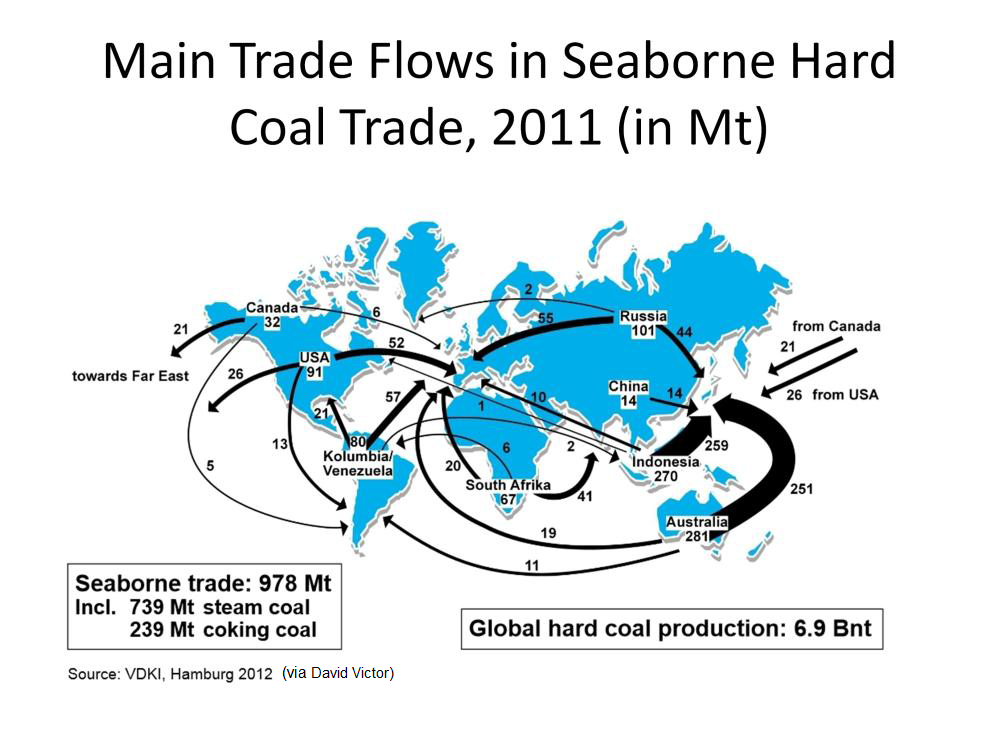
The thick black lines heading to China from Australia and Indonesia stand out in this map, suggesting just how much carbon China emitted in 2011. 

Coal exports to China can be understood as another instance of enabling. As global shipping costs for bulk commodities such as coal dropped significantly, the amount of the commodity traded increased significantly. Obviously, major exporters have a financial incentive to oppose global carbon-emissions limits being written into multilateral treaties. In 2011, Australian companies extracted a lot of coal, a majority of which went to China. Indeed, the sheer magnitude of coal imported into China can tell us a lot about just how much carbon China continued to emit in spite of the government’s forays into alternative energy sources. Even though parts of Australia had been burned by the hole in the ozone layer decades before 2011, the continent’s government and mining companies have had a financial incentive to keep China from shifting to wind and solar energy sources sufficiently even to level-off China’s annual carbon emissions.

Had the Kyoto Protocol included carbon limits for developing countries, complete with “self-enforcing” financial incentives (e.g., an international fund to cover incremental costs of compliance) and disincentives (e.g., other countries in the treaty can boycott trade with non-compliers), in spite of opposition from major coal-exporters, perhaps China would have curtailed the upward trend in the country’s total carbon-emissions even by 2010.  Lest it be thought that the dictatorship in China has far outpaced the world’s largest democracy (i.e., India) as a “global citizen” enabling our species to have a future, keeping global warming to within 2 degrees (C) will require much more from China, and indeed the world.

Monday, October 14, 2013

Wall Street Undercutting the U.S. Government When It Is Down

Irony can sting. During the week or so leading up October 17, 2013—“Armageddon” or “zero hour” for the default of the U.S. Government absent any increase in the debt-ceiling (even though the next big payment would not be due until October 21st)—Wall Street banks were already bailing on short-term treasury bonds even as governments around the world were holding on. Patriotism and corporate citizenship apparently collapse when money due may be delayed. Meanwhile, foreign governments—even big creditors like Japan and China—were taking a long-term view. “There’s no other way than for the U.S. government itself and the U.S. Congress to sort it out,” Japanese Finance Minister Taro Aso optimistically told Bloomberg Television.[1] Apparently Fidelity and JPMorgan Chase did not get the memo. In over-reacting out of an excessive desire to collect as stipulated, big American financial houses were not so subtly undercutting the U.S. Government’s waning credibility. It is ironic that Washington’s best supporters were foreign governments.

 The underlying debt-burden would again surpass 100% GDP in Obama's second term.  Image Source: Wikimedia Commons
Perhaps Wall Street’s bankers do not understand political theatrics whereas foreign government officials do. Maybe the bankers were privy to the real politics going on in Washington and the situation threw a beam of light on the bankers’ greed and selfish insistence that things go their way without exception. Either way, what is good for Wall Street is not necessarily good for America. Put another way, the Wall Street bankers who had been prospering so under the American hypertrophic value on economic freedom (e.g., no amount of wealth is too much) felt no gratitude or sense of obligation against even a chance that interest might be delayed a bit. In return, vast numbers of Americans strangely continued to defend the right of the super-rich bankers to pile on even more to their existing skyscrapers of wealth. If the bankers were merely being themselves in shedding short-term treasury bonds, the puzzling question may pertain not to them but to how a people could be so beguiled.  


[1] Mark Gongloff, “The Rest of The World Still Claims Faith In America (Even If Wall Street Doesn’t),” The Huffington Post, October 14, 2013.

Wednesday, May 30, 2012

India’s Business Environment: Beyond Corruption

In spite of expected growth of 6 or 7 percent for 2012, the economy of India was facing a pessimistic outlook at the time. The underlying cause seems to have been mismanagement by the federal government—in particular, by the ruling Congress Party. In actuality, the problem lies in the Indian business culture, and the society itself. As such, the problem is not so easily fixed as a change of government or policy.


The full essay is in Cases of Unethical Business: A Malignant Mentality of Mendacity, available in print and as an ebook at Amazon.