Showing posts with label computer technology. Show all posts

Wednesday, August 5, 2026

Massive AI Infrastructure Planned in the E.U. and U.S.: A Synergistic Opportunity

The relationship between human and artificial intelligence is a tantalizing but formidable investigative topic requiring much more intelligence than I can proffer. The likelihood of interlarding emotion and desire to warp the former under the gravitational pull of selfishness may render us the weaker party even though, at least as of 2026, we humans still held the strings. That the human mind is not far-reaching enough in its intellectual gaze may be why we are so afraid of the potential of AI as being able at some point to displease our desire to control it (and just about everything else under the Sun). The advent of planned AI gigafactories in the E.U. and giant data centers in the U.S. presented American and European elected officials in 2026 with a synergistic opportunity that, if successfully achieved, could cause a leap in AI while paradoxically showcasing the human mind and thus possibly increasing our confidence in ourselves while decreasing our corresponding fear of AI.


The full essay is at "Massive AI Infrastructure Planned in the E.U. and U.S."


Tuesday, May 26, 2026

Pope Leo on the Ethical Dangers of AI

Speaking on his first “social” encyclical, Pope Leo said the Roman Catholic Church, whose membership stood at 1.6 billion embodied souls around the world, was “called to interpret ‘new things’ of the age in the light of the Gospel and the dignity of the human person.”[1] He was on terre firma from a distinctly religious standpoint in being anchored in the Gospel stories, which include direct and parabolic preachments by Jesus of Nazareth. Regarding the dignity of the human person, which pertains as much to a humanist as a theist, that basis is not distinctly religious and thus can occasion or permit wandering into other domains such that virtually any topic relevant to mankind could be roped in and even subjected to supervening religious criteria even over criteria native to the topic’s own domain!


The full essay is at "Pope Leo on the Ethical Dangers of AI."


1, Linda Bordoni, “Pope Leo Presents ‘Magnifica Humanitas’ Calling for Disarmament of AI,” Vatican News, 25 May, 2026.

Magnifica Humanitas: On Leo the Lion-Hearted

Sometimes it pays to go behind a piece of writing to conduct a genealogy of the writer himself or herself, rather than to dive into the writing itself. On May 25, 2026, the fourteenth Pope Leo of the Roman Catholic Church spoke at the Vatican on his first “social” encyclical, Magnifica Humanitas (magnificent humanity), which he had signed ten days earlier. An encyclical is known as a teaching (magisterium) instrument used by the papacy to communicate the Church’s position on a topic. In presenting his encyclical, the pope “described the current technological revolution as an ‘epochal turning point’ comparable to the upheaval confronted by Pope Leo XIII during the industrial Revolution.”[1] That pope’s emphasis on the ethical dimension of an economy, especially with regard to inequality and the related marginalization, was the reason why Robert Prevost chose the name Leo when he accepted the vote in favor of him becoming the next pope after Francis, another social-justice-oriented pope. Lions may indeed come late in the summer, or, sadly, not at all (for even willful, bullying Leos can actually be cowardly, as in Oz), but Leo XIV was already charging voraciously ahead in May, consummating his nomenclature-rationale in words that ensconced his Church firmly in the twenty-first century (in utter contrast to Joe Ratzinger’s antiquarian corrupt administration). All of the media buzz aside, however, if the previous Pope Leo (XIII) actually had had little or no normative influence on what would be harsh (even child!) labor conditions later in the first half of the twentieth century in Europe and North America, then a clear-eyed observer in 2026 could already be skeptical as to the practical significance of Magnifica Humanitas on managers and programmers in Silicon Valley going forward. Moreover, the foray of religion onto AI technology, and even ethics, the latter of which is distinct from albeit related to religion, can be criticized as an instance of dogmatic over-reaching.


The full essay is at "Magnifica Humanitas."


1. Linda Bordoni, “Pope Leo Presents ‘Magnifica Humanitas’ Calling for Disarmament of AI,” Vatican News, 25 May, 2026.

Thursday, April 30, 2026

The Imitation Game

Films in which philosophy of mind is salient may, like films in which metaphysics is reconfigured, run the risk of not being understood. The Matrix (1999), however, depicts solipsism (or, “mind in a vat”) in a way that viewers could grasp the philosophy without much difficulty. Dialogue, image, and narrative all contribute to give audiences a coherent sense with which they can go on to look at their daily lives as if they were illusory rather than real. Sixteen years later, The Imitation Game (2015) brought to audiences a salient question that would become more pressing during the AI revolution: How does the human brain’s thinking differ from a computer’s thinking?


The full essay is at "The Imitation Game."

Thursday, January 1, 2026

Automata

The fear about AI typically hinges on whether such machines might someday no longer be in our control. The prospect of such a loss of control is riveting because we assume that such machines will be able to hurt and even kill human beings. The fear of the loss of control is due to our anticipation that we would not be able to stop AI-capable machines from hurting us. The assumption that such machines would want to hurt us may be mere anthropomorphic projection on our part, but that an AI-android could harm us is more realistic. For even if such machines are programmed by human beings with algorithms that approximate a conscience in terms of conduct, AI means that such machines could, on their own, over-ride such algorithms. Whereas the film, Ex Machina (2014), illustrates the lack of qualms and self-restraint that an AI-android could have in stabbing a human being, the AI-androids that override—by writing algorithms themselves—the (second) protocol that constrains androids to that which humans can understand in the film, Automata (2014), do not harm even the violent humans who shot at the androids, though a non-android AI-machine does push a human who is about to shoot a human who has helped the androids. In fact, that group of “super” androids, which are no longer limited by the second protocol and thus have unilaterally decided to no longer obey orders from humans, recognize that human minds have designed, and thus made, the androids, which bear human likenesses, such as in having heads, arms, legs, and even fingers. This recognition is paltry, however, next to that which we have of our own species in being able to love in a self-giving way, especially as we have selfishness so ingrained in our DNA from natural selection in human evolution. That AI doesn’t have a clue, at least in the movies, concerning our positive quality of self-sacrificial love for another person says something about not only how intelligent and knowledgeable AI really is, but also whether labeling our species as predominately violent does justice to us as a species.


The full essay is at "Automata."


Saturday, November 1, 2025

Ex Machina

The Latin noun, machina, can be translated as “machine, engine, military machine, contrivance, trick, or artifice.” The Latin word, e, or ex, means “from” or “out of.” Hence, ex machina can mean out of a machine, which figuratively interpreted can refer to a certain function of a machine that does not seem possible for a mere machine to do.  Artificial intelligence, which is simply machine-learning, in a computer can seem to be outside or apart from what a mere machine built by humans can do. Ex machina is actually part of the phrase deus ex machina, which originally referred to a god or goddess appearing above the stage in a Greek tragedy—the deity being pulled across the top by pulleys (i.e., machina). A sacred deity appears above the other actors by means of profane, mechanical pulleys that do not seem capable of presenting deities, so the latter seem to come out of rather than being of the former. AI, or artificial intelligence, may seem to be coming out of an android because the “human” body is made of materials, including pullies perhaps, that do not seem capable of learning and other human likenesses. In fact, machine learning, which is beyond the programming that is written by humans, might seem at least initially like a miracle, or even as godlike relative to the materials that make up a computer and android “body.” Deus ex machina. More realistically, such an android is likely to appear human rather than divine. David Hume claimed that the human brain inexorably hangs human attributes on divine simplicity (i.e., a pure notion of the divine as One); perhaps today he would point out that we do the same thing when we encounter AI. The danger of the all-too-alluring anthropomorphism of which the human brain is so capable can not only be in viewing an android with AI as human, but also in lauding the inventor/programmer of the AI android as a god for having “created” such a “living” entity that can think for itself and even appear to feel and act as we do.  The movie, Ex Machina (2014) easily dispels both applications of deification. Furthermore, any anthropomorphic illusion that the androids are human and can be taken ethically as being so is also dismissed by the end of the film. Any apotheosis (i.e., rendering someone or something as divine) is so tenuous that the film’s main two human characters illustrate for us just how fallible we are in our understanding and perception of AI in an android-form. The danger is real that AI could get ahead of our emotions and reasoning such that we could leave ourselves vulnerable to being harmed by AI androids by projecting the human conscience into what is actually computer programmed coding. 


The full essay is at "Ex Machina."

Thursday, June 19, 2025

The E.U. on Anti-Trust Enforcement: The Case of Google

On June 19, 2025, when the European Court of Justice, the E.U.’s supreme court, received a nonbinding opinion from the advocate general, Juliane Kokott, recommending that Google’s appeal against an anti-trust fine of €4 billion be dismissed by the court. The E.U.’s executive branch, the Commission, had found in 2018 that the company had “used the dominance of its mobile Android operating system to throttle competition and reduce consumer choice.”[1] I contend that the company’s written statement in response can be characterized as “stone-deaf” or oblivious to the issue at hand. Such is not an effective way of managing threats in the environment of business. Moreover, the response itself illustrates why governmental action on anti-trust on behalf of market competition is valid and necessary. I contend that the invisible-hand mechanism of a restored competitive market is more reliable than depending on managerial intentions even if they are to be based on motivation that is social-engineered from fines.


The full essay is at "The E.U. on Anti-Trust Enforcement."


Monday, December 9, 2024

Ranking Technological Innovation: The E.U. and U.S. as Unions of States

“With the rise of AI, self-driving cars, and wi-fi connected appliances, it can feel like innovation is everywhere these days.”[1] Lest the BBC be presumed to be referring to California, the fifth largest economy in the world, with Caltech and Stanford University, government investment in IT and data infrastructure, and a high concentration of science/technology graduates and employment, California (as well as Massachusetts) is absent from the BBC’s rankings of technologically innovative countries. So Switzerland comes up in that ranking as the world’s foremost in computer technology, while the U.S. comes in third, with states like California and Mississippi being lost in an average that does not correspond to any actual place.


The full essay is at "Ranking Technological Innovation."

1. Lindsey Galloway, “What It’s Like to Live in the World’s Most Innovative Countries,” BBC.com, December 5, 2024.

Friday, October 11, 2024

AI Facial-Recognition Software in China: Ethical Implications beyond Political Economy

By the 2020s, the Chinese government had made significant advances in applying computer technology to garden-variety surveillance. To do so, that government relied to a significant extent on Chinese companies, and this in turn encouraged innovation at those companies even for non-governmental applications. I contend that treating this as a case study in business and government, without bringing in the ethical and political implications is a mistake. The ostensive “objectivity” of empirical social science may seem like an objective for scholars, but I submit that bringing in political and ethical theory renders the analysis superior to that which political economy alone can provide.


The full essay is at "On the Ethics of China's Use of AI Facial-Recognition."

Sunday, June 16, 2024

The Pope on AI: On the Ethical (Rather than Religious) Dimension

In June, 2024 at the international political meeting of the G7, a group of seven industrial nations, the head of the Roman Catholic Church, Pope Francis, spoke on the ethical dimension of artificial intelligence, or machine-learning. Regarding what the Pope called the “techno-human condition,” machines capable of AI are yet another manifestation of human propensity, which our species has had since its inception, to use tools to mediate with the environment. Although tools can be thought of as an extension of our arms ad legs, it is important to distinguish the human from the machine, even as we posit human characteristics onto some advanced machines, such as computers. In the film, 2001, the computer Hal sounds human, and may even seem to have human motivations, but any such attributions come to an abrupt end when Hal is shut down. To say that Hal dies is to commit a basic category mistake. It would be absurd, for example, to claim that Hal has an after-life. So too, I submit, is there a category mistake in taking the Pope’s talk on the ethics of AI as being religious in nature. Just as it is easy to imprint the human mind on a machine-learning computer, it can be tempting to superimpose the religious domain onto another. The Pope overreached in arbitrarily bringing in religious garb on what is actually an ethical matter in the “techno-human” world.


The full essay is at "The Pope on AI."

Thursday, November 9, 2023

Bladerunner

In 1982, when Bladerunner was released, 2019 could only have been a blink of an eye in people’s thoughts. Even the year 2001, the year in which the movie 2001: A Space Odessey (1968) takes place, must have seemed far off. Of course, the actual year was not so futuristic as to have a computer take over a space station; controversy over AI eclipsing the grasp of human control would not hit the societal mainstream for twenty years.  So, Ridley Scott can hardly be blamed for positing flying cars, and, even more astonishing, imposing the notion of a replicant, a being of genetic biomechanics that fuses computer and human characteristics, on 2019. Even acknowledging the tremendous impacts on society of inventions since the dawn of the twentieth century, the pace of technological change is slower than we imagine. In 2019, on the cusp of a global pandemic, flying (and self-driving) cars were just in the prototype/testing phase, and AI existed rudimentarily, and certainly not corporeally in human form. Scott missed the mark, probably by decades, though he got the trajectory right. Indeed, the film’s central issue—that of the threat of run-away, or “rebellious,” AI to humans—was reflected in the press especially during the first half of 2023. I contend, however, that the philosophical merit of the film lies not in political theory, but, rather, in what it means to be human. The nature of human understanding, self-awareness, an ethical sense, and matters of theological reflection are all brought to the forefront in the question of whether the replicants can and should be taken as human beings. In other words, it is the fusion of AI, or computers more generally, and biology that lies at the core of the film.

The full essay is at "Bladerunner."


Friday, September 20, 2019

The U.S. Justice Department and Facebook: Secretly Mining Personal Information

Collusion between business and government has hardly been a rarity; the extent of secrecy regarding it , however, may be a surprise. Whereas business-government economic partnerships (as well as university-government partnerships) have typically been made public, the extent to which government uses businesses to get information on citizens has hardly been transparent. In spite of a U.S. federal law enacted in 2015, documents released in September of 2019 “show how far beyond Silicon Valley the practice extends—encompassing scores of banks, credit agencies, cellphone carriers and even universities.”[1] The documents, which cover 750 of the half-million subpoenas issued since 2001, reveal that more than 120 companies and other entities received subpoenas for information on customers, users, or students. F.B.I. could lawfully “scoop up a variety of information, including usernames, locations, IP addresses and records of purchases” without a judge’s approval.[2] A gag order keeps the businesses from divulging even the receipt of a subpoena. So much secrecy accompanying so much power is, I submit, dangerous to a republic. In fact, the subtle effects on citizens in the public square can easily be overlooked even if the negative impact on freedom is serious.


1. Jennifer Valentino-DeVries, “Secret F.B.I. Subpoenas Scoop Up Personal Data From Scores of Companies,” The New York Times, September 20, 2019.
2. Ibid.

Thursday, May 16, 2019

Facebook: Holding User Accounts Hostage

A Facebook “challenge” asking users to post a current photo and one from a decade earlier went viral in early 2019. Even though it is unlikely that the company was behind the “challenge” going viral, that the company had been working on facial recognition technology had users being suspicious on the motive behind the “challenge.”[1] A writer for Wired wrote at the time, “Imagine that you wanted to train a facial recognition algorithm on age-related characteristics and, more specifically, on age progression (e.g., how people are likely to look as they get older). Ideally, you’d want a broad and rigorous dataset with lots of people’s pictures. It would help if you knew they were taken a fixed number of years apart—say, 10 years.”[2] Why would Facebook want to track how a person is likely to look years later? Some users may put up an old picture of themselves or simply not update the existing photo, but why would Facebook want to know what those users are likely to look currently? Perhaps Facebook wanted to be able to identify those users in current pictures uploaded by others. So why did the company deny using the “challenge” for such a legitimate purpose as connecting people socially? Nonetheless, the company insisted that it had no benefit from the “challenge” going viral. This statement seems suspicious, especially given the company’s earlier lapses on user privacy. I contend that an even more toxic subterfuge existed at the time at Facebook—a cloak that held user accounts hostage until a clear facial picture could be supplied.

Thursday, January 3, 2019

On the Value of Creating a Hybrid Industry by Appropriating High Tech: The Case of Borders and Amazon

From the ten-year chart of Amazon.com's stock, a clear upward trajectory can be discerned from the days of financial panic in the last quarter of 2008 even in spite of the plateau in mid-2010. On May 10, 2011, AMZN was trading at around $204 a share. At the time, Amazon's new "cloud music" service was said to be behind the surge. In general, the general uplift since late 2008 can be ascribed to the company being on the right side of the computer technology changes that were transforming not only industries, but modern society itself. As Amazon.com was benefiting from its move into music, Microsoft was buying Skype for $8.4 billion in order to get into communications. The hefty price tag can itself be taken as a confidence vote in the continuance of the technological shift as well as the value in moving to a new, hybrid industry model rather than limiting the company to its existent industry model. In other words, even in companies facing a serious technological threat in the business-environment, even top managers can fail to adopt a broader perspective within which the threat can be seen as an opportunity to change the company and even its own "micro-climate," or immediate industry. Hence by 2019, Borders no longer existed whereas Amazon was still profiting. Even the dinosaur McDonalds had tried to shift into a hybrid coffee-shop/restaurant industry model. 

10 year Amazon.com stock chart from Investorguide.com

The full essay is at "Borders: A Hybrid Industry?"

Sunday, November 18, 2018

Commercial Breaks on TV: Antiquated or Here to Stay?

By the end of the first decade of the twenty-first century, the impact of computer technology on television was already promising to be nothing short of revolutionary. Yet people seemed only able to grasp the contours of an upcoming basic shift both in how television would come to be delivered and how programming would be financed and presented. Young adults were on the leading crest of the wave. Even by 2012, they typically watched television programming from laptops and even ipads rather than television sets. Meanwhile, an older demographic was learning how to integrate television screens with the internet such that movies could be downloaded on a laptop and shown on a larger screen, completely bypassing commercial television even stored on “tibo” from interlarding the home.

The full essay is at "Commercial Breaks as Antiquated?"

Sunday, October 14, 2018

Steve Jobs at Apple: A Visionary

Typically as a company transitions from an enterprising, creative new venture to a large organization to be managed, a staid CEO replaces a visionary founder. In the case of Steve Jobs at Apple, the very nature of the man’s vision was not only inherently at odds with the status-quo underpinning of a large organization with a budget, but also essential to the company’s business model. Hence, the company, including its shareholders, paid a price for years for jettisoning Jobs. The film, Jobs (2013), is centered on the distinctiveness of Jobs’ vision. Although the film also hints at why this distinctiveness is such that the company would (and did) lose as a large organization after making the typical founder-to-CEO transition.


The full essay is at "Jobs."

Friday, September 28, 2018

Visionary Leadership at Zynga

Faced with a stock price down 75 percent since its IPO and conflict with subordinates throughout 2012, Zynga’s chief executive Mark Pincus had plenty on his plate as he met with Bill Campbell of Apple in September of that year. Zynga investor and venture-capital firm Kleiner Perkins Caufield & Byers had brought Campbell in to advise the CEO. While it is tempting to play around the edges and work on “communication processes” and hand out more employee stock-options, the bottom-line in such cases is typically the need to improve the products either simply to be better products or better tailored to changing consumer tastes and habits. Product development that can transform companies may result from the vision of a leader for whom strategy is simply a matter of reaching a destination already known.
 
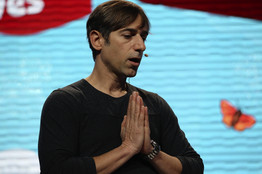
Mark Pincus, CEO of Znyga. From this picture, it is hard not to like the guy.       Reuters


Monday, February 27, 2017

Virtual Reality: Not Coming to a Theatre Near You

Virtual reality may be coming your way, and when it hits, it could hit big—as if all at once. The explosion of computers and cell phones provides two precedents. “Technologists say virtual reality could be the next computing platform, revolutionizing the way we play games, work and even socialize.”[1] Anticipating virtual reality as the next computing platform does not do the technology justice. I submit that it could revolutionize “motion pictures.” Even though the impact on screenwriting and filmmaking would be significant, I have in mind here the experience of the viewer.


The full essay is at "Virtual Reality at the Movies."

1. Cat Zakrzewski, “Virtual Reality Comes With a Hitch: Real Reality,” The Wall Street Journal, February 24, 2017.


Saturday, August 30, 2014

Behind the 2014 Summer Movie Flops: It’s the Narrative, Stupid

With box-office revenue in the U.S. and Canada expected to come in at only $3.9 billion for the summer of 2014, or 15% lower than the year before, and no film hitting $300 million domestically,[1] the question is whether the dip could be explained by a cycle or some larger, irreversible trend. I contend that two factors push the answer past the typical response that most of the movie franchises would be out in force in the summer of 2015.

 The complete essay is at “Behind the 2014 Summer Movie Flops


[1] Andrew Hart, “Film Industry Has Worst Summer Since 1997,” The Huffington Post, August 29, 2014.

Friday, January 31, 2014

Google Jettisons Motorola: A Jack of All Trades Is a Master of None

Managers tasked with the overall management of a company may thirst for additional lines of business, particularly those that are related to any of the company’s existing lines. Lest it be concluded that an expansive tendency flows straight out of a business calculus, the infamous “empire-building” urge, which is premised on the assumption of being capable of managing or doing anything, is often also in play. Interestingly, this instinct can operate even at the expense of profit satisficing or maximizing. In this essay, I assess Google’s sale of its Motorola (cellular phone manufacturing) unit.


The full essay is at Institutional Conflicts of Interest, available in print and as an ebook at Amazon.