Sunday, March 9, 2014

Meteorology vs. Astronomy: Is It Spring Yet?

Advancing clocks an hour ahead to Daylight Savings Time conveniently announces itself as the easy-to-remember Spring Forward. Advancing democracy in the Middle East in the early years of the 2010s proclaimed to the world the Arab Spring. Advancing global warming foretells earlier springs encroaching on softened winters. Even as spring blooms in the sights of the popular press, the media quite stunningly often stumbles over when the season begins. The groundhog is no help, differing from year to year on whether spring begins four or six weeks from February 2nd. Astonishingly—and in no small measure my impetus in writing here out of no less than dumbfounded curiosity—even television meteorologists play to the popular ignorance, willingly succumbing to the common practice of taking astronomical “spring” as meteorological spring too. The “professionals’” declaratory tone alone reveals just how certain human beings can be even of presumed knowledge lacking any real foundation.  Sadly, this mentality of assertion, having become so widespread, or ubiquitous, in modern society, is virtually invisible to us; and yet, the shrill of the epistemological missionary zeal reverberates from no less than modernity’s default: faith in one’s own use of reason. In this essay, I present the first day of spring as a case in point rather than make the entire argument.

Sometime during the first week of March 2014, as yet another front of frigid Arctic air charged southward through North America, various weather personalities on television newscasts relished in the apparently startling fact that spring was just two weeks away. Viewers looking out at snow-covered landskips as far south as Kansas City could marvel at the return of nature’s colors and smells so soon. Most years, the grass is green there by the Ives of March.

Even as the popularly broadcast juxtaposition made for good copy, meteorological spring in the Northern Hemisphere had already come—that is to say, with regard to weather and climate. According to the U.S. National Oceanic and Atmospheric Administration, “(m)eteorologists and climatologists break the seasons down into groupings of three months based on the annual temperature cycle as well as our calendar. . . . Meteorological spring includes March, April, and May; meteorological summer includes June, July, and August; meteorological fall includes September, October, and November; and meteorological winter includes December, January and February.”[1] Therefore, by the first week of March 2014, spring had already arrived as far as the weather is concerned even as television meteorologists were publicly pointing to March 20th as the first day. 

Even calling so much attention to the first day, as if suddenly the northern climes of the contiguous United States would suddenly return their fauna and flora to their other half-lives on that day, is horribly misleading. Assuming that the meteorologists were well aware that spring weather data begins on March 1st of each year in the U.S., the next-most plausible explanation may be found in the lazy assumption that it is easier to go with popular misconceptions than expend the effort to stare one in the face and overcome its stolid inertia head-on (the excuse being not wanting to cause confusion).

As a result, Americans are left with the incredibly incongruent “expert” assertion that summer begins not with Memorial Day, but just a couple of weeks before July 4th on June 21st of each year. Essentially, we are to believe that summer begins in the middle of summer! That such a logical and experiential absurdity can long endure in spite of evidence to the contrary is itself evidence of just how much cognitive dissidence human beings are willing to endure in the face of declarations from perceived expertise. In other words, an erroneous or outdated status-quo societal default has tremendous hold even in the age of (rationalist) Enlightenment (i.e., from the fifteenth-century Renaissance period).

Lest it be said that the enabled popular misconception came spontaneous out of nothing ex nihilo, the basis of the confusion lies in the rather stupid decision to apply the names of the meteorological seasons (i.e., fall, winter, spring, and summer) to the four quadrants of the Earth’s orbit around the sun. Whereas the meteorological seasons are based on the annual temperature cycle applied to the calendar, “astronomical seasons are based on the position of the Earth in relation to the sun.”[2] Due to the tilt of the planet, solar energy is maximized in the Northern and Southern Hemispheres in different parts of the planet’s orbit. To label a certain interval of space as “spring” is not just highly misleading; the label is a category mistake, for the climatic seasons on Earth do not exist in the void of space.[3]

Astronomy is distinct from weather, even though the two are related (i.e., not disparate).
(Image source: NASA)

Put another way, astronomical “spring” in the Northern Hemisphere refers to the portion of the Earth’s orbit from the point at which the vertical rays from the Sun hit the Earth on its equator (on the “Spring” Equinox, usually on March 21st) to point when the vertical rays are on the Tropic of Capricorn (the furthest north the vertical rays go, on the “Summer” Solstice, usually on June 21st). In fact, Summer Solstice is better translated as the highpoint rather than beginning of summer. That is to say, the sun reaches its highest arc in the Northern sky on June 21st, which is neither the pinnacle nor beginning of summer in terms of temperatures.[4]
 
In short, the piercing pronouncements on the public air-waves of the beginning of spring (and then three months later of summer) ring hollow. Nevertheless, the meteorologists who trumpet the good news do so year after year, as if deer caught in a car’s headlights (or speaking to such deer!). Perhaps the fix is as simple as changing the names of the Earth’s orbit’s four parts so they are not likened to climatic seasons. The puzzle would doubtless still present itself as to how it is that nonsensical claims can long endure as a societal (or even global) default, taken for granted in a way that strangely wards off reason’s piercing rays and those of our own experience. Something is oddly off in how human beings are hard-wired.


[1] National Climatic Data Center, “Meteorological Versus Astronomical Summer—What’s the Difference?” National Oceanic and Atmospheric Administration, June 21, 2013 (accessed March 9, 2014).
[2] Ibid., italics added.
[3] As another example of a mislabeling that should have been known to trigger much confusion and even false claims, the three law instructors from Harvard who founded the law school at the University of Chicago at the beginning of the twentieth century should have known better than to replace the name of the bachelors in law, the L.L.B. (i.e., bachelors in the letters of law), with a name implying a doctorate (the J.D., or juris doctor). The actual (professional and academic) doctorate in Law is the J.S.D., the doctorate in juridical science, of which the LL.B., or J.D., along with the LL.M. (masters), is a prerequisite and thus not possibly a doctorate in itself. A doctoral degree must be the terminal degree in a school of knowledge, have comprehensive exams in a discipline of said knowledge (graded by professors rather than an industry regulatory body), and include a significant work of original research (i.e., a book-length study, except in a quantitative or scientific field) that the candidate defends before a committee of faculty. Yet how many Americans correct an American lawyer who declares himself to be a doctor?  The same goes for the M.D. as well (a program of survey-courses followed by a couple years of seminars—the typical substance of a bachelors program), and yet how many physicians and surgeons presume themselves entitled to use the doctoral title (Dr.) even as they dismiss the valid appellations that holders of the Ph.D., J.S.D., D.Sci.M. (Doctorate in the Science of Medicine), D.B.A. (business), D.D. (divinity/theology), and D. Ed. (education) use as per the rights and privileges of these doctoral degrees?  Meanwhile, the general public goes on grazing as if the snow were green grass.
[4] The word solstice in English comes from the Latin word, solstitium, which combines sol (sun) and stit (from sistere, to make stand).  In other words, the sun is made to stand (highest) in the Northern Hemisphere on June 21st of each year. Nothing is thus implied about any beginning; rather, the implication is that of a pinnacle or high point. Yet even in this sense, meteorological summer is different, for its high point in terms of temperature comes in mid to late July. 

Friday, March 7, 2014

Former Fed Chair Greenspan: How to Break the Back of a Bubble

While being interviewed on CNBC on March 7, 2014, Alan Greenspan spoke a bit on the problem of irrational exuberance in a market. Pointing to the failure of the Federal Reserve under his chairmanship to innocuously dissolve the “dot.com” bubble in the 1990s, Greenspan said he had come to the conclusion that asset-appreciation bubbles cannot be “defused” (for reasons he says are in his new book) “unless you break the back of the actual euphoria that generates the bubbles.”[1] Alas, piercing that wave would involve nothing short of unplugging a basic instinct in human nature; both monetary and fiscal policy would doubtless come up short. However, I suspect that the field of rhetoric may have something to say about how we can deflate societal exuberance, but only on the condition that greater clarity will have been achieved in identifying whether a given market is overvalued due to emotional excess (i.e.g, emotive greed having reached a critical mass) circumventing normal risk-aversion.


The full essay is at "Chair Greenspan."


1.Greenspan Revisits ‘Irrational Exuberance,” CNBC, March 7, 2014 (accessed same date).

Sunday, March 2, 2014

Über “Surge-Pricing”: There’s a Mobile App for Price-Gouging!

A week into 2012, The New York Times ran a piece on Ubur (as in Übermench?), a taxi and livery company founded in 2009. As Curtis Lanoue aptly describes in his essay on the company, its novelty consists of a unique mobile app that passengers, drivers and the company’s managers use to bring demand and supply into equilibrium by means of differential pricing including “surge pricing.”[1] The price of a taxi or livery depends on temporal and geographic demand and supply levels. That is to say, the pricing increases as more people request rides. Theoretically, the pricing should go back down even in situations in which the demand is high as drivers are enticed to continue driving a few more hours. Hence, the wait time for an Uber cab after a concert or sporting event should be reduced even if the first people out have to wait until the price goes down or pay more than they expected. In this essay, I suggest that such “stickiness” in even such a small-scale market mechanism as a mobile app can give rise to some formidable ethical problems.

Price-gouging primped up as a mobile app?  (Image Source: thevirge.com)

The full essay is in Cases of Unethical Business: A Malignant Mentality of Mendacity, available in print and as an ebook at Amazon.

Wednesday, February 26, 2014

The Triangle Fire of 1911: A Story of Greed, Control, and Sadism in Business

If the standard business calculations and even greed are not sufficient to account for what occurs in the business world, perhaps we need to dig deeper in order to get to more subterranean motives that are not typically thought to surface amid the business fauna and flora. Did Richard Fuld, the CEO of Lehman Brothers when it collapsed in 2008, tell his subordinates to keep buying real-estate-based properties and securities because he was greedy? Was it greed that relentlessly pushed him to over-reach as repeatedly found Lehman to be wanting in comparison with Goldman Sachs? Rather than cutting into Lehman's over-dissected cadaver to look for pathogens besides greed, I engage here in a "dig" vicariously near Washington Park in New York City, at the site of a horrendous fire in a garment factory that occurred about a century before the implosion at Lehman Brothers. 

On March 25, 1911, 146 garment workers burned in the infamous “Triangle Fire.” The vast majority of the people who died—the youngest being 14 years-old—were women. Onlookers at street-level watched helplessly as 62 workers jumped or fell to the ground—many aflame as they plummeted. Louis Waldman, who would be elected to the New York Assembly, describes the scene as follows:

“Word had spread through the East Side, by some magic of terror, that the plant of the Triangle Waist Company was on fire and that several hundred workers were trapped. Horrified and helpless, the crowds—I among them—looked up at the burning building, saw girl after girl appear at the reddened windows, pause for a terrified moment, and then leap to the pavement below, to land as mangled, bloody pulp. This went on for what seemed a ghastly eternity. Occasionally a girl who had hesitated too long was licked by pursing flames and, screaming with clothing and hair ablaze, plunged like a living torch to the street. Life nets held by the firemen were torn by the impact of the falling bodies. The remainder waited [on the ninth floor] until smoke and fire overcame them. The fire department arrived quickly but . . . [had no ladders]  that could reach beyond the sixth floor.”[1]

The Triangle Fire in 1911. Why did NYC allow the construction of a building whose top floors were beyond the reach of existing fire ladders? (Image Source; wikipedia)

As policemen looked on helplessly, I wonder if any of them remembered beating those same workers a year before when the entire garment labor force in New York City went on strike in order to unionize. Max Blanck and Isaac Harris, the company’s owners, had paid off the police (and hired prostitutes) to attack the striking women. Adding insult to injury, the police would arrest them and tell the judge that the women had attacked them. Tellingly, Blanck and Harris held firm on the union issue even as the owners of the other companies capitulated on that pivotal point.

Blanck and Harris steadfastly believed that ownership of a factory meant that only they had the right of control not only over the terms of labor, but also what goes on inside the factory.[2] Hence, they were able to retain the industry norm of locking side exits so foremen could inspect the worker’s and their bags for stolen materials. Even though this policy doubtlessly came from the two owners, they subsequently claimed that they had not known the side doors were locked on the ninth floor and thus were not culpable as they made their way to the roof and onto another from the tenth floor. Incidentally, the foreman on the ninth floor managed to leave without unlocking any of the alternative exits. The owners evaded a criminal manslaughter conviction by discrediting a credible worker-witness, but they would have to pay $75 per victim, which the insurance settlement more than covered with $60,000 to spare.[3] In short, the owners who had singularly resisted unionization actually made out rather well from having defeated their workers’ demand for a safer workplace.

To be sure, winning on the union point was not necessary for an agreement on safety, as the two owners agreed to reduce workweek hours and increase wages. I submit that greed and the resulting unethical policy and conduct may not suffice in getting to the bottom of this tragedy. Far less obvious than the mangled, bloody pulp on the sidewalk is the owners’ shared mentality. Although a level of industry competition fit for Adam Smith’s The Wealth of Nations motivated Blanck and Harris to incessantly strive to reduce costs, including the labor cost of production, a fixation on being in control certainly of their “stuff” and even other people—almost to the point of viewing the workers at work as part of the “stuff”—may have surpassed even greed as the underlying motivation or even obsession. Certainly the owners were unique in the garment industry then in the extent to which they refused to admit a union during the strike in 1910; unionization represented to them an affront to their total control.[4] In other words, Blanck and Harris may have had “control issues.”

Even so, “being the boss” may not get us far enough down in our archeological dig. In 1913, Blanck was arrested again for locking the door in his factory during working hours.[5] In retrospect, the discredited worker who had testified two years earlier on the Triangle factory fire must have felt some vindication, at least concerning Blanck’s association with the short-sighted policy. The fine of only $20 unlikely had much impact on Blanck in his second venture, the workers of which could have little faith in the gilded justice of the courts and the moneyed laws of the legislatures.

One of the floors on which Triangle sewers worked. (Image Source: YouTube)

For our purposes here, that Blanck “just didn’t get it” even after the horrific tragedy in 1911 points to a sordid mentality beyond even a rather extreme control-fixation coming out of an inner sense of insecurity or emotional instability. The sickness also manifests in Blanck’s (and Harris’s) decision in 1910 to start the violence by paying prostitutes and officers of the law to beat workers on the picket line as though the two owners themselves had been attacked. Can we really say that they were not somehow involved in starting the fire, even if indirectly through a foreman putting a lit match in a scrap bin on the eighth floor? After all, the owners and foremen made it out of the building relatively quickly, and they already knew how to subvert officers of the law (both police and judges) so respect for the law would not have been an obstacle. The prospect of a nice insurance settlement may have also been in the mix, even if the money were secondary to the fuming desire to inflict still more pain on the workers who had presumed even to question the bosses’ (right of) control. I suspect the owners viewed the workers as subhuman in a sense, certainly not worthy of respect as fellow human beings.

In short, a certain sadism may enter into the equation as the desire to see those whom the owners viewed as inferior suffer for having dared resist the total control and insist on a share as a unionized workforce. I suspect the owners viewed themselves as the parents (or adults) and their workers as their children (based on level of income and being immigrants) even though this family picture breaks down even as a metaphor when the workers leave work. As “parents,” Blanck and Harris must have been jolted in 1910 as they finally had to encounter the “daughter” they had always excluded from the family (i.e., labeling her as a “black sheep” and so informing, or forming, the other family members as if supporting actors). The system works for the family’s dominant coalition and its enabling stakeholders (e.g., owners, foremen, suppliers, police, and the courts) by shielding them from their own pathologies. By 1910, the “daughter” had grown up sufficiently in self-confidence to recognize the ruse and insist, even at the risk of starvation (i.e., being estranged from the only family/normal she had known), on a share in the control governing and structuring her relationships with those who by then had become well ensconced in monopolized control. Blanck and Harris (two gay parents?) must have felt humiliated as their conveniently labeled “problem child” began to relate to them as one adult relates to another. A warped perspective maintained over years from the sheer willfulness of an underlying pathology can withstand the onslaught of reality with remarkable stubbornness. Hence, Blanck maintained his “locked door” policy in the wake of a horrific showing of reality.

The force of a warped mind engaged in business can overcome resistance from even greed; turning strikers into resentful victims (and perhaps even burnt corpses) is not exactly good business (i.e., financially as well as ethically). Reducing business to its financial element, treating it as the basis of business, not only enables Blanck’s and Harris’s absolutist notion of private property (the analogue in government being absolute national sovereignty), but also discounts or dismisses outright putrid motives that may reach further down than greed in the recesses of the mind, where hypertrophic (exaggerated) subterranean emotional monsters can evade the light of day by as they slither about in the river Styx.


1. Louis Waldman, Labor Lawyer (New York: E.P. Dutton & Co., 1944), pp. 32–33. If you are a writer or interested in improving your writing, the following sentence from the quote above provides a good example of what not to do. Waldman writes, “Life nets held by the firemen were torn by the impact of the falling bodies.” This sentence is in the passive voice (e.g., It was done by him). The passive can be used to emphasize a noun that would be the direct object in the active voice. Did Waldman really want to emphasize the life nets? “Falling bodies” fits better with the emphasis in the paragraph. Try this out for size: “The falling bodies tore through the life nets being held up by firemen.” Here, I want to emphasize the life nets more than the firemen, so I have used the passive voice in the subordinate clause. There is indeed a place for the voice, but only strategically rather than as a habit (often gained from using the device to evade responsibility rather sheepishly (e.g., “You will be asked to show I.D.” rather than “I/We will ask you for your I.D.”). Little people finding themselves with some power tend to find the allure of passive aggression too tempting to resist. Hence Maggie Smith’s line on Downton Abbey, “We give these little people some power and it goes to their heads like strong drink.” Notice the active rather than passive voice here as the Dowager Countess pushes back against the lower passive aggression. Part of my intent as a writer is to make the subterranean agendas transparent so we all know what is really going on rather than continuing to be beguiled by mere subterfuge primped up like some tropical bird.
2. Interestingly, 21 years later, Adolf Bearle and Gardiner Means would pen The Modern Corporation and Private Property in order to present their thesis that ownership (i.e., the stockholders) had become separated from control (i.e., the management) in the large-scale corporation-form of business enterprise. Blanck and Harris both owned and managed their company, and thus viewed the two as rightfully fused.
3. John M. Hoenig, "The Triangle Fire of 1911", History Magazine, April/May 2005.
4.Triangle Fire,” American Experience, PBS (aired February 25, 2014.
5. Hoenig, “The Triangle”

Sunday, February 23, 2014

On the Tyranny of the Status Quo

Ever wondered why so much energy must be expended to dislodge a long-established institution, law, or cultural norm? Why does the default have so much staying power? Are we as human beings ill-equipped to bring about, not to mention see, even the “no-brainer” changes that are so much (yet apparently not so obviously) in line with our individual and collective self-interest? In this essay, I look at Ukraine, Spain, and Illinois to make some headway on this rather intractable difficulty.

The full essay is at "On the Tyranny of the Status Quo"

Friday, February 21, 2014

Democratic Tyranny: The Case of Ukraine

Is democratic tyranny an oxymoron? If it were, why then did the delegates at the American Constitutional Convention go to such pains to carve up public or governmental power between the states and the federal government, as well as between three “arms,” or “branches,” of the federal government. Moreover, pitting ambition against ambition points to just how dangerous ambition itself can be. When it is legitimated under the auspices of democracy, democrats may have trouble coming up with justifications for removing a democratically-elected tyrant. In this essay, I draw on the case of Ukraine in early 2014 to suggest a few possible rationales.

Would it make a difference if the protesters were hitting other citizens rather than governmental forces? (Image Source: GlobalPost)

On February 19, 2014, violence erupted between the police and the protesters bent on toppling the democratically-elected president. Twenty died on that day, and over seventy on the following day. While it might be tempting to focus on “who started it,” a higher-yielding strategy goes after the means used by the government to end the protests. Such means need not involve violence. For example, after the second day of violence raging in Kiev, the president took part in a fruitful “all-nighter” negotiation session with the protest leaders and E.U. officials. 

To be sure, the president had an incentive to negotiate then, for his backing in the parliament was weakening. Violence rather than compromise had been his preference. Behind the scenes, the government had been paying titushki men to attack protesters whether they were being violent or not. Heather McGill of the Europe and Central Asia Regional Program at Amnesty International points to various reports of armed men carrying bats and other makeshift weapons roaming around Kiev in organized groups and attacking citizens presumed to be protesters.[1] “(W)e have seen interviews with titushki where they admitted they were being paid—there is definitely a body of young, athletic men being paid by the government.”[2] This practice obviously goes well beyond hiring people as counter-protesters, and this distinction is vital in forming an argument founded on human rights that can be used as a basis to re-conceptualize national sovereignty as inherently limited rather than absolute.

Specifically, in sanctioning payments to young athletic men tasked with hurting and even killing citizens who are not being violent at the time of attack, the Ukrainian president violated his governmental obligation to protect the citizenry. This duty goes back to the social contract between kings and subjects wherein the latter agreed to be ruled by the former, who in turn obligated himself to protecting the subjects. This social contract survives in the norm held around the world that a government is obliged to protect its citizenry (including residents). Put another way, a government that violently turns on its own people is typically viewed as having over-reached in a way that violates a major postulate of its monopoly on legitimate force. When people are themselves being violent against each other or their respective property, or are destroying public property, military or police force does not involve such a violation of the conditions of governmental sovereignty because protecting the citizenry includes stopping violence within the citizenry and a government acts legitimately to protect public goods.[3]

Besides being a case of over-kill, paying thugs to wander around Kiev (and other cities) to beat or kill citizens thought to have been in the protests or to be protesting non-violently at the time exceeds and thus violates a government’s legitimate use of force, which in turn comes out of the concept of governmental sovereignty and thus national sovereignty. Such a violation invalidates a government’s claim to the rights the sovereignty. Crucially, this human-rights and sovereignty based argument applies to any government official, regardless of how he or she gained power. Hence, tyranny invalidates even a democratically-elected government. Just as governmental and national sovereignty are subject to limits based on the normative social contract and the human right to life (which itself may be limited by committing violence), democratic government also faces limits at the expense of unlimited license.


[1] Olga Rudenko and Jennifer Collins, “Thugs Said to Roam in Ukraine,” USA TODAY, February 20, 2014.
[2] Ibid.
[3] I am assuming here that the case of citizens paid by the government to inflict harm on other citizens pertains to governmental power rather than violence between citizens. 

Wednesday, February 19, 2014

On the Democratization of Credibility: Global Warming Experts

Even as late as 2013, as if the mounting evidence of global warming and our carbon footprint were some new kind of faith narrative whose white-coated high priests preside over a new political religion distinctly American, some members of Congress, political commentators, and lay apostates recoiled with the declaration, "I don't believe in global warming." Epistemologically, to believe is less rigorous than to know. Actually, what they mean is that they know that our industries and carbon-emitting vehicles are blameless, even pure. It is the sheer declarativeness and the underlying epistemological assumption that I want to make transparent, as being inherently problematic and yet likely "hard-wired" in the very fabric of human brain.

The entire essay is at "On the Democratization of Credibility"


Digital-Journalism Entrepreneurs: Lured by Technology or Fleeing Journalistic Decadence?

How does a business model premised on abundance rather than scarcity look? Will the budding journalistic entrepreneurs end up freely adding to the trove of abundance subtly yet indelibly points to selective scarcity, or will the sea of free abundance dry up once the economic need for a viable revenue stream finally calls in the loan? If only we had infallible crystal balls capable of showing us the future. Rather than staring into the still-foggy abyss, let’s try breaking off pieces of the mammoth digital-media revolution that can be answered.  In this essay, I tackle the question of whether the expansion of online journalism has been primarily chasing the open-ended promise of the burgeoning technology, or pushing away from increasingly decadence in the traditional media. In investigating this question, I do not mean to imply a direct relation to the broader question. Putting GlobalPost under the microscope, I contend that shortcomings increasingly evident in the traditional media have been giving the online revolution a “shot in the arm” in the form of a transfer of talent.  

The full essay is in Cases of Unethical Business: A Malignant Mentality of Mendacity, available in print and as an ebook at Amazon.

Sunday, February 16, 2014

Global Warming: Has China Done Enough?

Whereas the Montreal Protocol in 1985 created a fund to reimburse countries for the incremental costs of banning ozone-depleting chemicals, later international agreements, such as the Kyoto Protocol, oriented to reducing global warming have not given countries, including developing nations such as China, a financial incentive to reduce carbon emissions. In fact, the U.S. Government rejected the Kyoto Protocol because the reductions only applied to developed countries. Even though China reduced its carbon emissions per unit of GNP by half from 1990 to 2010 by investing in alternative energy sources and mandating that polluting companies publicly disclose their respective emissions, the amount of emissions continued to increase dramatically through the period. How do we discern whether the Chinese government has done enough? Furthermore, are other countries enabling China and thus indirectly responsible and thus culpable too?

The steep rise in carbon emissions in China from 2003 demonstrate just how misleading incremental, or marginal, changes can be. Even China's goal of a 20% reduction in emissions by 2020 may not mean much in terms of the total amounts emitted. 

Because CO2 is a “stock” pollutant—meaning that global warming is a function of the total amount of accumulated CO2 in the planet’s atmosphere (regardless of when added)a country’s total emissions figure is key (total accumulated as well as annual amounts). As the following graph shows, China would have to do much more than it had accomplished during the first decade of the twenty-first century.

By 2010, industrialized countries had become large net-importers of products such as steel whose manufacture involves sizable CO2 emissions. 

Developed countries have enabled China’s emissions to the extent that they are “contained” in products exported. The increase for China from 1990 to 2010 (blue and red bars in the bar-graph below) is astonishing. So too is the increase in carbon emissions “embodied” in products imported by developed countries. Interestingly, the E.U. imported more product-emissions than did the U.S. both in 1990 and 2010. The larger manufacturing output of the U.S. may explain much of the difference in the respective nets. Europeans critical of the U.S. for walking away from the Kyoto Protocol may be surprised to learn that their country has been enabling foreign carbon-emissions more.  


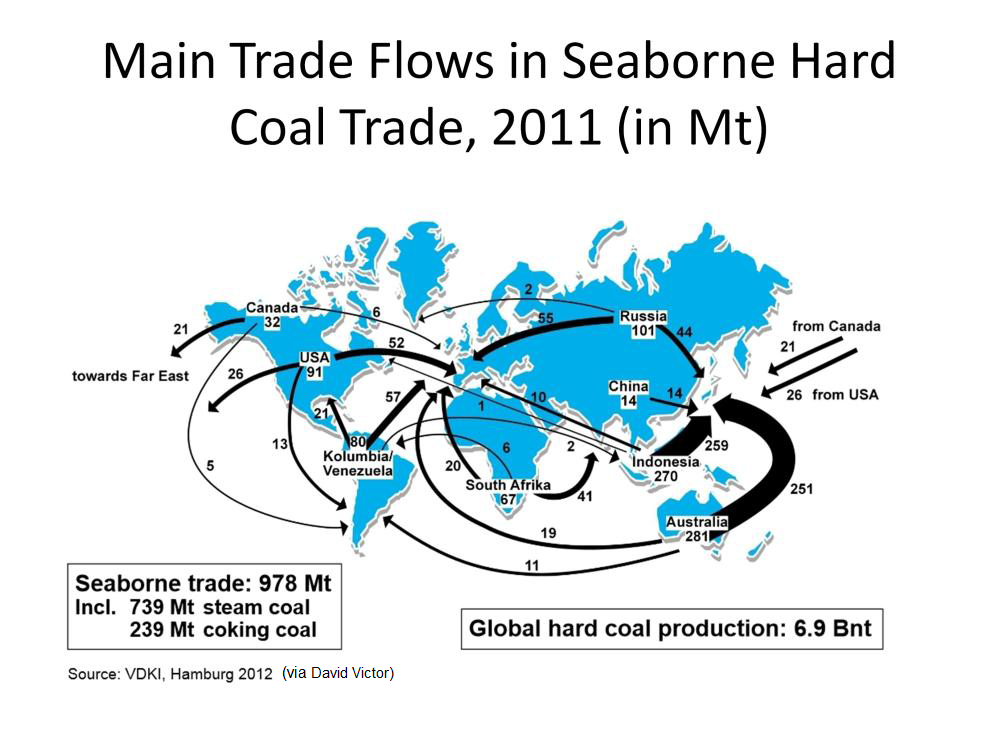
The thick black lines heading to China from Australia and Indonesia stand out in this map, suggesting just how much carbon China emitted in 2011. 

Coal exports to China can be understood as another instance of enabling. As global shipping costs for bulk commodities such as coal dropped significantly, the amount of the commodity traded increased significantly. Obviously, major exporters have a financial incentive to oppose global carbon-emissions limits being written into multilateral treaties. In 2011, Australian companies extracted a lot of coal, a majority of which went to China. Indeed, the sheer magnitude of coal imported into China can tell us a lot about just how much carbon China continued to emit in spite of the government’s forays into alternative energy sources. Even though parts of Australia had been burned by the hole in the ozone layer decades before 2011, the continent’s government and mining companies have had a financial incentive to keep China from shifting to wind and solar energy sources sufficiently even to level-off China’s annual carbon emissions.

Had the Kyoto Protocol included carbon limits for developing countries, complete with “self-enforcing” financial incentives (e.g., an international fund to cover incremental costs of compliance) and disincentives (e.g., other countries in the treaty can boycott trade with non-compliers), in spite of opposition from major coal-exporters, perhaps China would have curtailed the upward trend in the country’s total carbon-emissions even by 2010.  Lest it be thought that the dictatorship in China has far outpaced the world’s largest democracy (i.e., India) as a “global citizen” enabling our species to have a future, keeping global warming to within 2 degrees (C) will require much more from China, and indeed the world.

Wednesday, February 12, 2014

The Swiss Vote to Restrict Immigration: Direct Democracy in Action

On February 9, 2014, the Swiss voted in a non-binding referendum by a narrow margin (50.3%) in favor of immigration quotas and an end to “mass immigration.”[1] This result took the government by surprise; officials had been urging the people to vote no. So too had the Swiss bankers—only coincidentally of course. Just enough voters rebuffed the establishment of power and wealth for the referendum to pass. Johann Schneider-Ammane, the Swiss Economy Minister, suggested that a “culture of excess” in the pursuit of profit sometimes at the expense of the common good had discredited the political and business elite in the eyes of ordinary people.

Monday, February 10, 2014

Congressional Statements on Obamacare: A Crack in Representative Democracy

Even as democracy has many virtues, the political system is not without its own weaknesses. In times of economic crisis, such as Germany in the 1930s, stressors can “fan the flames” such that a few opportunistic people can exploit the vulnerability to the extent that the democracy itself collapses. The “rising phoenix” is often much worse than the original weakness. In this essay, I analyze how a congressional report on “Obamacare,” or the Affordable [health] Care Act, triggered a chain reaction that brought a weakness of representative democracy to the surface. Unfortunately, I do not believe many people thought it very serious (i.e., systemic implications); most Americans probably did not even notice the brief rupture on the skin of the U.S. body politic. For my “microscope slide” of the underlying “virus,” I have carefully selected a slice of the relevant “biomass” in which the pathogen can be most easily seen; it is hardly partisan in nature even though it tends to manifest as such. While you examine my “slide” below, I recommend that you ignore the partisan puss lest you miss the proverbial “fly in the ointment.” Once you have detected the rascal, you might want to ask yourself whether the lapse in representative democracy now rendered transparent is sourced in the people or their respective representatives.

On February 4, 2014, the Congressional Budget Office released a report that mentions in a “oh, by the way” fashion a novel twist in how Obamacare could be expected to impact jobs. Whether out of sheer gamesmanship or ignorance (of whom?), some of the public conclusions from Congressional leaders show more generally the gulf between what the public “is fed” by elected representatives and the actual content they claim is behind their interpretations.

Providing a succinct account of the “twist,” congressional budget analysts said that 2.3 million Americans “who would otherwise rely on a job for health insurance will quit working, reduce their hours or stop looking for employment because of new health benefits available under the Affordable Care Act.[1]

House Budget Committee Chairman Paul Ryan’s first statement on the report, however, concludes that the report proves that the health care law “will push 2.3 million people out of the workforce.”[2] At the time, many of Ryan’s Republican colleagues were making similar claims. I want to isolate the word push here, for it is logically incompatible with the report’s claim that people staying in a job only for the health-insurance benefit will no longer have to continue in the job to receive affordable health-insurance.

Notably, some influential conservatives were cautioning Republican members of Congress to be careful with their own nterpretations, lest constituents and even the public at large (domestic and even global) catch a glimpse of the proverbial “man behind the curtain.[3] Writing in POLITICO magazine on February 4th, National Review editor Rich Lowry notes that “we aren’t talking about jobs that are eliminated in the usual sense of discouraging employers from hiring, as some Republican talking points suggested.”[4] Yet this warning did not stop Rep. Lynn Westmoreland from referencing the CBO report on February 11th as Janet Yellen, the new chair of the Federal Reserve, faced a House committee. Adopting a factual tone, Westmoreland told the Fed chair that the Affordable Care Act "is estimated to cost more than 2.5 million jobs over the next decade." He then asked her whether she thought Obamacare would have an impact on "economic growth and job creation."[5] Lest I belabor the obvious, 2.3 million is less than 2.5 million, and, moreover, the report does not claim the jobs would be lost, as implied by "cost" and "job creation." 

Notice that Rep. Paul Ryan is using "props" (e.g., gray suit, button, flag, and the all-caps title) that add to the visual impression of authoritative fact rather than opinion, ideology, and interpretation. (Image Source: CNN)

Rep. Ryan had at least gone out of his way on February 5th during a hearing on the report to “clarify” his initial statement. “So just to understand this," he said, "it’s not that employers are laying people off, it’s that people aren’t working in the workforce, aren’t supplying labor to the effect of 2 and half million jobs in 2024, and as a result that lower workforce participation rate, that less labor supplied, lowers economic growth?” he asked CBO director Doug Elmendorf.[6] The easy pivot may have saved the Budget Committee chairman his credibility, yet Westmoreland's statement and question demonstrate that disinformation can have considerable staying power, even becoming the default, nonetheless.

I submit that the misinformation had been so glaring that even the general public, otherwise occupied with life, might notice the sheer distance between Ryan’s conclusion and what credible experts were saying of the report. Do we know what is really going on? If not, how can we make good judgments in voting?

In other words, the democratic premise of viable self-governance by a virtuous and educated citizenry may contain an inherent weakness in as much as the electors rely on their respective representatives for information translated for general consumption via interpretation. As the number of electors per representative increases (i.e., larger districts, especially if in an empire-scale republic of republics and citizens), the reliance increases, exponentially I suspect. For one thing, the constituents must rely increasingly on the media to transmit (and shape) their respective representative’s interpretations.

Furthermore, “official” misrepresentations by elected representatives can mask for many voters the value to the individuals who no longer have to work in a (second) job they hate, the companies for whom motivated employees are an asset, and even society itself (happier people). To be sure, a lower labor-force participation rate in a particular job category means higher wages (to attract potential workers), other things equal. Some employers may find that the increased commitment is not worth the more tangible monthly cost.

In fact, Obamacare may not even be the primary culprit behind relatively fewer people seeking employment.  According to The Washington Post, CBO’s analysis points out that “the upward pressure on [the labor participation] rate from improvements in the economy will be more than offset by downward pressure from demographic trends, especially the aging of the baby-boom generation.”[7] By implication, the downward pressure from Obamacare come in second, at best. As part of her congressional testimony on February 11th, Fed chair Yellen did not even mention the Affordable Care Act as a factor in the downward pressure; rather, she pointed to the aging population as the main contributor in the downward trend, with structurally and cyclically unemployed giving up playing a secondary role.[8]  


That the 66% participation rate held from 2004 to 2008 suggests that sustained increases in GDP can counter the huge aging factor as the unemployment rate falls. However, as shown in 2010-2012, both rates can fall concurrently, suggesting an impact from the long-term, or structurally, unemployed losing unemployment compensation and even finding further job-hunting to be futile.

Lest business managers fear a spike in wage rates, the report projects that the unemployment rate will decline only gradually, not dropping to 5.8 percent until 2017 and 5.5 percent in 2024. “Factors such as obsolescent skill-sets and the spread of automation that have fed into the persistently high long-term unemployment are expected to have diminishing effects on the unemployment rate after 2017.[9] We can expect, therefore, that the positions freed up by demographic changes and Obamacare will not go vacant for long; as pointed out above, it is not as though the positions themselves are to be sacrificed on the altar designated by the O-god.

In short, Ryan’s initial statement suggests not just that elected representatives are capable of putting out blatantly false “information” on a policy or new law (this is hardly a revelation), but also that electors may make electoral and public-policy judgments on the false assertions. Especially in a large, empire-scale republic like the U.S., the E.U., or India, the citizenry may have to rely so much on media-shaped sound-bites that the pronouncements are instantly stamped not only with legitimacy, but also as the default. In other words, an interpretation said into a microphone and then broadcast by the media enjoys the presumption of being true even if it is blatantly false. Falsity as truth coming from elected officials is not necessarily checked, since no other quarter in the public discourse has so much authoritative status. Furthermore, the media no longer speaks with one voice, so any “truth correction” may be eclipsed by rhetoric or assumed to be mere partisanship. In terms of representative democracy itself, the representatives may be able to exploit the inherent informational-difference that exists between them and their respective electors.


1. Zachary A. Goldfarb and Amy Goldstein, “Health-care Law Will Prompt over 2 Million to Quit Jobs or Cut Hours, a CBO Report Says,” The Washington Post, February 4, 2014.
2. David Nather, “Both Parties Keep Cherry-picking CBO Report,” Politico, February 8, 2014. See also "ObamaCare Could Lead to Loss of Nearly 2.3 Million Jobs, Report Says," Fox News, February 4, 2014.
3. This reference is to the Wizard working the controls behind a curtain in the film, The Wizard of Oz.
4. Zachary A. Goldfarb and Amy Goldstein, “Health-care Law Will Prompt over 2 Million to Quit Jobs or Cut Hours, a CBO Report Says,” The Washington Post, February 4, 2014.
5. "Economy & Monetary Policy," U.S. House Financial Services Committee, February 11, 2014.
6. Zachary A. Goldfarb and Amy Goldstein, “Health-care Law Will Prompt over 2 Million to Quit Jobs or Cut Hours, a CBO Report Says,” The Washington Post, February 4, 2014.
7. Ibid.
8."Economy & Monetary Policy," U.S. House Financial Services Committee, February 11, 2014.
9..Zachary A. Goldfarb and Amy Goldstein, “Health-care Law Will Prompt over 2 Million to Quit Jobs or Cut Hours, a CBO Report Says,” The Washington Post, February 4, 2014.

Thursday, February 6, 2014

The 2014 Winter Olympics in Russia: “Where There’s Smoke, There’s Fire”

In the weeks leading us to watch the Olympics, I suspect I was not alone in thinking, “I just don't like what I see here." Why was I resisting paying even scant attention to the pre-Olympics "coverage" (a.k.a. advertising) as NBC, the American broadcast network covering the games, was getting rather publicly revved up on the upcoming media event. In this essay, I briefly survey the external stimuli, leaving the self-analysis to the analyst’s couch.[1]

First, as the American press reported before NBC began promoting the games in earnest (hmm), there is the “whole gay thing” and Putin. I really think that's a non-issue with regard to the Olympics, given the uniqueness of the Olympic Village. I would not be surprised were the Russian police of the mind that “What goes on in Vegas stays in Vegas,” at least as far as vacations are concerned.

Now, the "not fit for primetime viewing" conditions of some of the hotels putting up the foreign press strikes me as more substantive because of the implicit and likely even explicit rudeness does not go down well, even at a distance. Relatedly, I suspect, the sheer amount of money "padded" into the construction projects, including hotel construction, for kick-backs undoubtedly directed to Putin's major political supporters eviscerates any possible excuse in the tardiness.

In fact, associating Putin at all with the Olympics comes off to me like associating liver with dinner; I instinctively spit out immediately any hint of liver-taste. I must admit I am glad the U.S. State Department put out a travel warning for Americans going to the games. I was also amused to read of the low numbers of non-Russians arriving from abroad in Sochi as of the first day of games.[2] Of course, the modern Olympics hinges on the broadcasts around the world, rather than attendance numbers.

 Even though NBC's studio in the Olympic Village is transparent, the network's tactics may be anything but. (Image Source: David Johnson)

Interestingly, as part of its rather obvious devices to remind/manipulate its general viewership to watch the approaching games (including inserting reporters live from Sochi into CNBC's coverage of the financial markets), NBC strategists may actually have been fomenting the security story in order to draw viewers' attention to the fact that the games would soon begin. Stirring up fear and the hope of visual voyeurism of others’ tragedies is a sure bet for news reporting as advertising.  However, overdoing it can be counterproductive if too much of the ploy is visible on the surface as a duplicitous, otherwise stealth agenda. Yearning to turn the subtropical town on the Black Sea into an international resort, Putin could not have been very happy about the coverage, though may have realized the importance of a huge broadcast viewership even for himself, not to mention covering some of the kick-backs.
   
Finally, starting particular events including skating the day before the OPENING ceremony may stand out among the various points of smoke above in being indicative of fire skipping fire lines below. Even though Chris Chase of USA Today concludes “it’s a small price to pay for the overall improvement of the Winter Games,” he admits “it still feels strange to start the Olympics before the Olympics technically start.”[3] In the film, Inglourious Basterds, Lt. Aldo Raine wryly clarifies the matter of something seeming odd (or strange).  “Yeah, we got a word for that in English. It’s called suspicious.” 


In spite of his conclusion (i.e., small price to pay), Chase provides a credible case for suspicion. “Television rules all." he states up front as if it were a natural law. "Adding another day of Olympic competition means adding another day of Olympic telecasts. Thursday is traditionally one of the biggest television nights (along with Sunday). With all the money being paid to cover the games by networks across the world, turning 17 days of Olympic coverage into 18 days is a nice bonus.”[4] Regarding the addition of a program of skating, Chase points to a five day interim within the two weeks without any skating scheduled.

In closing, I must let the philosopher in me have a few words (no philosopher ever has just a few words, so please take a bathroom break if you need to). From sheer logic, to begin something before it has begun is a blatant contradiction. As per his categorical imperative, Kant would call the practice unethical. Were everyone to adopt the maxim, “I will start activities before the start time,” it would not make sense to have a start time for anything. The maxim is thus self-contradictory if it (like reason itself) is universalized.

Hume would point out that Kant relies too much on logic and reason more generally in assessing whether a given practice is ethical. A person reading U.N.’s condemnation of the Vatican in February 2014  for having been more concerned about the reputation of the Church as a whole than children’s welfare—a priority that Rev. Joe Ratzinger, or Benedict XVI, put in a letter while archbishop of Munich—may think through the theological implications of priests covering for each other. However, the sentiment of disapprobation (think of my expression as I spit out odious liver) is likely, excepting sociopaths, to be the principal reaction. Emotive rather than of Reason.

When I read of the sports beginning a day before the opening ceremony, I felt a sentiment of disapprobation well up inside me. Because I had been feeling that something just isn’t right about the upcoming games, especially from an vague intuitive sense of NBC’s manipulative tactics as over-reaching at best, I suspected that the rather odd placement of some events before the ceremony also came from the mentality that wants incessantly to squeeze out a few more drops of lemon juice from lemon that has already shed enough.  The sight of this childish demeanor in action is enough for any non-manipulative person to resist going where the manipulations point.


[1] I have in mind here Nietzsche’s thesis that reasoning is really a person’s instinctual urges tussling for dominance—that which overcomes the others (here as obstacles) reaches the surface of consciousness as an idea. I do think about this point regarding philosophy (and particular philosophical systems) in general and how my own psychological background fuels or is otherwise expressed in the ideas and related theories I “intuit” and “create.”
[2] Associated Press, “Sochi Olympics Still Waiting for Spectators from Abroad,” The Huffington Post, February 6, 2014.
[3] Chris Chase, “Why Do the Winter Olympics Start before the Opening Ceremony?” USA Today, February 6, 2014.
[4] Ibid.

Wednesday, February 5, 2014

From Ground Zero to 1776 Feet

The glass exterior gives the Freedom Tower a look of unity, such as that which occurred on September 11, 2001. (Image Source: USA Today)

Aspiring to hope again, against the pull of the annualized calls to remember, yet again, a tragedy whose villain had met his fitting end, America could dare to inhale a fresh sense of pride instead of the stale bad air of vulnerability and death that stubbornly would not die under the cover of mourning. New Yorkers with an even longer memory could feel a sense of payback on behalf of their proud city, which had lost the World's Fair to Chicago in 1893. New York's press had dubbed the metropolis of the Midwest "the windy city" for all the bragging there for having been selected over Wall Street's locale. In 2013, New York's bewindowed Temple of Independence beat out the Sears, or "Willis," Tower in Chitown (pronounced shy-town, not shit-own, or, even worse, own-shit) as the tallest building in the Western hemisphere on account of a spire. 

Lest it be said that the sky is the limit for the perpetual Union of shimmering unity, the laws of nature do not allow a Rome or a Washington to rise forever. as if social organization were somehow not mortal. As between us and God, our cultural artifices are unfortunately on our side of the ledger. They are also in continuity with Nature, into whose embrace we mere mortals cannot evade. So what does Nature have in store for the American experiment of a general republic within whose borders semi-sovereign republics reside as though tamed members? Will the U.S. collapse from its own weight, or become increasingly susceptible to enemies foreign and even domestic? 

Our lot is not to know what lies beyond the horizon reflected in the unscratched glass of freedom's tower. We can, however, marvel at the sheer tenacity of a people whose hope, whose light, will not go quietly under the ashes at Pearl Harbor and Ground Zero. For from the extraordinary hardships of brave colonists in the wilderness, on the periphery of the known world, came bubbling to the surface the idea of self-governance, whose practicability and unity require the self-discipline of virtue and civic knowledge,  in 1776.


Sunday, February 2, 2014

Target Intimidating Customers by Impersonating Police: Nietzsche on Weakness Seeking to Dominate

In the PBS series Downton Abbey, the Victorian countess, magnificently played by Maggie Smith, delivers a reverberating line as fit for my hometown in the second decade of the twenty-first century as for a village in Britain a century earlier. Referring to the local physician, who had just been raised to the position of military manager of convalescent centers during World War I, the countess remarks in frustration after a rejected request, “We give these little people power and it goes to their heads like strong drink.” This poignant quote fits like a glove in the case of the typical store manager and assistant managers, especially in my decaying hometown in the U.S. a century after World War I. In this essay, I apply Nietzsche's philosophy to a rather distinct pattern that I discovered there decades after I had left for college.


The full essay has been incorporated into (or swallowed up by) On the Arrogance of False Entitlement: A Nietzschean Critique of Business Ethics and Management, available in print and as an ebook at Amazon.