A closeted gay student at an evangelical seminary is a contrast with a rather obvious clashing point, with the predicted ending being that the student is kicked out and must find or come into his own identity free of exterior constraints. Yet The Seminarian (2010) smartly avoids that road well-traveled. Instead, the screenwriter risks giving theology a prominent, and perhaps even central place in the film. The venture is at odds with the bottom-feeder mentality of Hollywood represented in the film, De-Lovely (2004), in which Cole Porter’s bisexuality occupies center-stage. Comparing these two films, irony drips off the screen as De-Lovely, which is patterned after a theatrical musical, looks down on Hollywood and yet has a common theme, while The Seminarian is a film through and through and yet takes the high road by supposing that the viewers can and will stay through some substantive theology, which transcends social issues and even the dramatic.
Sunday, September 30, 2018
Friday, September 28, 2018
Visionary Leadership at Zynga
Faced with a stock price down 75 percent since its IPO and
conflict with subordinates throughout 2012, Zynga’s chief executive Mark Pincus
had plenty on his plate as he met with Bill Campbell of Apple in September of
that year. Zynga investor and venture-capital firm Kleiner Perkins Caufield
& Byers had brought Campbell in to advise the CEO. While it is tempting to
play around the edges and work on “communication processes” and hand out more
employee stock-options, the bottom-line in such cases is typically the need to
improve the products either simply to be better products or better tailored to
changing consumer tastes and habits. Product development that can transform
companies may result from the vision of a leader for whom strategy is simply a
matter of reaching a destination already known.
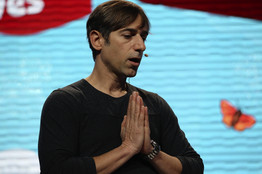
Mark Pincus, CEO of Znyga. From this picture, it is hard not to like the guy. Reuters
The full essay is at "Visionary Leadership: The Case of Zynga."
CEOs in 2012: Avoid the “Fiscal Cliff”!
Reporting in November 2012 in anticipation of the
across-the-board budget cuts and end of the Bush tax cuts, together expected to
amount to around $500 million for 2013 alone, the Wall Street
Journal observed that some large American corporations were “making
plans to slow investments, lay off workers and pay less-generous dividends if
Congress and the Obama administration don’t find a way to avert the so-called
fiscal cliff.” Such plans could represent a self-fulfilling prophesy wherein a
hit of just over a half trillion dollars in an economy of over $16 trillion is
nonetheless depicted by the media as a cliff. In actuality, it
could be more like taking a step down the stairs rather than falling off a cliff.
Even if the federal budget cuts and end of the Bush tax breaks in
2013 would not in themselves drive the U.S. economy off the cliff into an
economic abyss, the assumption of economic Armageddon could
build-up downward momentum to something even far worse than a return to
recession. The culprits are those in business, government and the media who
were engaging in a series of steadily loud exaggerations. It could justifiably
be asked, what’s the difference?
J.P. Morgan led banks in bailing out Wall Street in 1907. Source: Upsidetrader.com
The full essay is at "CEOs Warn the U.S. Government: No Fiscal Cliff!"
Off-Shore Drilling off Virginia’s Coast: The Stakeholder Framework Applied
By the early 1990’s, the U.S. had banned drilling off the
Atlantic coast. In the wake of BP’s deep-water-drilling disaster in the Gulf of
Mexico in 2010, President Obama cancelled his go-ahead of drilling leases off
Virginia’s shore. A few years later, Doug Domenech, the Secretary of Natural
Resources in Virginia, and that republic’s head of state, Bob McDonnell, teamed
up with Virginia’s two delegates in the U.S. Senate to “put Virginia’s coast on
the energy map through an act of Congress.” Domenech said, “I personally
believe that the East Coast of the U.S. does have the ability to be the
prolific economic basin.” The Bureau of Ocean Energy Management estimated based
on two-dimensional seismic surveys that 3.3 billion barrels of recoverable oil
exist under the Atlantic’s outer continental shelf and 31.1 trillion cubic
feet, or 886.3 million cubic meters, of natural gas. However, the executive arm
of the U.S. Government alone is more than that bureau. Moreover, lest this
conflict over drilling be viewed as primarily between Virginia and the U.S.
Government, it should be noted that the East Coast is not exclusive to Virginia.
Respecting the integrity (i.e., valid claims) of both frameworks requires integrity, or self-discipline. Worden
The full essay is at "Drilling Off-Shore: Strategic and Societal Leadership Applied."
Constructing a Constitution: Egypt in the Arab Spring
Concerning a new constitution, which is more important: the
process or the content? In Egypt in 2012, that most secularists and the Coptic
Christian representatives walked out of the assembly working on a constitutional document
suggests that the final product would not have legitimacy for all of Egypt. To be sure, it is possible
for a partisan group to design a system of basic law that is not overtly
self-serving at others’ expense. The document that emerged from the assembly
weakens the presidency and strengthens the parliament. This shift was in line with the popular
protest in “the Arab Spring.” However, the assembly left in place a
“longstanding article” grounding Egyptian law in the principles of one
religion. Furthermore, a provision on women’s equality was left out, and the
military generals would keep their existing power. Moreover, anticipating
dissolution from Mubarak-appointed judges, the assembly began its work from the
last Egyptian constitution.
Do the members of the constitutional assembly look liberal or conservative? Reuters
The full essay is at "How to Make a Constitution."
Sunday, September 23, 2018
De-Lovely: A Film Depicting the Sea-Change from Broadway to Hollywood
Cole Porter (1891-1964), an American composer and songwriter, is the centerpiece of the film, De-Lovely (2004). The film begins when he meets Linda, who would become his wife. Their relationship is at the center of the story, as well as Porter’s love songs sung throughout the film. Although the complicated nature of the relationship takes center stage, the film can be viewed as a moving snapshot of the first half of the twentieth century, when film made inroads that would dwarf the stage.
Saturday, September 22, 2018
A Deal with China: Did the Vatican Lose Its Soul?
In September, 2018, the Vatican and the Chinese government
reached “a provisional deal” that would end “a decades-old power struggle over
the right to appoint bishops in China.”[1]
In regard to the power struggle itself, the deal “would mark a major victory
for China.”[2]
In regard to spreading Catholicism globally, the Vatican stood to gain both in
terms of souls and money. Protestantism had been spreading fast in China,
whereas the number of Catholics at the time was 10 to 12 million.[3]
The question is therefore whether the Vatican ceded too much for the promise of
access to the world’s most populous nation.
The full essay is at "The Vatican and China Reach a Deal on the Appointment of Bishops."
1. Jason Horowitz and Ian Johnson, “China
and Vatican Reach Deal on Appointment of Bishops,” The New York Times, September 22, 2018.
2. Ibid.
3. Ibid.
Expansion at Volkswagen: Minimizing Risk in E.U.?
It is perhaps common among gigantic corporations, such as
the major automobile manufacturers, to assume that current profitability is
likely to be augmented by expansion. Economies of scale are presumed to outpace
diseconomies as even a large company expands. At a more basic level, it is
generally assumed that if a company is not expanding, it is necessarily facing
its downfall. The notions of equilibrium and
steady state are fundamentally at
odds with the more, more, more mantra
of mammon. Accordingly, it can be asked whether efforts to strengthen a
company’s equilibrium are more in line with long-term
profitability. The very expression, strengthening
an equilibrium is étranger or
foreign to business parlance.
The full essay is at "Volkswagen in 2012: Minimizing Risk in the E.U."
John Kerry: An American Politician
Just after President Barak Obama announced that he would
nominate Sen. John Kerry of Massachusetts to be the U.S. Secretary of State,
the E.U. Secretary of State (Minister of Foreign Affairs), Catherine Ashton,
welcomed the prospect of working with Kerry. Whether she knew it at the time or not, she would be working with an American politician. After all, Kerry had already run for the American presidency. To be sure, he was not taking up the foreign affairs post to build his resume. I believe he genuinely wanted the job. The problem is, is trying to please all the people all the time, a politician's patina (or deeper?), best in foreign affairs? In this essay, I focus not on this question, but, rather, on the patina itself in the case of John Kerry so the underlying problem behind the question of fit with foreign affairs can be more transparent to the wider public.
Friday, September 21, 2018
Preparing for the U.S. Presidency: Build a Resume
How should an aspiring candidate for President of the United
States go about attaining that esteemed office?—an office whose occupant was
regularly referred to as “the leader of the free world” when part of that world
was behind an iron curtain. Mitt Romney spent six years of his life campaigning
for the job only to lose it to an incumbent whose record on “pocket-book
issues: was mixed at best. Perhaps it is possible to want something too much.
Fortunately, a more substantive alternative
is also possible.
The full essay is at "How to Prepare to be President of the United States: Build a Resume."
Hillary Clinton as U.S. Secretary of State.
The full essay is at "How to Prepare to be President of the United States: Build a Resume."
Luring Business: “Job Creators” in Texas
As of December 2012, Texas was giving out more financial
incentives—mainly in the form of tax breaks and subsidies—to business than was
any other American state. The government was handing out around $19 billion annually,
while at least $80 million was being spent in the U.S. overall, according to
the New York Times. Although at the time Texas had half of all the
private-sector jobs created in the U.S. during the preceding decade, the Times
points to “a more complicated reality behind the flood of incentives.” It
cannot simply be assumed that good jobs will be created.
The full essay is at "Luring Business to Texas."
China or USA: Which Will Rule Trade?
The Association of Southeast Asian Nations (ASEAN) announced
at its meeting in November 2012 that it would host negotiations among its
members on “a sweeping trade pact that,” according to the New York Times,
“would include China.” The trade agreement would include not only the ten
countries that are in the association, but also six other countries that have
free-trade agreements with the association. In addition to China, those
countries include Australia, India, Japan, New Zealand and South Korea. Half of
the world’s population would be included in the pact. Notably absent is the
United States. This is no accident, as the Obama administration’s own proposal
for an eleven-nation Trans-Pacific Partnership excludes China. In other words,
the contending proposals may be more about a “control battle” between two
contending empires—the United States and China—than anything else. Moreover,
which proposal succeeds could say something about whether China succeeds the
United States as the hegemonic super-power of the twenty-first century.
The full essay is at "Global Trade Dominance: China or The USA?"
The ECB as the E.U.'s Bank Supervisor: States in the Driver's Seat
Although the establishment of a federal regulator of major
banks in the E.U. was as yet not approved by the European Parliament or ratified
by the governments of states using the euro as well as any other states opting
in, the European Council of Ministers signed off in December 2012 on an
amendment that would give the European Central Bank authority over banks that
have at least €30 billion in assets, make up more than 20% of their state’s
economic output, or operate in at least two states (i.e., interstate banking).
At the very least, three banks per state would come under the central bank’s
oversight. Other banks would remain the responsibility of state regulators. This
is an interesting “working out” of federalism, distinctively European-style.
German Finance Minister Wolfgang Schäuble at the E.U. Council of Ministers discussing the bank supervisor amendment. WSJ
The full essay is at "The European Central Bank."
Exaggeration on the U.S. Economy “Going Over the Cliff” after the Financial Crisis of 2008
As the U.S. Government faced down its own deadline in 2012 before
the Bush tax cuts would expire and across-the-board budget cuts would commence,
the Federal Reserve, which had been struggling to prop up the economy by buying
bonds and keeping interest rates low, would, according to the Chairman, Ben
Bernanke, be largely powerless to do more in the face of a recessionary policy
on taxes and spending. "We cannot offset the full impact of the fiscal
cliff," he said of the Fed. "It's just too big." That he had
written a doctoral dissertation on the Great Depression and had specialized on
it as a professor at Princeton lends a lot of weight to his judgment on the
matter. However, he had also managed to be re-appointed to the Fed and thus
knew how to play the game. In the case of the automatic budget cuts, major
power-brokers, specifically in the military industrial complex, had a lot
riding on Congress and the White House making a deal that would obviate the
cuts in defense spending. The chairman of the Fed could have been carrying
their water.
Ben Bernanke, Chairman of the Federal Reserve, in front of the lights. Reuters
The full essay is at "The U.S. Economy Going over the Fiscal Cliff."
Honeywell’s David Cote: Carrying the Water in Washington
In the midst of the talks in Washington in 2012 to avoid the so-called fiscal “cliff” with a bipartisan deal, the Wall Street Journal reported that David Cote, the CEO of Honeywell, a $48 billion “industrial giant,” was at the time “the business executive most in the middle of the fiscal-cliff debate.” The Senate Finance Committee Chairman Max Baucus (D., Mont.) said, "People on both sides of the aisle are sending messages through Dave. He's become an active participant.” For a sitting CEO to have ensconced himself so deeply among the power-players in Washington did not come controversy-free. Even though his company had a vested interest that a deal be reached, the matter of his involvement raises larger implications, positive as well as negative.
The full essay is at "Honeywell's CEO in Washington."
Subscribe to:
Posts (Atom)