Friday, November 1, 2013

A Diet Dug Out of Anthropology

The Big Bang took place 13.7 billion years ago. Earth formed about 4.54 billion years ago out of “stardust.” So our planet is not nearly as old as our universe (which consists of clusters of galaxies). It was not until 1.8 million years ago that our species, homo sapiens, took shape, formed by the forces of natural selection. We are relative newcomers to our planet’s existence, yet much of what we encounter, make, or use in the modern world has existed as only a mere flicker in our species’s 1.8 million year life as a species.  
For example, it was not until about 70,000 years ago that our ancestors’ brains developed to the extent that a fictive imagination was possible. That is, the homo sapiens brain was no longer dependent on the senses (e.g., touch, sight, smell) and thus empirical observation of one’s environment (e.g., appearances). The brain could imagine a unicorn, justice as an ideal (even as a Platonic form!), and a utopian vision having little if anything to do with how the world is at the time.  
It was not until 9,500 BCE that homo sapiens settled into permanent settlements to farm. Only a relatively few types of plants were grown and animals were domesticated as a result of the agricultural revolution. For example, wheat originally grew only in a small area in the Middle East; by the end of the twentieth century, the crop’s area had reached 200 million hectares.[1] From roughly 6,000 BCE, wheat has been a basic staple food of Europe, West Asia, and North Africa.
It was not until the eighteenth century that the scientific revolution found some traction. At that time, the gravitational pull of the past, through tradition and custom, began to lose out to an orientation to the future, and thus to discovery and innovation. This was a major shift in the history of our species. As a result, the modern world as it exists would look like another world to a person living in the sixteenth century, whereas the same person would find the life of people living in the eleventh century to be familiar.
As a result of the agricultural and scientific revolutions, we moderns have a myriad of processed foods (e.g., hormones, preservatives). Paradoxically, even though agriculture has essentially mass-produced only a relative few of the foods that our ancestors ate from one day to another in the eons of time in the Stone Age, the advent of long-distance transportation has extended the reach of otherwise geographically limited foods (e.g., pineapples) as well as the agricultural staples (e.g., wheat). This all sounds well and good, but a subtle problem festers that can only be discovered by taking a very long historical perspective grounded in anthropology—the study of the homo sapiens species.
I have been applying my own study of what almost two million years of natural selection has etched in our biology to this day to dieting. The forces of natural selection have not had nearly enough time to tweak our bodies (including our brains) to the modern world in which we live. For example, we eat much more in complex carbohydrates (e.g., wheat, so breads, pasta, etc.) than our stomachs are designed to digest. In other words, it is difficult for our species to digest wheat because that food was not factored into the equation by the forces of natural selection in adapting the stomach of a homo sapiens over almost two million years. How long out of the 1.8 million years has wheat been a staple food for us? Almost a blink of an eye.
Additionally, sugar is difficult for our livers to process because that organ was formed when sugar was only consumed when fruits were in season. Accordingly, besides being overworked, the human liver produces cholesterol particles in the process. Coca-Cola is like a frontal assault on the liver, with the heart being hit as collateral damage through a lifetime. It is no wonder that heart disease is the leading killer of modern man.
Combining these snippets of anthropological food science with the fact that few of us get anywhere near the amount of exercise of the prehistoric hunter-gatherers, we cannot count on the burning of calories nearly as much. By the way, the hunting made our ancestors more muscular and fit (and without the pathogens that have plagued our species ever since we created large societies and domesticated animals).  Even with regular visits to a fitness center, we moderns really must attend to the intake side of the energy budget wherein a surplus of retained calories is bad. To reduce current and accumulated surpluses, we can apply a bit of anthropology with beneficial results.
Because complex carbs can turn into fat while a person sleeps and most exercise typically occurs during the day rather than at night (except, perhaps, in the bedroom), I have shifted my intake of “heavy foods” like bread, pasta, meat, and potatoes to breakfast and lunch. In this mix I have drastically reduced my intake of wheat foods (even whole wheat bread!) because I know my stomach is not well-suited to digesting them. Because fruits and vegetables are of relatively few calories and natural selection has taken them into account in adapting the human stomach, I emphasize them for dinner. I make sure the proportion of fruits and vegetables is than that of wheat foods.
In short, both timing and proportions are in the mix along with food servings when anthropology—taking the millions of years of natural selection as the default—is itself added into the equation in formulating a diet to lose weight. As Plato wrote, much of being virtuous is changing habits. I would add self-discipline in countering the lure of instant gratification as a vital ingredient. In terms of dieting, a changed habit that a person sustains can actually result is a smaller, shrunken stomach. This physiological change can in turn take away some of the pain in applying the self-discipline. Although I do not read published diets, I suspect that this anthropological approach is quite novel.


[1] 2 million square kilometers or 77,204 square miles.

Wednesday, October 30, 2013

McDonald’s Strategic Use of Its Charity: Clowning around with Ethics?

Corporations have undoubtedly oriented their philanthropy to take advantage of the potential synergy with marketing their products and services. This “revelation” should not surprise anyone in modernity. Even so, overdoing any convergence to maximize profits is certainly open to ethical critique, even if leaning excessively on strategic interest at the expense of reputational capital is perfectly legal. This point ought to impress itself on the frontal lobe of any dean who hires lawyers to teach business ethics. In this essay, I focus on McDonald’s funding of its own charitable organization, McDonald House Charities. Has the corporation’s financial contribution been sufficient, ethically speaking, to justify the resulting reputational capital, marketing synergies, and long-term profitability?


The full essay is in The full essay is in Cases of Unethical Business: A Malignant Mentality of Mendacity, available in print and as an ebook at Amazon.com.

Monday, October 28, 2013

JPMorgan: Fault and Criminal Fraud under the Settlements' Radar?


Resolving just a part of the $13 billion being demanded by the U.S. Government in court, JPMorgan capitulated in October of 2013 to a $5.1 billion settlement to resolve claims by the U.S. Federal Housing Finance Agency that the largest American bank had sold Fannie Mae and Freddie Mac mortgages and mortgage-based (i.e., derivative) securities by knowingly misrepresenting the quality of the loans and the loan-based bonds.[1]  At the time of the $5.1 billion settlement, JPMorgan’s executives were trying to settle “state and federal probes into whether the company misrepresented the quality of mortgage bonds packaged and sold at the height of the U.S. housing boom.”[2] It would seem that the bank was in a vulnerable position in the settlement negotiations, having “capitulated.” I’m not so sure.

The full essay is at "Essays on the Financial Crisis."


[1] Clea Benson and Dawn Kopecki, “JPMorgan to Pay $5.1 Billion to Settle Mortgage Claims,” Bloomberg, October 25, 2013.


[2] Ibid.


[

Thursday, October 24, 2013

Arctic Warming: Not Just Another Natural Cycle This Time

In late October 2013, research was published on the average summer temperatures over time in the Canadian Arctic. The scientists found from analyzing deep ice samples and moss only recently freed from the grip of ice that the average temperatures in the twentieth century were the highest going back at least 44,000 years to 120,000 years. The most significant warming did not begin until the 1970s and is particularly striking in the 1992-2012 period. The most significant implication of the study is that the argument that we are merely seeing another natural cycle underway can finally be put on ice.
"The key piece here is just how unprecedented the warming of Arctic Canada is," Gifford Miller, one of the study’s scientists, said. "This study really says the warming we are seeing is outside any kind of known natural variability, and it has to be due to increased greenhouse gases in the atmosphere."[1] Particularly striking is the phrase, “outside of any kind of known natural variability.” We are in unchartered waters made possible only by melting glaciers. In other words, we could really get blind-sided.
To get some perspective on how long the moss had been encased in ice, our species reached Australia approximately 45,000 years ago. Another 25,000 years earlier (50,000 years after 120,000 years ago!), homo sapiens underwent a cognitive revolution, which resulted in the “fictive mind.” The sapiens brain had via development from natural selection become capable of apriori imaginary realities or ideas. Story-telling in the hunter-gatherer bands (i.e., small groups) no longer be bound to observable (i.e., empirical) phenomenon. After the agricultural revolution based on permanent settlements in place of the nomadic life of the hunter-gatherer, the imaginary ideas of the fictive mind would enable homo sapiens to get past the lack of any “hard-wiring”(via thousands of years of natural selection) enabling members of the species to live in close proximity with many strangers. Larger, more complex social living groups (e.g., cities, kingdoms, and eventually even empires) could be formed and maintained through inter-subjective imaginary ideas.
Perhaps then the question is whether the human fictive mind will be able to harness enough coordinated effort and invention to compensate for the non-natural roller-coaster ride in the twenty-first century.    


[1] Douglas Main, “Arctic Temperatures Reach Highest Levels in 44,000 Years, Study Finds,” The Huffington Post, October 24, 2013.

Wednesday, October 23, 2013

Has Facebook Been Too Invasive?

A general or basic distrust of business can show through in charges that a particular company has just gone down an unethical path on the road to perdition. In such cases, the societal concern is not only applied to what a company is doing publically; the fear is also that a subterranean activity is also going on, which is unethical. The generalized distrust finds fertile ground in the dark recesses that are possible in private enterprise. For example, government regulators as well as some ethicists raised concerns about Facebook’s face-recognition feature when it came out. Specifically, the concern was not so much regarding the feature's stated purpose, but, rather, any other uses of the technology that the company was not divulging.


The full essay is at "Taking the Face Off Facebook."

Monday, October 21, 2013

Leadership Funds: A Congressional Conflict of Interest

Congressional leadership funds constitute a loop-hole by which members of Congress can more easily use donations for personal expenses including vacations. To count on those very same members to turn off the sugar-water that they themselves enjoy is perhaps the epitome of naivety. A solution to a systemic conflict of interest cannot come out of the parties themselves, but must be from an exogenous or outside force. In this essay, I depict the conflict of interest and suggest places we might look to eliminate the conflict of interest.


The full essay is at Institutional Conflicts of Interest, available in print and as an ebook at Amazon.

Wednesday, October 16, 2013

Up-Ending the Dramatic U.S. Debt-Ceiling-Limit Cliff-Hanger: Pay No Attention to the Man Behind the Curtain

It can be said that the media's currency is credibility. If so, the American media may have outdid itself yet again in characterizing the federal government's sequester in 2013 as an imminent disaster of Congressional design. Countdown clocks going back days only escalated the orchestrated yet subterranean calculus of attention-getting and fear-mongering by the usual suspects. Not only did the actual sequester not turn out to be a train wreck; the enforced budget discipline brought the spending line significantly more into line with the revenue line. 
 
Later in the same year, the clocks were back for the government partial shutdown and a default deadline. CNN outdid itself. Not only did the network sport a clock counting down to the partial shutdown; the countdown clock turned into a precise indicator of the ongoing duration of the partial shutdown down to the second, even after eleven days!  The unnecessary, dogmatic inclusion of minutes and seconds could only have been intended to deliberately stretch out the manufactured sense of alarm or crisis beyond its unnatural life. The mendacity and manipulation are of course unethical, yet the novel practice had already become the industry's norm so the viewers naturally assumed it must be proper and well-proportioned.

Even as the days, hours, minutes and seconds mounted, CNN added a second clock just below the first in order to countdown the upcoming default deadline. Fortunately, after a day or two of numbers galore, someone at the network made the momentous decision to simplify the "shutdown" clock into a count of days. Unlike the excessive day-count by the networks as the hostage situation in Iran went on and on in 1979, CNN's "Government Shutdown" day-count and "Debt Ceiling Deadline" clock were seemingly etched onto the screen (except during commercials, of course). Although the advent of the 24/7 news-channel eased this shift appreciably, the trajectory itself can be graphed as a curve evincing a sort of cancerous decadence spreading through the body politic. I want to unpack the very nature of that pathogen by placing a slice of the media on a microscope slide.
 
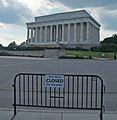
A look at the catastrophic partial government shutdown.  Wikimedia Commons.

Is what we have here one artificial "catastrophe" on top of another? That the first had never really gotten off the ground as catastrophic was apparently beside the point as the media began crying wolf yet again. Perhaps imminent catastrophe as a sort of continuing resolution had already become the primary strategy of television news editors, who were at least outwardly impervious to whether or not the last crisis had actually turned out to be catastrophic as they had thought and pronounced. No learning curve extraneous to what sells was allowed by those who refuse to look in the rear-view mirror. The new "reality" (or reality show) premised on a permanent adrenaline-rush (coffee no longer being required) had been found to be cheap to produce, and thus it had become the default. For added fun, the viewers could look forward to a  cacophony of puffed-up talking mouths forming a cavalcade of exaggerated metaphors with no curtain call in sight.
 
The confluence of the government's partial shutdown and the prospect of a default fueled a confluence in turn of journalists and politicians around a storyline to which only they and Wall Street were privy. Meanwhile, the usual suspects treated the public to an exaggerated roller-coaster ride over the supposition that the cars really could suddenly fall to the ground. The manufacturers were even considerate enough to supply a countdown clock! 
 
Source: NPR.org
 
Besides magnifying the significance of each public statement and meeting by labeling almost every twist and turn "BREAKING NEWS," broadcast and online/print journalists as well as the ubiquitous pundits happily joined members of Congress in misappropriating war terminology even to someone's refusal to talk to someone else on Capitol Hill. 

For example, former U.S. House Speaker Newt Gingrich said at one point on CNN, "It is a nasty, bloody fight." Meanwhile, U.S. House representatives were referring to the difficulty in reaching a deal as a terrible battle. Had any of them been to the real battlefields at Gettysburg in Pennsylvania? Had the former Speaker, perhaps when he was studying for the doctorate in American history? Lest the thick, humid air of the odious irony cause anyone difficulty in breathing, I can supply a bayonet to cut through the miasma of soupy air.

To correct the squalid, sensationalizing habit of militarizing the "sausage making" in Congress, an actual military veteran gives us a needed reality-check in an ad sponsored by a vet group and aired on CNN just before the former Speaker over-reached. The veteran declares with an obvious note of disgust and disbelief, "It is not an epic battle. I've been in an epic battle and running the government is not one of them." I was instantly reminded of Sen. Lloyd Benson's clever response to Sen. Dan Quayle in the vice-presidential debate in 1988.

 
As if recalling faded images of soil tainted with the blood of those who had sacrificed their lives does not go over the top, the Huffington Post ran the following headline: "[U.S. Senator] Joe Manchin: Democrats May Consider 'Nuclear Option' On Debt Ceiling." Was it really necessary to stir the old fears of those Americans who could still remember the corrosive taste of the Cold War? Selfish and inconsiderate, or perhaps the old sin of pride overlaid with whipped presumptuous, may aptly describe the underlying mentality. Yet even sickness can be found in the nucleus of the interlarding pathogen.

Ironically, Wolf Blitzer of CNN turned away after only a minute or so from Sen. Rubio speaking live in the U.S. Senate chamber on the Iranian nuclear talks then going on only days after Sen. Manchin made his infamous "nuclear option" threat. In spite of the fact that getting Iran to the negotiating table had just been a significant step toward a solution and the media around the world was covering the talks, the veteran news anchor in America relegated the issue as soon as he discerned that the topic was not the upcoming debt-ceiling. As though an infant missing his thumb for two seconds, Blitzer quickly said (paraphrasing), "Senator Rubio on the Senate floor is just talking about Iran. I want to turn to . . . on what is going on right now on Capitol Hill." Nothing was going on.

I was astonished that the folks at CNN could be so obsessed with microscopic, minute reports of this and that meeting of lawmakers, a brief public statement of no substance (e.g., "We want fairness."), and various trial-balloons seemingly meant to preempt running up against the debt-ceiling at "ZERO HOUR." In hindsight, few people would notice that President Obama signed the bill after midnight, hence past the zero hour. the Apocalypse. Put another way, the timing of the bill finally becoming law early on October 17th invalidates all the clocks counting down the minutes and seconds, as well as the USA Today newspaper front-page headline on October 16th proclaiming "ZERO HOUR" as if the world as we know it would end at midnight without the debt-ceiling having been extended. As conflict is the stuff of a good show, the paper's editors flanked the "ZERO HOUR" (in a flaming red square) with photos the Speaker of the U.S. House and the U.S. President, seemingly staring each other down. Conflict sells, as do even artificial, arbitrary deadlines invented and then fed to a beguiled public. After the fact, few people even think to look in the rear-view mirror, and so we can expect the manipulation to go on.

Why is the application of zero hour to the debt ceiling fake? It is important for us to realize the severity of our lapse so we won't be taken so easily in the future. The U.S. Government would not go into default the minute, or even necessarily days, after the debt ceiling has been reached unless cash on hand is not sufficient to pay the bills due immediately. That is, not being able to borrow more does not preclude the government from using its cash on hand and incoming revenue from taxes and other sources to pay the bills as they come due. Regarding the October 17th "deadline" at 12:01 a.m., the big bills (e.g., Social Security and interest payments) were not to come due until October 21 and then again on November 1st. Even though Treasury's software may not have been able to "pick and choose" what to pay in order to stave off actual default (i.e., missing an interest payment to U.S. bond-holders), presumably a law passed by Congress and signed by the president would override such logistical matters. Furthermore, because no interest payments were due on October 17th, not to mention exactly at 12:01 a.m., actual default would not have occurred at the end of "zero hour" or even the next day! Nevertheless, the media, Congressional lawmakers, and the self-anointed pundits qua experts easily foisted the lie on a gullible public eager to believe anything said on television or in print.  

Given the government's cash on hand and strong revenue stream coming in, I suspect that the feared trade-off between paying interest on the debt or issuing Social Security checks is a false dichotomy.  To be sure, the ethics of paying wealthy bond-holders while retirees, the sick, and the hungry go without sustenance is daunting, if not prohibitory. Such a breach of ethics would be on top of the media's  hidden agenda or biased discretion to maximize "me, me, me" and profits at the expense of the journalist mission to report the news let the viewers make up their own minds. Moreover, to deliberately foment fear excessively violates Kant's "Kingdom of Ends," wherein beings having a rational nature are treated not just as means, but also as ends in themselves.

The real crunch point would have come with the first of the huge pay-outs, which would not be until October 21st. Even putting off non-interest bills coming due before that date would not be an actual default, which is defined as missing a payment of interest and/or principal to creditors. The "ZERO HOUR" was a hoax, which, unfortunately, could have become a self-fulfilling prophesy. Fortunately, Wall Street wasn't buying into the stunt. Had the drama been allowed to play out until October 20th, the continuing financial uncertainty alone might have caused a "run on the bank" even if the traders and major investors were privy to the end-game already worked out in Washington. Smoke and mirrors can spur someone into starting an actual fire.
 

Another casualty from the media's obsession based on the assumed validity of a "zero hour" is what I would call the monopoly of the story crowding out virtually all other news. As if creating the countdown clocks in the first place is not bizarre enough, the refusal to break away even for five minutes has all the earmarks of a pathology or dysfunctional mindset even if the intent of the network executives and anchors was to maximize the audience-share for the first half of October. Even if the viewers had already been suckered into the purported significance of the "breaking news" flashes regarding trivial "developments" in line with profitability, gaining from lying violates journalistic ethics and the mentality involved is sordid. At the very least, that journalistic strategy enables a personality disorder. 

For example, twelve hours before the declared zero hour ending at midnight, voices presumably screaming in Blitzer's ear-piece would not tolerate even five or ten minutes on the Iran talks then concluding, even though similar voices had saturated the entire morning with hours of unrestrained verbal diarrhea ad nauseam zooming in on every little twist and turn. The refusal to break away from a dearth of real news to briefly cover a story being heavily reported on that day by news networks around the world is a huge red flag begging to be examined. The pathogen goes far deeper than merely a tunneled perspective and even a lack of judgment (in one's own field!). At the subterranean level at CNN must lie a dysfunctional organizational culture enabled by the obsessive-compulsive personality disorder.
 
To be sure, an actual default by the U.S. Government would have serious economic implications. Sen. John McCain reported that the likely impact on the market, according to Wall Street bankers and stock analysts, would be "very, very negative." That the media used "Armageddon" rather than "very, very negative" and referred to October 17th as "the magic day" and to midnight there of as "Zero Hour" is a red flag. Even if most of us are color-blind, the choices that were made in the (misuse of) discretion say something about the mentality underneath the carefully-cropped haircuts.

Meanwhile, the continuing partisan remarks by members of Congress belie their artful shrieks that the sky would soon fall unless the other party caves.  For days, the public had been blanketed with baleful warnings of imminent catastrophe. In other words, if the lawmakers really did think a financial meltdown might occur, they would not be prioritizing political points unless risking their own wealth, not to mention the U.S. economy (and thus their jobs), was of no concern.

Days before the public new that a deal was in the works in the Senate, Sen. Reid's "Don't screw it up" comment was caught by a microphone as the mayor of Washington, D.C. stopped the majority leader on the Capitol steps to ask for enough money to operate the city (including trash pick up). What is the it? A grammar detective would point to the missing antecedent as being very suspicious.

Also suspicious, with even just 12 hours to go before the global financial system could turn into a pumpkin at midnight, the Dow Industrials was up more than 100 points. Had the traders and major investors believed that an actual default was possible, the dire consequences coming with even low probability would have been factored into the market. The Wall Street elite must have known that even a House vote well after zero hour would not trigger a default. In short, the countdown clocks and word of a zero hour were both a ruse perpetrated on an beguiled public (you and me). Feels nice, doesn't it? Yet we continue right along in the matrix.

 I submit for your consideration the possibility that Congressional lawmakers, the president, Wall Streeters, and even perhaps the media already knew that Act 3 would end with a dramatic (i.e., attention-grabbing) climax and a favorable ending. With the "it" set, the incumbents could enact various displays like peacocks to give themselves political cover or simply look good amid all the manufactured attention. Meanwhile, the American people were being manipulated into believing in the existence of an epic bloody battle ending on time, as planned, just before "ZERO HOUR." If I am correct with this scenario, the players on the mighty stage do not deserve a standing ovation for having saved the day. Least of all are we to permit them an encore, even if one has already been pre-determined and thus inevitable.


Tuesday, October 15, 2013

Human Weakness Enables Market Bubbles: A Nietzschean Perspective

As a young idealist in business school, I believed in the efficient market hypothesis; an efficient market based on perfect competition would obviate excess profits (e.g., monopoly rents) while keeping prices as low as possible. I assisted a professor with his article on the NASD (National Association of Securities Dealers) as a stellar example of industry self-regulation. The ideology cutting off the far left of my peripheral vision, I dismissed the possibility that an industry would look the other way on a miscreant firm as executives of other companies fear accountability from the industry association. Moreover, the business practitioners may profit, at least in the short term, from foisting on the general public the illusion of industry self-regulation, which can serve as a front protecting a squalid underbelly.

The full essay has been incorporated into (or swallowed up by) On the Arrogance of False Entitlement: A Nietzschean Critique of Business Ethics and Management, available in print and as an ebook at Amazon.

Monday, October 14, 2013

Wall Street Undercutting the U.S. Government When It Is Down

Irony can sting. During the week or so leading up October 17, 2013—“Armageddon” or “zero hour” for the default of the U.S. Government absent any increase in the debt-ceiling (even though the next big payment would not be due until October 21st)—Wall Street banks were already bailing on short-term treasury bonds even as governments around the world were holding on. Patriotism and corporate citizenship apparently collapse when money due may be delayed. Meanwhile, foreign governments—even big creditors like Japan and China—were taking a long-term view. “There’s no other way than for the U.S. government itself and the U.S. Congress to sort it out,” Japanese Finance Minister Taro Aso optimistically told Bloomberg Television.[1] Apparently Fidelity and JPMorgan Chase did not get the memo. In over-reacting out of an excessive desire to collect as stipulated, big American financial houses were not so subtly undercutting the U.S. Government’s waning credibility. It is ironic that Washington’s best supporters were foreign governments.

 The underlying debt-burden would again surpass 100% GDP in Obama's second term.  Image Source: Wikimedia Commons
Perhaps Wall Street’s bankers do not understand political theatrics whereas foreign government officials do. Maybe the bankers were privy to the real politics going on in Washington and the situation threw a beam of light on the bankers’ greed and selfish insistence that things go their way without exception. Either way, what is good for Wall Street is not necessarily good for America. Put another way, the Wall Street bankers who had been prospering so under the American hypertrophic value on economic freedom (e.g., no amount of wealth is too much) felt no gratitude or sense of obligation against even a chance that interest might be delayed a bit. In return, vast numbers of Americans strangely continued to defend the right of the super-rich bankers to pile on even more to their existing skyscrapers of wealth. If the bankers were merely being themselves in shedding short-term treasury bonds, the puzzling question may pertain not to them but to how a people could be so beguiled.  


[1] Mark Gongloff, “The Rest of The World Still Claims Faith In America (Even If Wall Street Doesn’t),” The Huffington Post, October 14, 2013.

Tuesday, October 8, 2013


Americans on the Impact of a Government Default: Everyone Is an Expert

Would default of the U.S. Government be catastrophic to the world economy? In searching for an answer, the discerning inquirer knows to avoid the incredulous reports. One problem is that the American media treats even such sources as just as valid as those that are backed up by expertise. It may even be that enough Americans presumptuously dismiss or discredit expertise out of sheer jealousy and resentment that the media have become accustomed to treating public surveys as equivalent to experts on matters requiring expertise. In Madison’s Notes on the Constitutional Convention, a fear of excess democracy can be found among some of the delegates who feared that expanding popular election in the U.S. Government beyond the U.S. House of Representatives would unbalance that government (i.e., in terms of “the one, the few, and the many” in favor of the many). The fear has been realized as the U.S. Senate turned to popular election and the Electoral College has been captured by the political parties (i.e., electors are forced or pressured to vote in line with the election results). I contend that excess democratization of presumed expertise is related to the expansion and the values (e.g., anti-elitism) behind it.
 
Regarding anticipations of the impact of a government default, the U.S. Treasury released a report in October 2013 with the following results: "A default would be unprecedented and has the potential to be catastrophic. . . . Credit markets could freeze, the value of the dollar could plummet, U.S. interest rates could skyrocket, the negative spillovers could reverberate around the world, and there might be a financial crisis and recession that could echo the events of 2008 or worse." This forecast came from experts on the topic at Treasury, whom I suspect made use of the expertise of economists. Hence, the report has high credibility.
 
At the same time, however, American news networks were reporting that, according to public-survey polls, a default would not be catastrophic. The media was also reporting poll results indicating that a quarter of the Americans believe that Obama was secretly working to on a third term. Doubtless the journalists give no credibility to such claims. In fact, the tone of the reporting suggests that the sheer madness of such a belief is what is really being reported. “Just where is such paranoia coming from?” one journalist asked after reporting the poll. Yet the tone used by journalists reporting that a default would not be catastrophic according to a significant percentage of Americans suggests that opinions—even those biased by political ideological agendas—can be treated as fact or at least as of equal value to the Treasury report or those of economists. The underlying assumption is deeply problematic, yet it has become a staple of the public discourse via the media.
 
Of the 21% who claim the U.S. dollar would no longer be a reserve currency around the world, how many people are just guessing? How is it that non-finance/economists know the market would not tank?  For my part, I don't know. I'm not an economist. Source: CFA Institute                                      
 
As an experiment of sorts, try paying extra attention to the claims that people make generally and you will soon come to the realization that many people go beyond their justifiable basis of knowledge or expertise in making clreaims with absolutely no caution that such would even be possible. The proclivity may be inversely related to the level of education, though the know-it-all graduate students and even professors is hardly a rarity. Even just after a few sentences from one, the arrogance-fueled over-reach is easily detected.
 
Try listening for the media basing findings requiring expertise as valid simply because a majority of Americans polled say so. Even though expertise renders a conclusion more credible (and accurate!), even experts can over-reach on their own territory. For example, an airline pilot who announces from the cockpit just after take-off, “We will arrive in Paris at 7:34am is overshooting. What if touch-down is at 7:35am due to a bit stronger headwind than anticipated? Would the passengers bail or storm the cockpit were the pilot to have said “around 7:30” instead?
 
Many Americans will leap to sue a professional (e.g. pharmacist, physician, surgeon, lawyer, CPA) who goes beyond his or her expertise such that people are harmed. So it is telling that we take at face value the economic conclusions of a political pundit whose expertise is in journalism or politics. The presumption that a majority of Americans saying X is not a problem can be taken as reason to conclude X really won’t be a problem makes it easy for the self-proclaimed “experts on the content” in the media to beguile an incredulous viewership.


Thursday, October 3, 2013

Can the U.S. President Unilaterally Raise the Debt Limit?


Does the Fourteenth Amendment to the U.S. Constitution give the president authority to order the Treasury Secretary to raise debt above the existing debt limit? I contend such authority does not exist, at least as of 2013.

In December 2012, Jay Carney, the White House spokesman, had “flatly renounced the 14th Amendment option, saying: ‘I can say that this administration does not believe that the 14th Amendment gives the president the power to ignore the debt ceiling — period.’”[1] During October 2013, Wall Street, including investors and bank executives, was quietly coming to the opposite conclusion. Of course, fear of a declining stock market in the wake of a governmental default means that the financial sector has a strong financial interest in forestalling default by finding sufficient presidential authority in the Fourteenth Amendment.

   Are these Wall Street execs qualified, whether by virtue of their jobs or wealth, to advise the White House administration on matters of constitutional interpretation?   Image Source: Jason Reed/Reuters

“At the end of the day if there is no action and the United States has a default looming, I think President Obama can issue an executive order authorizing the Treasury secretary to make payments,” said David Kotok, chief investment officer of Cumberland Advisors. “There’s always been more flexibility in the hands of Treasury than they’ve acknowledged.”[2] Kotok could cite some lawyers teaching in American law schools who claimed that “the president could essentially ignore the debt limit imposed by Congress, because the 14th Amendment states that the ‘validity of the public debt of the United States, authorized by law,’ including for debts like pensions and bounties to suppress insurrections, ‘shall not be questioned.’”[3] Authorized by law is the key to unpacking the fourth section of the amendment. The relevant passage in the section states: “The validity of the public debt of the United States, authorized by law, . . . shall not be questioned.”[4] Let’s unpack it.

The validity of the debt incurred and being held by the Federal Government shall not be questioned. The reference in the section to debt incurred to suppress insurrection or rebellion provides a hint as to at least one of the section’s purposes. The amendment was ratified in 1868 in the wake of the war between the USA and CSA. Affirming the validity of the U.S. Government’s debt implies that the debt incurred by the CSA was not valid and thus not an additional obligation foisted on the U.S. Government. In any rebellion, moreover, the validity of the government’s debt is naturally subject to dispute, thus lessening its credibility even among citizens not in rebellion. So the section acts to fortify by exclusion the validity of U.S. Government debt. The question then becomes, which debt?

Is any debt that is incurred by the U.S. Treasury automatically to be regarded as valid? Here we have arrived at the crux of the matter. The “authorized by law” clause in the section qualifies the public debt that is valid to that which has been authorized by law. Having only a veto legislatively, the president cannot make law. That is the legislature’s task in the system of separated powers. Debt that is incurred without legislation passed by Congress—such as by an executive order by the president—is not valid because such debt is not “authorized by law.” In fact, section five gives Congress the “power to enforce, by appropriate legislation, the provisions of” the amendment.[5]

Obviously financial and political interests go into how various parties interpret the amendment. Even so, it is odd that rational beings would ignore “authorized by law” and conclude that an executive order is sufficient. Yet it is conceivable that given the severe economic and political impact of governmental default, some might argue as a political analyst has done that “(d)esperate times require desperate measures.”[6] In other words, the end justifies the means.

I suspect that Wall Street executives would find it rather easy to justify to themselves that the ends justify the means. In this case, the means involves overlooking a clause in the amendment’s fourth section, and thus violating logic and reasoning as if with impunity—as if knowledge itself were valid only where it serves a particular financial good.


1. Nelson D. Schwartz and Charlie Savage, “Wall St. Fears Go Beyond Shutdown,” The New York Times, October 2, 2013.
2. Ibid.
3. Ibid.
4. Legal Information Institute, Cornell University Law School (accessed October 3, 2013). http://www.law.cornell.edu/constitution/amendmentxiv
5. Ibid.
6. Nelson D. Schwartz and Charlie Savage, “Wall St. Fears Go Beyond Shutdown,” The New York Times, October 2, 2013.

Wednesday, October 2, 2013

The U.S. Government Shutdown: A Future of Clogged Consolidation?


Stalemate. A government shutdown. Well, not actually completely shut down, but significantly enough for many people to suffer as a result. Resisting the temptation to expound off the media reports, I proffer an alternative hypothesis altogether: The continuing impact from natural selection through 70,000 years when the homo sapiens species was in the state of nature manifests even today as an innate proclivity to a sort of wandering myopia. With tigers as predators of man and no available refrigerators for food, natural selection favored an orientation to one’s immediate surroundings and needs. 

The complete essay is at "Is the E.U. a Federal System?"


Tuesday, October 1, 2013

US Income Tax Turns 100: Unintended Consequences


On October 3, 2013, the U.S. federal income tax turns 100. As the twentieth century demonstrates, a lot can change in a century. Given the sheer amount of time and even inevitable adaptations, a program's original purpose and design (i.e., what it was designed for) can easily become obscured to the naked eye. As a result, contemporary debates on a long-standing program or policy tend to be unnecessarily constrained because its original purpose and initial design tend to be excluded, even thought to be impossible! In their exchange of letters in retirement, Jefferson and Adams agreed that a virtuous and educated electorate is necessary for a republic to endure. Within the educated rubric, the history of the republic, including the history of existing policies and programs that are significant, is not a small matter. 

In terms of the federal income tax, the legislation passed in 1913 applied only to the rich. The personal exemption was $3,000 ($71,000 in 2013 dollars) for individuals and $4,000 ($94,500) for married couples. Interest and state/local taxes were deductable. After the exemption (none for dependents) and deductions, the rate of 1% was applied to the remaining income up to $20,000 ($472,500). The rate shot up all the way to 2% for income over $20,000 to $50,000 ($1,181,200)—then increments from 3% to 7 percent.[1]  It had been estimated that only 425,000 people out of the U.S. population of about 100 million would have to pay income tax.[2]

                          Remember this is after the exemption and deductions.  Source: IRS and US Dept. of Labor.

It follows that the assumption taken for granted in 2013 that everyone who has income should be taxed does not jive with the tax in 1913.  Arguing that people earning less than say $12,000 a year (before exemptions and deductions) should not have to pay any income tax looks incredibly heartless (as well as petty) from the vantage point of a personal exemption of what would be $71,000 in 2013 dollars.

The movement pushing the constitutional amendment and subsequent legislation had to do in part with tariff reform, rather than being sought as a means by which the federal budget could be expanded. In 1890, almost all of the federal government’s revenue can from tariffs (60%), taxes on alcohol (27%), and tobacco taxes (8%). Also in that year, the McKinley Tariff raised tariff rates appreciably, “principally for protectionist purposes, rather than revenue.”[3] In 1894, the Democrats enacted a modest income tax (2% on incomes over $4,000 ($110,000)) to “help finance a reduction in tariff rates.”[4]

Although the Pollock decision in 1895 declared the direct, non-proportional tax unconstitutional, even in 1913 the federal income tax was re-initiated (after ratification of the amendment) as a means to foster free trade. The disproportionate hit to the poor from alcohol and tobacco taxes was also a factor. The notion that everyone with income should be taxed on it was not in the mix. Nor was the Congress intent to “crowd out” the ability of the State governments to tax sufficiently to safeguard their governmental turf from encroachments by Congress.

Nevertheless, especially from World War II the federal income taxation expanded “downward” and thus in terms of the number of people subject to the tax; it became ubiquitous in application. Meanwhile, State legislatures faced increasing pressure to keep a lid on the revenue side at least from citizens launching tax revolts (especially in California). By 2013, the Federal Government had done what some of the delegates to the Constitutional Convention had feared; the feds had sucked up so much of taxation that Americans would accept that the States were starving for cash even to help feed and house their most vulnerable. Not coincidentally, the power of the Congress had come to dwarf that of the States, so the check-and-balance proffered by federalism could hardly function. Had what would come to pass influenced Congressional debate in 1913, I doubt the unintended risks would have had much sway—just as the incremental changes to the federal income tax would discount or ignore the original design (i.e., application) of the tax.

What can we learn from this case study? First, public and Congressional debate on whether to reform an extant program or policy should include some reference to its history. What did the program (including tax schemes) look like initially? What were the initial results? What policy objectives and political forces drove its adoption? Have subsequent problems stemming from the program proved the importance of including factors not considered in the legislative (or policy) process? 

In short, public and congressional debates on whether to change an existing policy or program can be broadened and deepened if its history is included. The initial assumptions and purpose(s) can be uncovered and treated as a sort of privileged alternative, or non-alien alien in juxtaposition to the existing basis. Initial blind spots,  such as unforeseen long-term negative impacts on the governance system itself, can be brought in, assessed and finally obviated. 

Moreover, the lesson here is that we as human beings tend not to  know what we don’t know. All too easily, we fall into the customary two well-worn groves, which can easily become a false dichotomy if as if we had no choice but to wear horse-blinders. Too often than not, the substance of the vaunted self-government consists of what Nietzsche calls herd animals

If a self-governing people, perhaps even aided by its media, publically questions assumptions hitherto taken for granted (i.e., critical thinking), the breadth of policy and program options could  increase substantially. Maybe the principle behind the U.S. federal income tax is not that everyone should contribute. Maybe the assumption that every possible source of income should be subject to the tax is unnecessarily harsh. Maybe the existing reliance of income tax to fund the U.S. Government is not only ahistoric, but risky and unwise. The matter may boil down to figuring out how to effectively counter the gravity of the status quo (and its vested interests). 


1. Bruce Bartlett, “Happy Centennial, Federal Income Tax,” The New York Times, October 1, 2013.
2. Ibid.
3. Ibid.
4. Ibid.

Saturday, September 28, 2013

Britain Bucks E.U.on Banker Bonuses

Not long after the passage of an E.U. law limiting bonuses for bankers in the E.U., one state government (the usual suspect) filed a lawsuit in federal court (the ECJ) to contest the new law before it even went into effect. Perhaps it could have been said that 'banker-bonus caps is to Britain as "Obamacare" is to Texas.' Although federal overreach was an element in both complaints, we can still ask what was the true basis of Britain's suit.