Showing posts with label pollution. Show all posts

Friday, June 26, 2026

El Nino as a Distraction as the E.U. Swelters

It is likely due to natural selection having formed our present-day species overwhelmingly in the hunter-gatherer very, very long period of our species 1.8 million years of existence (agriculture just having begun around 7000 BCE!) that we tend to take notice of a foreground and leave the background along because any threats it holds are immediate. Tigers, for example, become particularly dangerous when they are up close rather than several fields away. During the (Northern hemisphere’s) summer of 2026, as the E.U. was sweltering in successive heatwaves, the El Nino current event in which warm equatorial water in the Pacific Ocean moves eastward readily became a target as the culprit producing the heat far away in Europe. In actuality, according to scientists (but what do they know?), the gradual (i.e., background) warming of the planet’s atmosphere, especially in the Artic as well as in Europe, was behind the heat breaking records in the E.U. as well as in bordering sovereign states like Britain, where on 25 June, presumably in London, an all-time-high temperature for the month of June was recorded. Global warming, once safely in the background, was coming home to roust in the foreground.


The full essay is at "El Nino as a Distraction as the E.U. Swelters."

Monday, May 25, 2026

On Religion and Public Policy: Pope Leo on Dumping

The Terra dei Fuochi, or “land of fires,” is a region in southern Italy where “decades of illegal dumping, burying and burning of waste” had been devastating by the time Pope Leo paid Acerra a visit in May, 2026.[1] Lest visual images of hell’s fires reminiscent of Jonathan Edwards’ sermons come to mind, the devastation was squarely in the this-worldly domain of public policy. The pope’s speech can thus be viewed as an over-reach from the standpoint of his native fauna—the sui generis domain of religion, whose referent transcends not only the limits of cognition, perception, and sensibility (emotion), but also Creation itself![2]


The full essay is at "On Religion and Public Policy."


1. Fortunato Pinto, “Pope Leo XIV Visits Southern Italy’s ‘Land of Fires’,” Euronews.com, 23 May, 2026.
2. I am borrowing here from Pseudo-Dionysius, a sixth-century Christian theologian, who wrote on what I would call God’s radical transcendence. Relatedly, God has been thought of as being wholly other. In both of these characterizations, it follows that the domain of religion is not only distinct from every other domain, but also unique.

Monday, November 10, 2025

COP30: Is Symbolism Enough Amid Climate-Change?

With the U.S. fed up and only 100 governments left willing to attend COP30 in Brazil on combatting carbon-emissions and the related global warming, the question of whether the basis of the annual conference, voluntary compliance, is sufficient and thus should be enabled by the staged meetings. Even to continue to have the conferences annually can be viewed as part of a broader state of denial, given that the 1.5C degree maximum for the planet’s warming set at the Paris conference a decade earlier was by 2025 universally acknowledged by scientists to no longer be realistic; the target would almost certainly be surpassed. It is in this context that any progress from COP30 should be placed.


The full essay is at "COP30." 

Tuesday, August 6, 2024

On Europe’s Nonlinear Climatic Future

The probable impacts of climate change are anything but straightforward, and thus predictable. From the standpoint of mid-2024, huge changes could be in store for Europe and other continents. The magnitude of the shifts is particularly worthy of notice, such that the changes being unleashed even as of 2024 and especially in the decades following the 2020s will be difficult to reverse or even change even if a Green revolution were to take hold. It bears noting that in 2023, the increase in energy usage globally outstripped contribution from alternative or clean energy, such that even more fossil fuel was used to meet the post-pandemic demand. A look at Europe provides a good case study of the unstoppable magnitude of some of the changes already underway.  


The full essay is at "On Europe's Nonlinear Climatic Future."

Saturday, February 1, 2020

Judaism and Christianity on Climate Change

First Reformed (2017) contains fundamental ideas concerning the human condition and wrestles with the relationship between religion and politics.  Ideas play a significant role in the film, hence it can be used in support of the thesis that film is a viable medium in which to make philosophical (and theological) ideas transparent and derive dramatic tension from clashing ideas. In this film, the ideas that clash concern the role of religion in the political issue of climate change—or is that issue primarily religious?

The full essay is at "First Reformed."


Wednesday, June 26, 2019

On the United Technologies-Raytheon Merger: The Macro Level of Analysis

In analyzing a merger, incorporating the macro context is vital. For very large mergers, for instance, public policy concerns inevitably surface even if they are typically ignored not only in merger analyses, but also by in societal and even governmental public discourse. Analysis at this level takes a societal standpoint, including on the relationship of business and government. This does not diminish the salience of firm-level analysis, for even how the respective organizational cultures would mesh is very important to a functional merged company. This is even true regarding the respective business-ethics climates, for it is not a given that a healthy organizational culture dominates an unethical one.

Friday, February 15, 2019

Western Banks Lending to Asia's Expanding Middle Class: Profit vs. Planet

In April 2013, debt levels in Asia were reaching record levels as international lenders were extending short-term loans to a growing middle class. Non-mortgage consumer credit in Asia outside of Japan had increased 67% from 2007 to reach $1.66 trillion by the end of 2012. This credit included credit cards and loans for cars, electronic products, and appliances. Outside of Japan, Asian car and motorcycle loans nearly doubled from 2007 to 2012, to reach a record $219.7 billion. Appliance and electronics loans also more than doubled, reaching a high of $10.9 billion. Meanwhile, credit-card loans grew by 90% to reach a record $234.1 billion, according to Euromonitor. The incentive for the banks is not difficult to fathom. At the time, more than half of the world’s middle class was expected to be in Asia by the end of the decade. That translates yearly into more than 100 million additional people per year. For the banks, this was an opportunity since at least the beginning of the decade because growth was not possible in the European Union and the United States on account of the financial crisis of 2008 and the ensuing European debt-crisis that extended well into 2013. The European Commission of the E.U. was also working on regulatory proposals that would limit the incentives of mortgage servicers to produce too many “bubble-creating” mortgages. 
So Western banks had an incentive to look east for fruitful markets. Interesting, government regulators in China, Malaysia, and Indonesia had began reining in mortgage, credit-card and auto/motorcycle lending, perhaps in fear of an Asian financial crisis. Had Western bankers learned their lesson, or were they unwittingly bringing their reckless mentality to Asia? Two levels of concerns can be extracted from this case. I contend that the more immediate concerns were crowding out attention that ought to have been paid to the larger, but longer-term, problems.

The full essay is at "Lending to China's Middle Class."
More people=More cars=More pollution    source: Businessweek

Thursday, February 7, 2019

On the Impact of Political Rhetoric: From “Global Warming” to “Climate Change”

Words matter in politics. The side that can frame a question by definitively naming it in the public mind enjoys a subtle though often decisive advantage in the debate and thus in any resulting public policy as well. For example, “pro-choice”privileges the pregnant woman, while “pro-life” defines the abortion debate around the fetus. Similarly, “global warming” implies a human impact, whereas“climate change” defines the issue around nature. Even though the shift from“global warming” to “climate change” is more in keeping with the evolving science and won’t be bumped off by a cold winter, political players have been the driving force—language hardly being immune to ideological pressure.

Saturday, August 18, 2018

On Leaving Coal Emissions to the States: Implications for American Federalism

With the transportation (i.e., fuel) and power (i.e., coal) sectors accounting for a majority of the carbon emissions in the U.S., according to the EPA, the Trump administration’s moves to freeze his predecessor’s fuel efficiency standards and relax pollution rules for power plants needing renovation put at risk the declining trend of emissions in 2018. The implications for climate change (e.g., hotter summers) were stark, according to Janet McCabe, who had been Obama’s EPA air chief.[1] The Trump administration’s proposal to allow the states, including West Virginia, to set their own rules for regulating coal was, according to the New York Times, “the administration’s strongest and broadest effort yet to address what the president has long described as a regulatory ‘war on coal’.”[2] An implication is that carbon emissions from coal in the U.S. would likely increase as a result, even though large states like California and New York could be expected to tighten the rules. The interesting point about turning the regulations to the states revolves around federalism. Constitutionally speaking, should the states regulate the carbon emissions from coal?


The full essay is at "States Regulating Coal."


1. Lisa Friedman, “Trump’s Plan for Coal Emissions: Let Coal States Regulate Them,” The New York Times, August 18, 2018.
2. Ibid.

Friday, December 1, 2017

Carbon-Dioxide Emissions amid Global Warming: A Species’ Death-Wish

Global emissions of carbon dioxide from fossil-fuel burning rose 5.9 percent in 2010, the largest amount on record, according to an analysis released in early December, 2011 by the Global Carbon Project. According to the analysis as reported by the New York Times, “the increase, a half-billion extra tons of carbon pumped into the air, was almost certainly the largest absolute jump in any year since the Industrial Revolution, and the largest percentage increase since 2003.” 

The full essay is at "Carbon Emissions: A Species' Death-Wish."

Wednesday, November 1, 2017

Social Harmony and Toxic Chemicals in China

According to the New York Times in 2012, the Chinese had become increasingly willing “to take to the streets despite the perils of openly challenging the country’s authoritarian government.” Even more surprising, government officials had actually acquiesced in some notable cases. Given the raw nature of power, particularly under authoritarian auspices, revolution rather than gradual reform may still be the most likely means by which democracy can bloom under the golden, albeit hazy, sun.

The full essay is at "Chemical Pollution in China."

Monday, August 7, 2017

The U.S. Goes after Executives at Volkswagen: A Deterrent?

Oliver Schmidt, a Volkswagen executive who had been head of the company’s environmental and engineering center in Michigan, pleaded guilty on August 4, 2017 to two federal charges in the United States: conspiracy to defraud the federal government and violating the Clean Air Act. He “admitted conspiring with other Volkswagen employees to mislead and defraud the United States in 2015 by failing to disclose that thousands of diesel cars were rigged to evade detection of excess emissions levels. He also admitted filing fraudulent emissions reports to regulators.”[1] He faced possible fines and time in prison. James Liang, another of the company’s executives who had been charged, had already pleaded guilty to charges of conspiracy and violating the Clean Air Act. The other executives charged were in the E.U. state of Germany, which does not extradite its residents. Given the power of the auto industry in that state, such accountability applied to executives for the same fraud in the E.U. may have been too difficult to achieve. Nevertheless, for the sake of business ethics alone, prosecuting executives personally rather than just companies is in general important as a deterrent.

The full essay is at "Executives at Volkswagen."


[1] Bill Vlasic, “Volkswagen Executive Pleads Guilty in Diesel Emissions Case,” The New York Times, August 4, 2017.

Tuesday, August 1, 2017

Unethical Business at Volkswagen: Loans Cut off

As R&D was at a premium in car companies reorienting to electric and even driverless cars, Volkswagen could ill-afford the suspension of the European Investment Bank’s low-cost financing in 2017. The company “was barred from receiving European Union research funding over allegations it misused a previous loan to cheat on emissions” by programming “11 million cars to fool regulators.”[1] At issue were the company’s “use of so-called defect devices, software that caused pollution controls in diesel motors to work properly only when the engine computer detected that an official emissions test was underway.”[2] Accordingly, the European Anti-Fraud Office concluded that the company had misled authorities about how €400 million ($472 million) was used ostensibly to develop engines to be more fuel efficient and thus pollute less. I contend that the company’s reply was worse than none.

The full essay is at "Unethical Business at Volkswagen."
A related book: Cases of Unethical Business, can be obtained in print or as an ebook at Amazon.com.


1. Jack Ewing, “European Bank Cuts Funds to VW Because of Emissions Fraud,” The New York Times, August 1, 2017.
2. Ibid.

Monday, August 29, 2016

California Passes Stricter Pollution Targets: Bringing Business Around


California’s legislature approved a bill (SB 32) in August, 2016 that extends the climate targets from reducing greenhouse-gas emissions from 1990 levels by 2020 (the former target) to just 40 percent of 1990 levels by 2030.[1] A second law, which includes increased legislative oversight of California regulators and targets refineries in poor areas, passed as well. Diane Regas of the Environmental Defense Fund pointed to California’s climate leadership. “As major economies work under the Paris Agreement to strengthen their plans to cut pollution and boost clean energy, California, once again, is setting a new standard for climate leadership worldwide.”[2] At first glance, it would seem that the legislature had freed itself from big business to pass the bills, but the sector itself was split. I submit the anticipation of a refreshed “cap and trade” program as an alternative (or mitigating factor) to stricter regulations played a role. Simply put, using the market mechanism in government regulation makes the stricter targets more palatable to market-based enterprises.

The full essay is at "California on Greenhouse Gases."


1. Chris Megerian, “’A Real Commitment Backed Up by Real Power’: Gov. Jerry Brown to Sign Sweeping New Climate legislation,” Los Angeles Times, August 25, 2016.

Sunday, April 19, 2015

Electric Utilities Thwart Solar Applications: A Conflict of Interest Rewarding the Status Quo

Considering the contribution of coal-burning power-plants to atmospheric carbon-emissions and thus global warming, governments around the world should be encouraging rather than discouraging home-owners to install solar panels. That is to say, we ought not privilege the status quo when it has contributed so much already to an uncomfortable or even uninhabitable Earth for mankind. So it is unfortunate that energy officials in Hawaii’s government had to step in to pressure—no, order—the Hawaiian Electric Company to approve its “lengthy backlog” of solar applications.[1] I submit that the officials should have gone further in correcting for the conflict of interest in the utility. Put in the vernacular, electric companies tended at the time to screw customers who could sell back “home-grown” solar power. The root problem here is in the utilities’s dual roles of seller and consumer of power.


The full essay is at Institutional Conflicts of Interest, available in print and as an ebook at Amazon.


[1] Diane Cardwell, “Utilities See Solar Panels as Threat to Bottom Line,” The New York Times, April 19, 2015.

Tuesday, July 29, 2014

Humanity Getting Ahead of Itself: A Mass-Extinction Event Already Underway

Around 252 million years ago, the “Great Dying” took out 90% of the world’s species. About 66 million years ago, a meteor caused the extinction of three out of four species, including those known to us as dinosaurs.[1] After 1.8 million years of existence, our own species is triggering yet another mass extinction event, according to a study in the journal Science by Stuart Pimm and Clinton Jenkins. According to Pimm, species are now going extinct at about ten times faster than scientists had thought. Prior to the arrival of homo sapiens (i.e., our species), the extinction rate was about 0.1 out of a million species per year; as of 2014, the rate had climbed to 100 to 1000 species per 1 million.[2] Behind this evolutionarily abrupt bump is not only the complicity of our species, but also unforeseen consequences that could easily take homo sapiens out of the equation.

The full essay is at “Humanity Getting Ahead of Itself”


[1] Seth Borenstein, “World on Brink of Sixth Great Extinction, Species Disappearing Faster than Ever Before,” The Huffington Post, May 29, 2014.
[2] Ibid.

Sunday, February 16, 2014

Global Warming: Has China Done Enough?

Whereas the Montreal Protocol in 1985 created a fund to reimburse countries for the incremental costs of banning ozone-depleting chemicals, later international agreements, such as the Kyoto Protocol, oriented to reducing global warming have not given countries, including developing nations such as China, a financial incentive to reduce carbon emissions. In fact, the U.S. Government rejected the Kyoto Protocol because the reductions only applied to developed countries. Even though China reduced its carbon emissions per unit of GNP by half from 1990 to 2010 by investing in alternative energy sources and mandating that polluting companies publicly disclose their respective emissions, the amount of emissions continued to increase dramatically through the period. How do we discern whether the Chinese government has done enough? Furthermore, are other countries enabling China and thus indirectly responsible and thus culpable too?

The steep rise in carbon emissions in China from 2003 demonstrate just how misleading incremental, or marginal, changes can be. Even China's goal of a 20% reduction in emissions by 2020 may not mean much in terms of the total amounts emitted. 

Because CO2 is a “stock” pollutant—meaning that global warming is a function of the total amount of accumulated CO2 in the planet’s atmosphere (regardless of when added)—a country’s total emissions figure is key (total accumulated as well as annual amounts). As the following graph shows, China would have to do much more than it had accomplished during the first decade of the twenty-first century.

By 2010, industrialized countries had become large net-importers of products such as steel whose manufacture involves sizable CO2 emissions. 

Developed countries have enabled China’s emissions to the extent that they are “contained” in products exported. The increase for China from 1990 to 2010 (blue and red bars in the bar-graph below) is astonishing. So too is the increase in carbon emissions “embodied” in products imported by developed countries. Interestingly, the E.U. imported more product-emissions than did the U.S. both in 1990 and 2010. The larger manufacturing output of the U.S. may explain much of the difference in the respective nets. Europeans critical of the U.S. for walking away from the Kyoto Protocol may be surprised to learn that their country has been enabling foreign carbon-emissions more.  


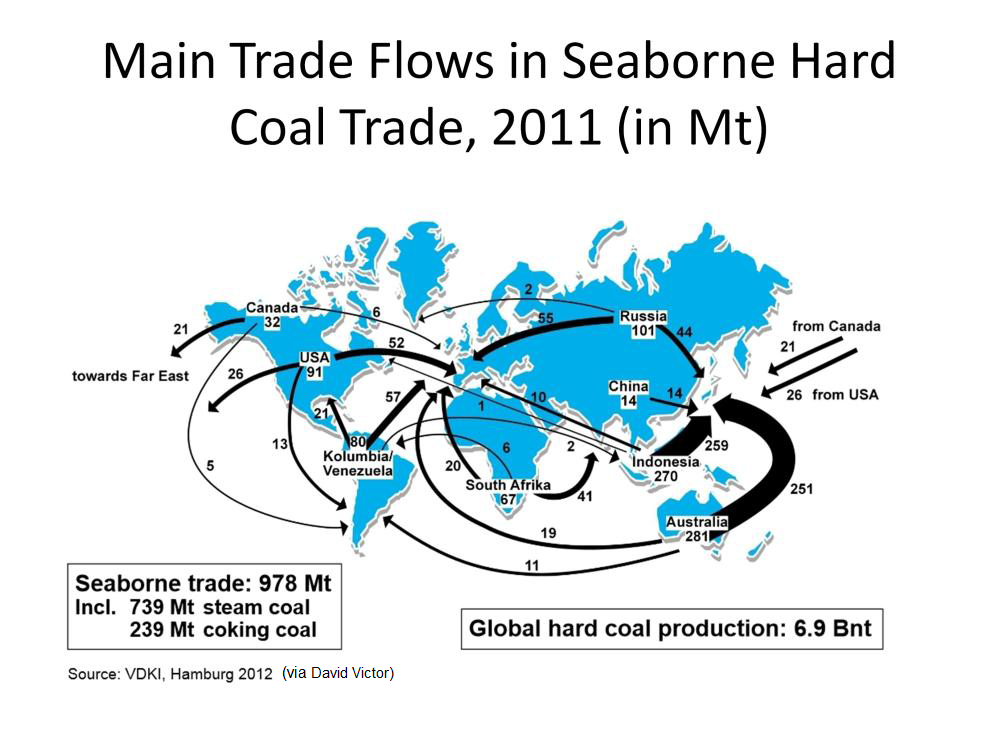
The thick black lines heading to China from Australia and Indonesia stand out in this map, suggesting just how much carbon China emitted in 2011. 

Coal exports to China can be understood as another instance of enabling. As global shipping costs for bulk commodities such as coal dropped significantly, the amount of the commodity traded increased significantly. Obviously, major exporters have a financial incentive to oppose global carbon-emissions limits being written into multilateral treaties. In 2011, Australian companies extracted a lot of coal, a majority of which went to China. Indeed, the sheer magnitude of coal imported into China can tell us a lot about just how much carbon China continued to emit in spite of the government’s forays into alternative energy sources. Even though parts of Australia had been burned by the hole in the ozone layer decades before 2011, the continent’s government and mining companies have had a financial incentive to keep China from shifting to wind and solar energy sources sufficiently even to level-off China’s annual carbon emissions.

Had the Kyoto Protocol included carbon limits for developing countries, complete with “self-enforcing” financial incentives (e.g., an international fund to cover incremental costs of compliance) and disincentives (e.g., other countries in the treaty can boycott trade with non-compliers), in spite of opposition from major coal-exporters, perhaps China would have curtailed the upward trend in the country’s total carbon-emissions even by 2010.  Lest it be thought that the dictatorship in China has far outpaced the world’s largest democracy (i.e., India) as a “global citizen” enabling our species to have a future, keeping global warming to within 2 degrees (C) will require much more from China, and indeed the world.

Thursday, October 24, 2013

Arctic Warming: Not Just Another Natural Cycle This Time

In late October 2013, research was published on the average summer temperatures over time in the Canadian Arctic. The scientists found from analyzing deep ice samples and moss only recently freed from the grip of ice that the average temperatures in the twentieth century were the highest going back at least 44,000 years to 120,000 years. The most significant warming did not begin until the 1970s and is particularly striking in the 1992-2012 period. The most significant implication of the study is that the argument that we are merely seeing another natural cycle underway can finally be put on ice.
"The key piece here is just how unprecedented the warming of Arctic Canada is," Gifford Miller, one of the study’s scientists, said. "This study really says the warming we are seeing is outside any kind of known natural variability, and it has to be due to increased greenhouse gases in the atmosphere."[1] Particularly striking is the phrase, “outside of any kind of known natural variability.” We are in unchartered waters made possible only by melting glaciers. In other words, we could really get blind-sided.
To get some perspective on how long the moss had been encased in ice, our species reached Australia approximately 45,000 years ago. Another 25,000 years earlier (50,000 years after 120,000 years ago!), homo sapiens underwent a cognitive revolution, which resulted in the “fictive mind.” The sapiens brain had via development from natural selection become capable of apriori imaginary realities or ideas. Story-telling in the hunter-gatherer bands (i.e., small groups) no longer be bound to observable (i.e., empirical) phenomenon. After the agricultural revolution based on permanent settlements in place of the nomadic life of the hunter-gatherer, the imaginary ideas of the fictive mind would enable homo sapiens to get past the lack of any “hard-wiring”(via thousands of years of natural selection) enabling members of the species to live in close proximity with many strangers. Larger, more complex social living groups (e.g., cities, kingdoms, and eventually even empires) could be formed and maintained through inter-subjective imaginary ideas.
Perhaps then the question is whether the human fictive mind will be able to harness enough coordinated effort and invention to compensate for the non-natural roller-coaster ride in the twenty-first century.    


[1] Douglas Main, “Arctic Temperatures Reach Highest Levels in 44,000 Years, Study Finds,” The Huffington Post, October 24, 2013.

Friday, September 27, 2013

Are Science and Human Nature at Odds in Climate Change?

“Climate change is the greatest challenge of our time,” says Thomas F. Stocker, co-chairman of the Intergovernmental Panel on Climate Change, the United Nations-sponsored group of scientists who presented their rather definitive report on September 27, 2013. “In short,” Stocker observed, the anticipated change “threatens our planet, our only home.”[1] Not only are the stakes painfully high; human nature itself must come through, perhaps beyond its very nature, for homo sapiens species to make it through the twenty-second century.

The natural human proclivity to seek a (schizogenic) maximum rather than be content with sustaining an equilibrium steady-state had been all too evident in production management alone during the industrial revolution. So too was the human approbation of instant gratification, including attempts to obviate the costs incurred. Accordingly, the 2013 report provides the rather unwelcome news that “(h)uman influence has been detected in warming of the atmosphere and the ocean, in changes in the global water cycle, in reductions in snow and ice, in global mean sea level rise, and in changes in some climate extremes.”[2]

                                                     The red and purple areas saw increases in avg. temps. Image Source: IPCC

In fact, the report claims, “It is extremely likely that human influence has been the dominant cause of the observed warming since the mid-20th century.”[3] Reflecting advances in the science (e.g., the models), the report “finds a 95 to 100 percent chance that most of the warming of recent decades is human-caused, up from the 90 to 100 percent chance cited in the last report, in 2007.”[4]  Even as the confidence in these findings is improved by 5 percent, such clarified empirical knowledge does not necessarily translate into a brighter future.


The likely consequences, according to the report, is a range of potential warming of between 2.7 and 8.1 degrees Fahrenheit, should the carbon dioxide level double from the amount in already in the atmosphere in 2013. According to the Potsdam Institute for Climate Impact Research in the E.U. the 2013 report is more conservative in its underlying assumptions than the previous report in 2007.

“To stand the best chance of keeping the planetary warming below an internationally agreed target of 3.6 degrees Fahrenheit (2 degrees Celsius) above the level of preindustrial times, . . . no more than one trillion metric tons of carbon can be burned and the resulting gas released into the atmosphere,” according to the 2013 report.[5] Just over half that amount had already been emitted since the beginning of the Industrial Revolution, and at the rate energy consumption was growing, the trillionth ton would be released somewhere around 2040.

That as of 2013 more than three trillion tons of carbon were still left in the ground as fossil fuels set the human species up for a confrontation with its own nature along the following lines: Can we keep our paws off the cookies freely within our reach that would make us sufficiently obese that we could die from our overeating? Moreover, just how strong is the species’ self-discipline as against the lure of the pleasure garnished from additional albeit baleful consumption? That 2012 saw record carbon emissions into the earth’s atmosphere suggests a rather dramatic disconnect between what the scientists report and how policy-makers, business practitioners, and consumers react. Incredibly, the two were going in opposite directions!

The flaw is likely in human nature itself. Specifically, the disproportionate worsening of an on-going, un-rectified situation receives too little weight in the human decision-making process on whether to engage immediate correctives (or even damage-control). “Continuing rapid emissions now is kicking the climate can down the road, leaving climate change for our children and grandchildren,” said Christopher B. Field, a scientist working at the time on another intergovernmental study on climate impacts. He added that the can “gets to be bigger, heavier and harder to move with each kick.”[6] Why would rational human beings kick the can nonetheless?

The answer could simply be that for the homo sapiens species through roughly 60,000 years, natural selection favored those humans who focused on the next meal or running away from the tiger closing in. Cognition and perception being limited, attention to solving problems that would turn harmful only much later could be expected to suffer. Put another way, for the vast majority of the species’ existence, societal problems inflicting only or primarily long-term harm did not exist because complex social living arrangements did not exist beyond the intimate relations of a small clan. We cannot expect natural selection to “turn on a dime.” After tens of thousands of years, suddenly humans live in large nations and work in big corporations. Our very design, while being well-adapted to the hunter-gatherer “stone age” human existence, has not sufficiently adapted (yet) to the radically changed agricultural and urban ways of life.

The sapiens name of our species means “knowledge” or “wisdom” in Latin. Such a prideful label notwithstanding, it is worth pondering whether human reason can compensate sufficiently for the lag in adaption. Does reason discount long-term costs (especially those that are low-probability but severe), or is human desire, still oriented to hunter-gatherer needs, as if still going forward even though the species only recently quickly turned left, performing the task? Nietzsche would likely point out that reasoning is simply contending instinctual urges striving to overcome each other. Unfortunately for modern man, the urges have been born and raised in a very different context and are behaving as though they were still in it. It could be that the quick (reckless?) development of complex social arrangements (politically, socially, and economically) will turn out to be our species’ undoing. That is to say, the sheer magnitude of the discounted long-term harm of our own doing could easily come about well before the process of natural selection will have had sufficient generations to effect enough adaptation to rid us of the tyranny of an antiquated human nature.


[1] Justin Gillis, “U.N. Climate Panel Endorses Ceiling on Global Emissions,” The New York Times, September 27, 2013.
[2] “Climate Change 2013: The Physical Science Basis,” The IPCC Fifth Assessment Report.
[3] Ibid.
[4] Gillis, “U.N. Climate.”
[5] “Climate Change 2013,” IPCC Report
[6] Ibid.

Monday, June 11, 2012

Warming Oceans: Humanity’s Death-Wish


Released in 2012, a study published in Nature Climate Change found an "anthropogenic fingerprint" (human influence) on the warming oceans. The study, "Human-Induced Global Ocean Warming On Multidecadal Timescales," is based on observations of rising upper-ocean temperatures. The researchers used improved estimates of ocean temperatures to examine the causes of our warming ocean. The warming is explained only when greenhouse gas increases are included in the models.

                Scientific evidence now points to human air-pollution as a major cause of warming oceans.  HP

Lead author and climate scientist Peter Gleckler said in the press release, "The bottom line is that this study substantially strengthens the conclusion that most of the observed global ocean warming over the past 50 years is attributable to human activities. Although we performed a series of tests to account for the impact of various uncertainties, we found no evidence that simultaneous warming of the upper layers of all seven seas can be explained by natural climate variability alone. Humans have played a dominant role." According to oceanography expert Nathan Bindoff, "This paper's important because, for the first time, we can actually say that we're virtually certain that the oceans have warmed, and that warming is caused not by natural processes, but by rising greenhouse gases primarily." He added, "We did it. No matter how you look at it, we did it. That's it."

Lest it be supposed that shorter winters and warmer water for swimming represent a net-gain for the human species, arctic monitoring stations were measuring over 400 parts per million of carbon dioxide in the atmosphere, which is higher than the 350 ppm that many scientists consider the upper limit of “safe.” It turns out that the loss of coastal real-estate is the least of our worries; humanity, acting like an unstoppable virus, may be making the air unfit for human consumption. In other words, our economizing (and our related zest to consume and reproduce) may spell the eventual end of the species, rather than a technological utopia of effortless living.

Assuming a general knowledge of the findings discussed here exists in human society, the campaign by polluting industries and their sycophants in government for deregulation can be interpreted as a species’ death-wish. The question is perhaps whether the species will continue to allow itself to governed by that instinct, which at the species level is oriented to what can be termed specicide. 

Even if we have the technology to get the oxygen and CO2 back to levels that can sustain the species, the greed-fueled instinct, if allowed to stay in charge at the level of the species as a whole, could continue to undermine the species itself, even bringing it to extinction through the suicide of the species. This is not to say that such an end is consciously intended by the forces dominated by that instinct, but such an end can nonetheless occur down the line, and sooner rather than later if the scientists are correct. Of course, the same popular arrogance that is so dismissive of them is also within the specicidal instinct of the species. 

Perhaps it is self-hate (i.e., humanity's hatred of human nature) even more than greed that is motivating the sordid instinct to dominate all others in directing the species. If so, the resulting specicide can be interpreted as the species' own verdict on itself. More particularly, it could be the species' verdict on the instinct. To the extent that it hates itself, self-hatred is driving the human race. As self-hatred enervates or weakens a thing (or person's instinct), it a curious thing that a self-ashamed, and thus weakened instinct can nonetheless direct the species. In other words, how is it that that of the species not fueled by the instinct is somehow beguiled into viewing the instinct of denial and greed as somehow strong and thus as incapable of being taken down from its dominance? 

Nietzsche's question was essentially, how is it that the strong are so beguiled by the weak who are driven by an instinct to dominate that the strong defer to the weak in self-shame for being strong? It is the weak who should be ashamed of themselves for demanding power beyond what naturally corresponds with their innate strength. In terms of polluting industries (and their sycophants in government), how is it that the species even lets them in the room (not to mention to dominate the result) when regulation is being discussed and determined? If on some level the short-sighted and greedy vested-interest is ashamed of itself, it must be weak rather than how it appears to others of other instincts. It is the appearance here that is particularly problematic, as it is paralyzing (as well as specicidal). If indeed the non-specicidal instincts are stronger, this would have to be recognized before the species can regain control of itself from the hypertrophy of an over-aggrandizing faction that unconsciously hates itself and the species.

Sources:


P. J. Gleckler et al, “Human-Induced GlobalOcean Warming on Multidecadal Timescales,” Nature Climate Change, June 10, 2012.